
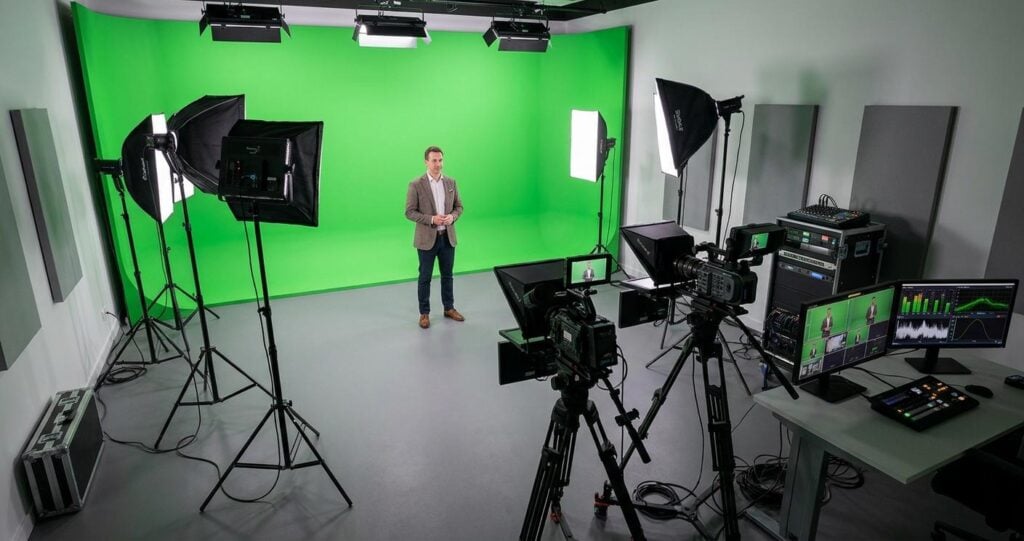
In the high-stakes environment of B2B event streaming and hybrid production, the seamless integration of presenters into virtual environments is not merely an aesthetic choice; it is a critical technical requirement for maintaining audience engagement and delivering a polished, professional brand image. Green screen, or chromakey, technology serves as the backbone for these sophisticated virtual productions, allowing for dynamic, immersive experiences far beyond the limitations of physical sets. However, the efficacy of chromakey compositing hinges entirely on one fundamental, yet often underestimated, technical discipline: professional lighting optimization. Without precise, technically informed lighting strategies, even the most advanced virtual sets and real-time rendering engines will struggle to achieve a convincing, realistic integration, leading to distracting artifacts, poor key quality, and ultimately, a diminished production value for enterprise clients.
Spring Forest Studio’s Technical Team understands that optimising lighting for green screen studios transcends basic illumination; it is an intricate dance between color science, photometric principles, and the specific demands of high-definition video acquisition and real-time compositing workflows. This article provides an advanced technical analysis of lighting methodologies, equipment considerations, and integration techniques essential for achieving photorealistic virtual environments in professional B2B live event streaming and hybrid productions. We delve into the physics of light interaction with chromakey backdrops, explore advanced three-point lighting adaptations, examine specialized equipment for enterprise studios, and discuss the critical interplay between studio lighting and post-production or real-time keying performance. Our objective is to equip corporate event planners, AV professionals, and IT directors with the actionable technical insights required to elevate their virtual productions to an unparalleled level of realism and broadcast quality.
The Physics of Light in Chromakey Compositing and Spill Management
The foundation of effective chromakey lies in the precise separation of foreground subjects from a monochromatic background, typically a specific shade of green (or blue). This separation is a luminance-based and chrominance-based process. Keying algorithms analyze the video signal, identifying and isolating the chrominance values corresponding to the green screen. For this process to be successful, the green screen must exhibit absolute uniformity in both color and luminance. Any variations, such as hot spots, shadows, or uneven saturation, will introduce noise into the keying matte, resulting in jagged edges, transparency issues, or the dreaded “dirty key.”
The spectral properties of the green screen material are paramount. Professional chromakey paints and fabrics are engineered to reflect light within a specific, narrow spectrum of green, making them distinct from skin tones and common clothing colors. When illuminated, these materials reflect this specific green wavelength back to the camera sensor. The choice of lighting fixtures and their spectral output is therefore critical. Full-spectrum LED fixtures with high Color Rendering Index (CRI) values, typically 95 Ra or higher, are preferred. CRI indicates how accurately a light source renders colors compared to natural light. A high CRI ensures that the green screen’s color is accurately represented to the camera and that the talent’s skin tones appear natural.
Color Temperature (CCT), measured in Kelvin (K), is another crucial parameter. Consistent CCT across all light sources (talent illumination and green screen illumination) is vital to prevent color shifts. Common professional standards are 3200K (tungsten equivalent) or 5600K (daylight equivalent). Mismatched CCTs will complicate white balancing and color grading, potentially introducing unwanted color casts that interfere with the keying process. Furthermore, the intensity of illumination, measured in lux, must be sufficient to achieve a clean signal-to-noise ratio from the camera sensor without clipping highlights or crushing shadows. A typical chromakey studio might target 500-1000 lux on the green screen and subject, ensuring ample light for high-quality video acquisition at optimal camera aperture settings and ISO levels, preventing digital noise which can degrade keying performance.
Spill suppression, the mitigation of green light reflecting from the green screen onto the subject, is a primary technical challenge. This “green bounce” can cause an unnatural green tinge on hair, clothing, and skin, making the subject appear to glow or contaminate the key. Strategies for spill suppression include:
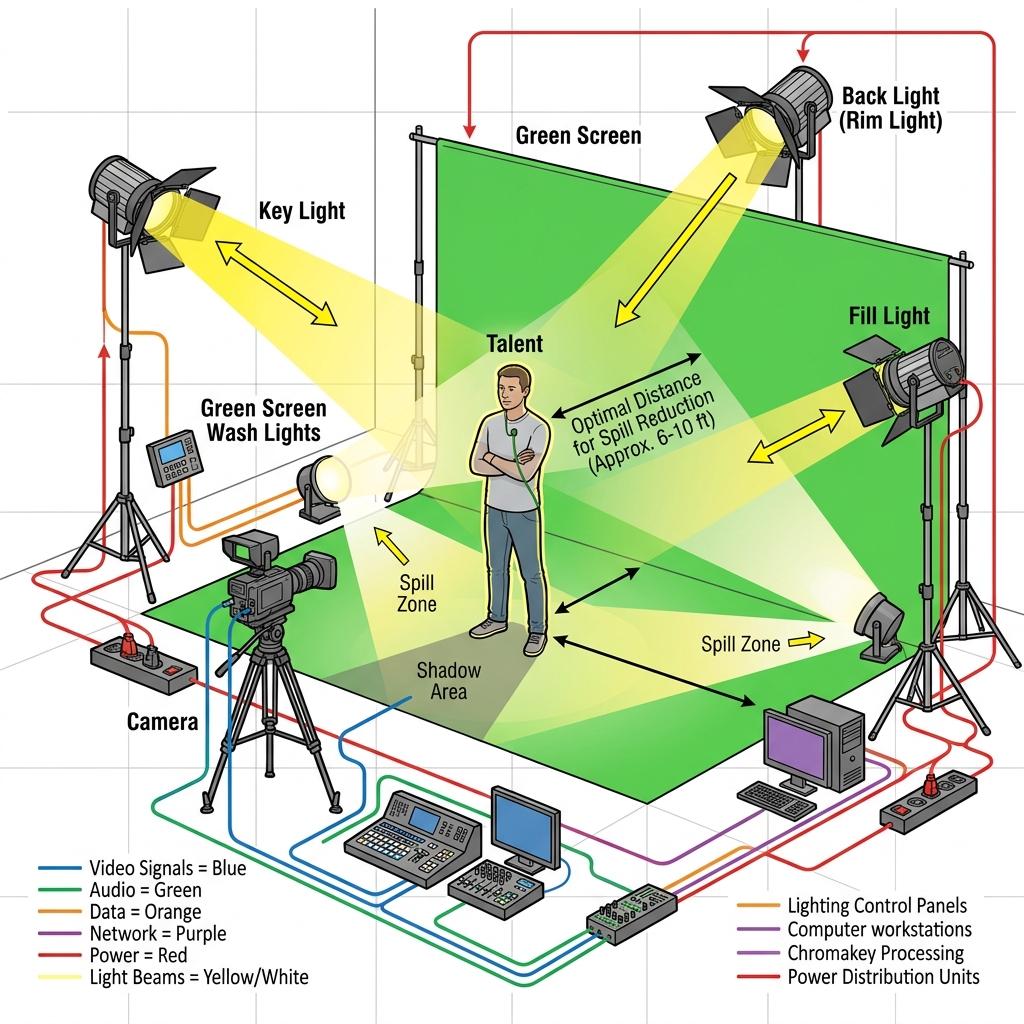
- Distance: Maximizing the distance between the talent and the green screen minimizes the intensity of reflected green light. A minimum of 6 to 10 feet (approximately 1.8 to 3 meters) is often recommended, allowing for independent lighting of the talent and the background.
- Background Lighting: Using separate, dedicated lighting for the green screen, often with a slightly cooler color temperature or a very narrow-spectrum green light source, can create a uniform wash without significantly impacting the talent.
- Backlighting/Rim Lighting: Employing a strong backlight on the subject helps to create separation from the background and can effectively “burn out” some minor green spill on the subject’s edges.
- Flags and Gobos: Strategic placement of flags (black fabric panels) or gobo (go-between optics) can block green screen light from hitting the talent, or conversely, block talent lighting from hitting the green screen to avoid shadows.
- Software/Hardware Spill Suppression: Modern real-time keyers and post-production software include sophisticated spill suppression algorithms, but these are most effective when starting with a well-lit, clean plate. Relying solely on software to correct poor lighting introduces artifacts and compromises final image quality.
The goal is to achieve a pristine, even luminance and color across the green screen, allowing the keyer to differentiate the green pixels from all other pixels with maximum precision, thereby generating a clean alpha matte. This technical rigor directly impacts the realism of virtual elements, from subtle graphic overlays to complex augmented reality (AR) scenes, which are increasingly integral to enterprise-grade hybrid events and corporate communications.
Three-Point Lighting and Beyond for Seamless Virtual Set Integration
The classic three-point lighting paradigm, consisting of key, fill, and back lights, forms the fundamental framework for illuminating a subject in any professional video production. When adapted for a green screen studio and virtual set integration, its application requires meticulous refinement to ensure the talent appears organically situated within the virtual environment. The objective is not just to illuminate the subject, but to illuminate them in a way that visually matches the light sources, angles, and intensity implied by the virtual set design.
The Key Light, the primary and strongest light source, typically positioned 30-45 degrees off-axis from the camera and slightly above the subject, establishes the dominant light direction. For virtual sets, the key light’s intensity, color temperature, and angle must be carefully chosen to emulate the most prominent light source within the virtual scene, whether it is a simulated window, a ceiling fixture, or an environmental light. If the virtual set depicts a sunny outdoor scene, the key light should be bright, perhaps slightly cool (e.g., 5600K), and directional. Conversely, a dimly lit virtual control room would necessitate a softer, lower-intensity key light, possibly warmer (e.g., 3200K).
The Fill Light, positioned on the opposite side of the camera from the key light, reduces the harsh shadows created by the key light. Its intensity is typically 50-70% of the key light, creating a natural ratio. In virtual set integration, the fill light helps to match the ambient illumination or secondary light sources within the virtual environment. It smooths out transitions between light and shadow, preventing the subject from appearing artificially cut out and pasted into the scene. The quality of the fill light – whether hard or soft – should also align with the virtual lighting. For instance, a virtual environment with many diffused light sources would benefit from a very soft, large fill light source on the talent.
The Back Light, also known as a hair light or rim light, is positioned behind and above the subject, often counter to the key light. Its primary function is to create separation between the subject and the background, defining the subject’s edges and adding depth. In green screen applications, a strong backlight is invaluable for mitigating green spill on the subject’s shoulders and hair, providing a clean edge for the keyer. The backlight’s intensity and color can also be used to mimic implied light sources from the virtual background, such as a strong sunlight effect from a virtual window or a subtle glow from a virtual display panel. This contour lighting adds a crucial layer of realism, preventing the subject from blending optically into the virtual environment.
Beyond the classic three-point setup, advanced techniques involve incorporating “practical” lighting cues. If the virtual set includes a virtual monitor glowing blue, or a red emergency light flashing, a subtle, colored practical light (e.g., a small LED panel with DMX control) can be positioned off-camera to cast a corresponding colored light onto the subject, creating an incredibly convincing interaction between the talent and the virtual elements. This technique, often requiring DMX integration for precise color and intensity control, elevates the sense of immersion. Employing gobos or projection patterns can also simulate textures or light patterns (e.g., Venetian blinds, dappled light through trees) from the virtual background onto the subject, further blurring the line between physical and virtual realities. Maintaining consistency across multi-camera setups is paramount; each camera must capture the subject under the same lighting conditions to ensure seamless switching between perspectives within the virtual environment, a common requirement for large-scale corporate webcasts and hybrid conferences.
Advanced Lighting Techniques and Equipment for Enterprise Studios
Achieving truly photorealistic integration in enterprise-grade green screen studios demands a sophisticated approach to lighting equipment and control. The selection of fixtures and their precise deployment are paramount. Professional studios often gravitate towards specialized chromakey lighting systems that offer superior color accuracy, intensity, and beam control. Brands such as Kino Flo, known for their fluorescent tube systems, or Litepanels and Aputure, with their high-output, color-tunable LED panels, are staples. These fixtures provide broad, even washes of light, essential for uniform green screen illumination and soft, flattering light on talent. Many high-end LED panels offer variable Color Temperature (CCT) control from 2800K to 6500K, and full RGBWW capabilities, allowing for precise color matching to virtual environments or creating dynamic practical lighting effects.
Precision control of these light sources is facilitated by DMX (Digital Multiplex) control systems. A DMX lighting console, connected via a DMX512 network, allows a lighting director to individually address and control the intensity, color, and often beam characteristics of each fixture. This granular control is indispensable for fine-tuning lighting ratios, adjusting for real-time changes in virtual sets, or executing complex lighting cues during a live event. For example, a DMX-controlled LED wash light aimed at the green screen can be precisely adjusted in color to optimize the key for a specific camera sensor, while separate DMX channels control the talent’s key, fill, and backlights to match the virtual environment’s dynamic lighting. Such systems integrate seamlessly into the overall production control architecture, often alongside video switchers (e.g., Ross Carbonite, Blackmagic ATEM, Grass Valley K-Frame), audio mixers, and graphics engines.
Effective spill suppression demands more than just distance. Diffusion techniques, employing large soft boxes, octabanks, diffusion frames, or grid cloths, soften light sources, reducing harsh shadows and creating a more even field of illumination. These tools minimize specular reflections and help to wash out subtle variations on the green screen surface. Furthermore, some specialized “chromakey wash lights” emit a narrow-band green light specifically tuned to the chromakey fabric, maximizing green screen uniformity without significantly contributing to spill on the talent. For very large studio spaces, continuous green screen LED walls can be employed not only as a background but also as an interactive light source, dynamically changing color and intensity to match virtual scene elements in real time. This advanced application significantly enhances the immersive quality of augmented reality (AR) and extended reality (XR) productions.
Consideration must also be given to lighting for multi-camera productions, which are standard in B2B event streaming. Each camera angle must maintain consistent exposure, white balance, and lighting quality. This often necessitates a larger lighting grid and more fixtures to ensure uniform illumination across the entire performance area, accommodating wide shots, medium shots, and close-ups from various camera positions without introducing visible lighting inconsistencies. Adherence to broadcast standards, such as SMPTE ST 2084 for High Dynamic Range (HDR) workflows or Rec. 709 for Standard Dynamic Range (SDR), guides the selection and calibration of lighting to ensure the acquired video signal conforms to established colorimetry and luminance specifications. Professional monitoring tools, including waveform monitors and vectorscopes, are indispensable for verifying these technical parameters, ensuring optimal signal integrity for downstream processing, encoding (H.264/H.265), and streaming via protocols like SRT (Secure Reliable Transport) or RTMP (Real-Time Messaging Protocol).
Post-Production and Real-time Keying Synergy: The Lighting Interface
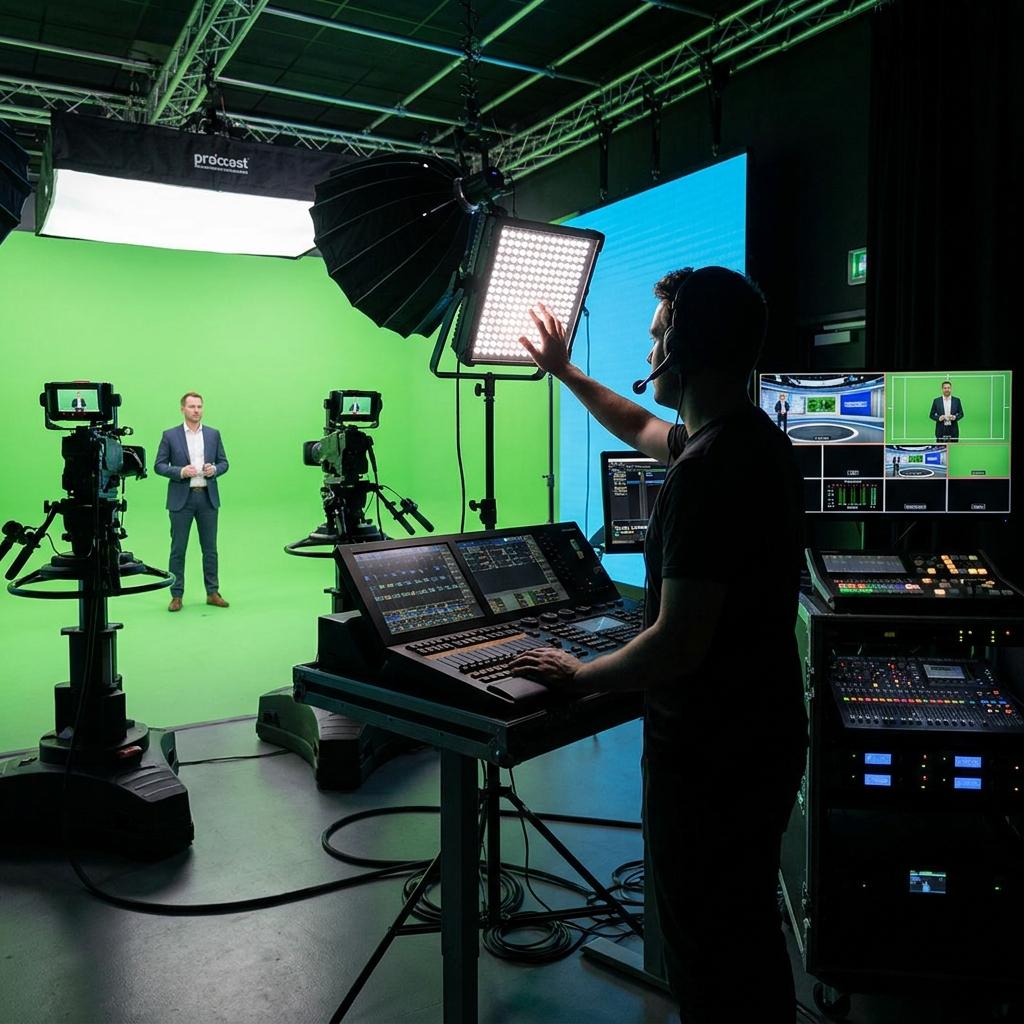
The successful execution of chromakey compositing, whether in real-time for live hybrid events or in post-production for pre-recorded corporate content, is profoundly influenced by the quality of the initial studio lighting. Poor lighting in the green screen environment places an immense burden on keying software and hardware, often leading to compromises in visual fidelity and increased processing overhead. Conversely, meticulously optimized lighting provides the cleanest possible alpha matte, allowing the compositing engine to focus its resources on seamless integration rather than artifact correction.
For real-time chromakey, which is critical for live B2B event streaming and interactive hybrid productions, the synergy between studio lighting and the keying engine is immediate and absolute. Hardware keyers, often integrated into video switchers or dedicated graphics systems like Ross XPression, Vizrt Engine, or NewTek TriCaster, operate with extremely low latency, processing video frames in milliseconds. These systems perform best with a clean, uniformly lit green screen and a well-separated subject. Any unevenness in the green screen illumination or significant spill on the subject directly impacts the keyer’s ability to generate a sharp, stable matte without noticeable fringing or transparent edges. The luminance levels and color accuracy (adherence to Rec. 709 or Rec. 2020 color space) of the input video feed directly from the camera, influenced by studio lighting, dictate the keyer’s performance. Precise white balance of all cameras to the studio lighting’s CCT is non-negotiable for consistent color reproduction across multiple angles and for accurate chrominance sampling by the keyer.
In the context of hybrid events, where virtual presenters interact with physical audiences or remote participants, real-time keying must be robust and reliable. Solutions leveraging NDI (Network Device Interface) or SRT protocols for video transport require that the source video, including the keyed talent, be of the highest possible quality to withstand network conditions and encoding processes (e.g., H.264/H.265 at optimal bitrates of 10-50 Mbps for 1080p60). A compromised key due to poor lighting will be further exacerbated by compression artifacts, leading to a degraded viewing experience for the enterprise audience.
Color matching and grading between the live talent and the virtual set elements are facilitated significantly by initial optimal lighting. When the talent is lit to emulate the virtual environment, the colorist or real-time compositing operator has a much easier task of achieving a cohesive look. Monitoring tools such as waveform monitors and vectorscopes are indispensable for ensuring that video levels (luminance) and chrominance values are within broadcast-safe limits and are consistent across the entire production chain. False color monitoring on professional field monitors can provide immediate visual feedback on exposure and highlight/shadow clipping, allowing lighting adjustments to be made on the fly. Optimal studio lighting, therefore, acts as the primary interface between the physical production space and the virtual realm, dictating the quality of integration and the believability of the final composite for enterprise communications.
Conclusion: Elevating B2B Event Streaming with Strategic Lighting Integration
The successful execution of B2B event streaming and hybrid productions leveraging green screen technology is fundamentally intertwined with the strategic optimization of lighting. As demonstrated, achieving realistic integration is not an incidental outcome but the direct result of a meticulous, technically informed approach to illuminating both the chromakey background and the on-screen talent. From understanding the physics of light interaction and managing spill effectively to employing advanced three-point lighting adaptations that mirror virtual environments, every lighting decision has a profound impact on the fidelity and persuasiveness of the final composite.
For enterprise clients, the implications are clear: investing in professional-grade lighting equipment and engaging skilled lighting technicians translates directly into superior production quality, enhanced audience immersion, and a more authoritative brand presentation. The synergy between high-CRI, DMX-controlled LED fixtures, precise color temperature management, and sophisticated spill suppression techniques forms the bedrock of a robust virtual production pipeline. Moreover, the integration of these lighting strategies with real-time keying hardware and software, adhering to industry standards like SMPTE for video levels and optimal encoding protocols, ensures that the visual output remains pristine from acquisition to delivery.
Spring Forest Studio recommends that enterprise decision-makers and AV professionals prioritize a comprehensive lighting plan as an integral component of their virtual and hybrid event strategy. This includes investing in versatile LED lighting with high CRI and CCT control, implementing dedicated DMX control systems for granular precision, and establishing sufficient physical separation between talent and green screen. Furthermore, leveraging professional monitoring tools like waveform monitors is crucial for maintaining technical accuracy throughout production. By mastering the art and science of lighting for chromakey studios, businesses can transcend the visual limitations of traditional event formats, delivering captivating, immersive, and technically flawless streaming experiences that resonate deeply with their target audience, solidify their market position, and ultimately drive engagement and achieve their strategic communication objectives in the digital age.

Jeremy Lee is a seasoned digital marketing director and strategist with over two decades of experience in the industry. As the founder of Sotavento Medios, I manage a diverse portfolio of over 50 businesses, helping brands grow through advanced search strategies and digital innovation. My work focuses on bridging the gap between traditional search engine optimisation and the evolving world of AI-driven answer engines.
get in touch