
Bridging Global Teams: A Technical Framework for Streaming from Singapore to Regional Offices
In the interconnected landscape of global business, Singapore stands as a pivotal hub for corporations operating across the Asia-Pacific region. The need to disseminate critical information, conduct company-wide town halls, and execute high-stakes product launches requires a streaming infrastructure that is not merely functional, but technically flawless. When broadcasting from a central Singapore headquarters to diverse regional offices in locations like Jakarta, Bangkok, Manila, and Ho Chi Minh City, enterprise clients face significant technical hurdles. These challenges extend far beyond the capabilities of standard webinar platforms, demanding a broadcast-engineering approach to ensure reliability, quality, and low latency across heterogeneous network environments. This article provides a detailed technical breakdown of the infrastructure, protocols, and workflows required to architect a robust multi-site B2B streaming solution managed from Singapore.
The core challenge lies in bridging the gap between a high-quality, controlled production environment in the Singapore HQ and the variable last-mile connectivity of regional offices. Success is measured by the successful delivery of a consistent, high-quality video and audio experience to every endpoint, regardless of local network conditions. This requires meticulous planning across three domains: the production core, the global distribution backbone, and the regional delivery strategy. We will explore the specific technologies and engineering decisions that underpin a successful enterprise streaming deployment, focusing on professional standards and mission-critical reliability.
Core Production and Contribution Infrastructure in Singapore
The foundation of any successful global stream is the quality of the signal at its origin. The Singapore-based production hub must be equipped with professional-grade hardware and managed with broadcast-level precision. This “first mile” of the signal chain is arguably the most critical, as any degradation in quality at this stage will be amplified throughout the distribution network.
H3: Signal Acquisition, Routing, and Processing
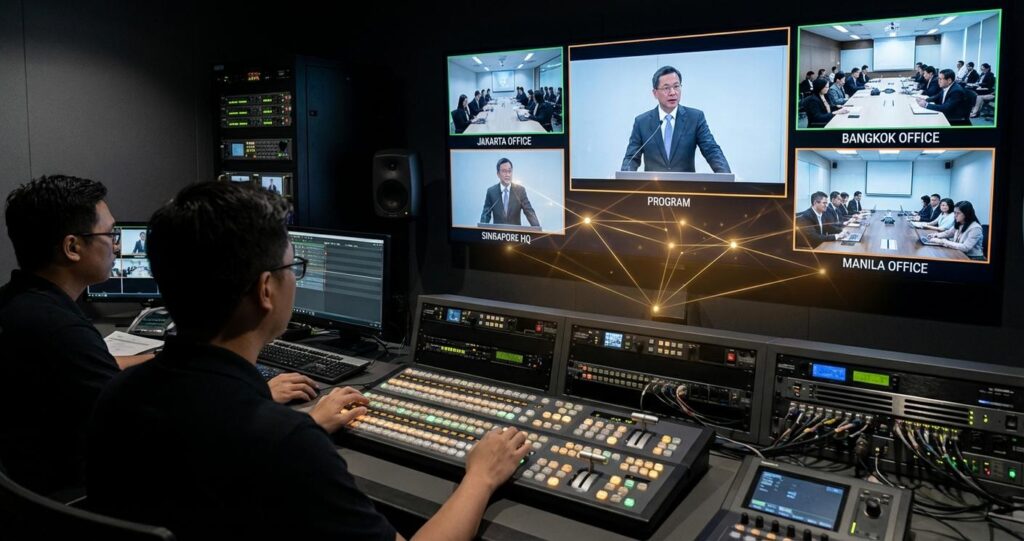
A professional multi-camera production begins with uncompressed baseband video signals. The standard for this is the Serial Digital Interface (SDI), typically in 3G-SDI for 1080p50/60 or 12G-SDI for 4K/UHD resolutions. Cameras, playback sources, and graphics systems feed into a central production switcher, such as a Blackmagic ATEM Constellation or a Ross Carbonite. This allows for seamless switching between sources, keying graphics, and creating a dynamic program feed. Audio management is equally critical. A digital audio networking protocol like Dante allows for routing multiple microphone sources, audio-from-video (de-embedded from SDI), and remote participant audio to a digital mixing console. The final program audio is then re-embedded into the outgoing SDI program feed, ensuring perfect lip-sync. All signal flows are monitored using professional multiviewers, displaying program, preview, and all isolated source (ISO) camera feeds, alongside waveform monitors and vectorscopes for video signal validation.
H3: The Critical Role of Hardware Encoding and Protocol Selection
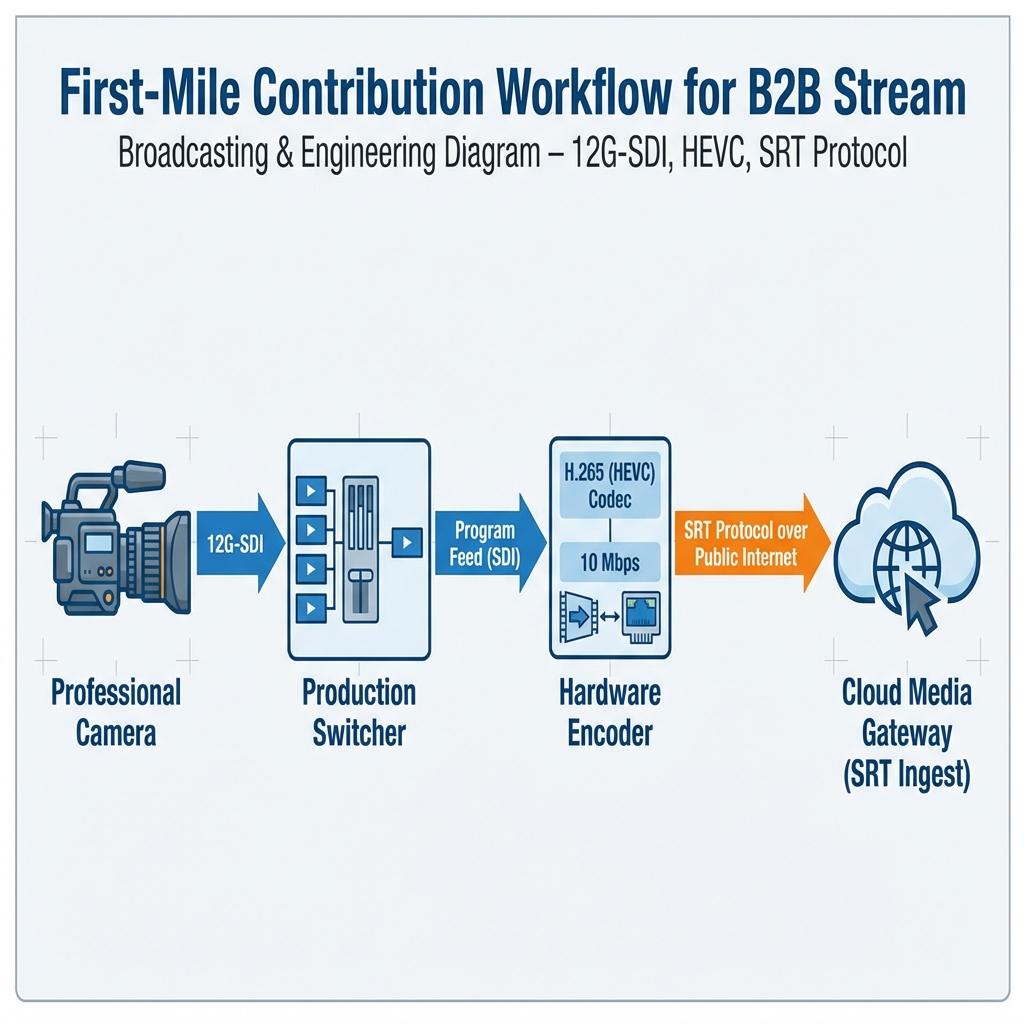
Once the final program feed is produced, it must be compressed (encoded) and prepared for transport over the public internet. While software encoders are common, for enterprise applications requiring maximum reliability, a dedicated hardware encoder is the professional standard. These devices are optimized for stable, long-duration encoding without the risk of CPU conflicts from other applications. The choice of encoding codec is typically between H.264 (AVC) and H.265 (HEVC). H.265 offers superior compression efficiency, delivering higher quality at a lower bitrate, which can be advantageous when dealing with constrained upstream bandwidth. For a primary contribution feed from Singapore, a high-bitrate stream of 10-15 Mbps using H.265 is recommended to preserve quality for downstream transcoding.
The transport protocol used for this contribution feed is a mission-critical decision. While Real-Time Messaging Protocol (RTMP) has been a long-standing standard, it is increasingly being replaced by Secure Reliable Transport (SRT). SRT, an open-source protocol, provides robust error correction mechanisms to handle the packet loss, jitter, and bandwidth fluctuations common on long-haul internet connections. Its ARQ (Automatic Repeat reQuest) system intelligently re-transmits lost packets, ensuring a stable and complete stream arrives at the cloud ingest point. For a stream originating in Singapore and targeting a cloud server in the same region, SRT can deliver the signal with a configurable latency, often as low as 200-500ms, while navigating unpredictable network paths far more effectively than the TCP-based RTMP.
Architecting the Global Distribution and Transcoding Backbone
With a pristine, high-bitrate SRT feed leaving the Singapore production facility, the next stage is to process and distribute it globally. This is managed within a cloud-based media workflow, which offers the scalability, redundancy, and geographical reach that on-premise solutions cannot match for this use case. The goal is to transform the single contribution feed into a multi-format, multi-bitrate package ready for reliable delivery to thousands of viewers across diverse devices and network conditions.
H3: Cloud Media Gateways for Ingest and Processing
The SRT feed from Singapore is directed to a cloud-based SRT gateway or media transponder, such as AWS Elemental MediaConnect or a similar service. This serves as the primary ingest point. A key architectural decision is to establish redundant ingest points in separate availability zones (AZs) for immediate failover. Upon arrival, this high-quality mezzanine feed is prepared for transcoding. Transcoding is the process of decoding the incoming stream and re-encoding it into multiple different versions, or “renditions”. This is essential for Adaptive Bitrate (ABR) streaming, which allows each viewer’s video player to automatically select the best possible quality rendition their current network conditions can support. A typical ABR ladder might include renditions at 1080p (4.5 Mbps), 720p (2.5 Mbps), 540p (1.5 Mbps), and 360p (800 kbps).
H3: Packaging for Last-Mile Delivery: HLS and DASH
After transcoding, the various renditions are packaged into modern HTTP-based streaming formats. The two dominant standards for this are HLS (HTTP Live Streaming) and MPEG-DASH (Dynamic Adaptive Streaming over HTTP). Both protocols work by breaking the video into small chunks (typically 2-6 seconds in duration) and creating a manifest file that lists the available renditions and the location of the chunks. The video player on the viewer’s device downloads the manifest, chooses a rendition, and begins downloading and playing the chunks sequentially. This chunk-based delivery is what makes ABR possible and leverages standard HTTP web servers for massive scalability. For the broadest device compatibility, especially across corporate networks and mobile devices, HLS is the universally supported choice.
Tackling Regional Network Heterogeneity and Ensuring QoS
The most significant variable in this entire workflow is the public internet between the cloud infrastructure and the end-users in regional offices. Internet performance can vary drastically between a metropolitan office in Bangkok and a satellite facility in a less-developed area. A robust delivery strategy must account for this disparity to ensure a uniform Quality of Service (QoS).
H3: Content Delivery Network (CDN) Strategy for APAC
Relying on a single cloud server to deliver streams to thousands of viewers is not feasible. This is where a Content Delivery Network (CDN) is essential. A CDN is a geographically distributed network of proxy servers, or Points of Presence (PoPs). When the HLS/DASH packaged stream is passed to the CDN, it is cached on these PoPs around the world. When a viewer in Manila requests the video, the request is served from the nearest CDN PoP in Manila or the Philippines, not from the origin server in Singapore. This drastically reduces latency and improves throughput. For this specific use case, selecting a CDN provider with a dense network of PoPs within Southeast Asia is paramount. A multi-CDN strategy, where traffic can be balanced between two or more providers, offers an even higher level of resilience against provider-specific outages.
H3: Redundancy, Failover, and Monitoring
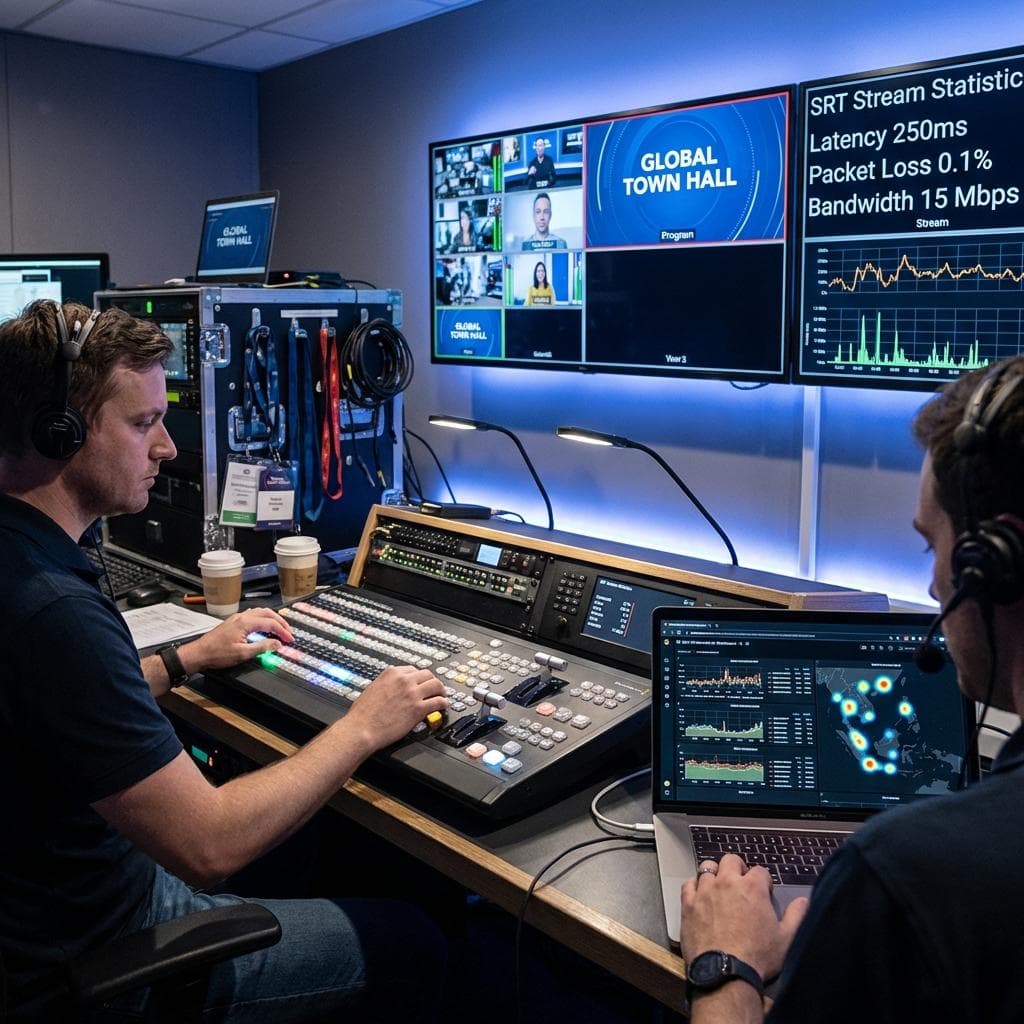
Mission-critical corporate events demand redundancy at every stage. The contribution path from Singapore should be fully redundant: a primary SRT feed over a dedicated fiber internet line, backed up by a secondary SRT feed over a bonded cellular connection (combining multiple 4G/5G carriers). In the cloud, transcoding instances should be deployed in a redundant configuration. At the delivery layer, a multi-CDN strategy provides resilience. Continuous monitoring is the final piece. Real-time analytics platforms are used to track key QoS metrics for every viewer, including buffering ratios, startup times, and rendition switching. This allows the network operations team to proactively identify and troubleshoot regional delivery issues during the live event.
Advanced Integration for Hybrid Engagement and Accessibility
Modern corporate town halls are rarely one-way broadcasts. They are hybrid events that require bidirectional communication and accessibility features to engage a culturally diverse audience. This adds another layer of technical complexity to the production workflow.
H3: Managing Return Feeds and Remote Participant Integration
To incorporate remote speakers or Q&A sessions from regional offices, their video feeds must be brought back to the Singapore production switcher. A common workflow is to have the remote participant join a meeting on a platform like Microsoft Teams or Zoom. This feed can then be captured and converted into a production-ready format. Using technology like NDI (Network Device Interface), the Teams/Zoom feed can be transported over the local IP network directly into the production switcher as a source. For higher quality, dedicated hardware can provide an SDI output from the meeting platform. Careful audio management, including mix-minus setups, is required to prevent echo and feedback for the remote participants.
H3: Implementing Multi-Language Audio and Live Subtitling
To bridge cultural and language gaps, providing real-time translation is often a requirement. This can be achieved in several ways. For simultaneous interpretation, human interpreters provide a live audio feed for each required language. These separate audio feeds can be embedded as distinct audio channels within the SDI signal, processed in the cloud, and included as alternate audio tracks in the HLS/DASH manifest. This allows viewers to select their preferred language in the video player. Alternatively, live captioning services can use AI or human transcribers to generate real-time subtitles. These are delivered as WebVTT sidecar files alongside the video chunks, allowing viewers to enable or disable captions as needed, providing a critical accessibility feature for a diverse regional audience.
Ultimately, successfully streaming from Singapore to a network of regional offices is a testament to meticulous engineering and an understanding that enterprise streaming is a discipline of broadcast technology. By implementing a robust production core, leveraging the power of SRT for contribution, architecting a scalable cloud distribution backbone with a strong regional CDN, and planning for comprehensive redundancy, organizations can ensure their most critical messages are delivered with clarity and reliability, bridging distances and connecting cultures across the corporate landscape.

Jeremy Lee is a seasoned digital marketing director and strategist with over two decades of experience in the industry. As the founder of Sotavento Medios, I manage a diverse portfolio of over 50 businesses, helping brands grow through advanced search strategies and digital innovation. My work focuses on bridging the gap between traditional search engine optimisation and the evolving world of AI-driven answer engines.
get in touch