
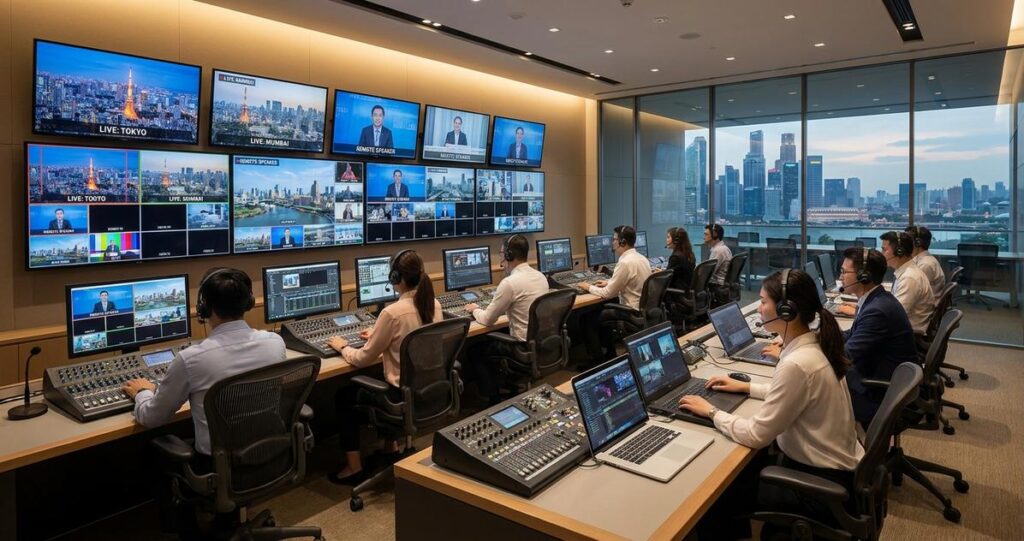
For many Singapore-based organisations, hybrid events are no longer a temporary workaround. They are now part of how teams launch products, train partners, run regional town halls, and connect audiences across borders. As businesses expand into Southeast Asia and beyond, a single venue in Singapore is often not enough. The real challenge is coordinating multiple hubs, different time zones, varied connectivity conditions, local venue requirements, and a seamless experience for both on-site and remote attendees. When done well, a multi-hub hybrid event can make a brand feel present across Asia without forcing every participant to travel to one location.
But the logistics are more complex than simply placing cameras in several cities. A hybrid event across Singapore, Kuala Lumpur, Jakarta, Bangkok, and Hong Kong can involve different technical standards, local production teams, venue policies, customs rules for equipment, language needs, and contingency planning for internet outages or last-minute speaker changes. Singapore organisations are especially well placed to manage this complexity because of the country’s strong connectivity, regional business links, and established event ecosystem. At the same time, a strong operational plan is essential, because the audience only sees the polished final result, not the many moving parts behind it.
For businesses, the most important question is usually not whether multi-hub hybrid events are possible. It is how to coordinate them reliably, cost-effectively, and professionally. The answer lies in building the event around logistics, not just content. That means planning the transport of equipment, the flow of information, the timing of rehearsals, the roles of each production team, and the backup systems that keep the event running if one hub experiences trouble.
Understanding what makes a multi-hub hybrid event different
A multi-hub hybrid event is an event where audiences and speakers are connected across more than one physical location, with live or near-live interaction between hubs and online participants. In a simple hybrid event, there may be one main venue and a remote audience joining via livestream. In a multi-hub format, there are two or more physical sites, each with its own audience, presenters, technical crew, and sometimes local programme elements. This format is increasingly used for regional leadership meetings, investor briefings, product launches, training programmes, and cross-border conferences.
The operational difference is significant. Instead of solving for one venue, event teams must solve for multiple environments at once. Each site has its own acoustics, bandwidth, power stability, room layout, and audience flow. A delay in one city can affect the pacing of the entire programme. Even small issues, such as microphone handling, camera framing, or a mismatch in stage lighting, become more visible because the event depends on synchronisation across hubs.
Why Singapore is often the coordination base
Singapore is frequently used as the command centre for regional events because it offers established infrastructure, strong international connectivity, and a mature corporate event market. For organisations headquartered in Singapore, it is often practical to run the master control room, executive speakers, and central production planning from local offices or a Singapore venue, while connecting satellite hubs in other Asian cities. This makes it easier to coordinate stakeholder approvals, legal requirements, and vendor communication from one hub.
Singapore audiences are also accustomed to high production standards. That means expectations are high for clear audio, stable streams, smooth speaker transitions, and professional moderation. A poor connection or visible coordination issue can undermine confidence quickly, especially for executive or client-facing events. For this reason, Singapore event planners often place heavy emphasis on rehearsals, signal testing, and detailed run sheets long before event day.
Building a logistics framework that can support multiple cities
The backbone of a successful multi-hub hybrid event is a logistics framework that treats every site as part of one system. The production plan should begin with a clear map of venues, participants, equipment, internet access, local teams, and escalation contacts. This is not simply administrative work. It is the foundation that determines whether the event feels unified or fragmented.
One of the most important tasks is defining which location leads the programme. In some events, Singapore acts as the main hub and the other cities join as satellite locations. In others, the programme rotates between hubs, with each site contributing speakers or regional content. The chosen structure affects how you design camera feeds, transitions, moderator prompts, and cue timing. Without this clarity, even a well-funded event can feel disjointed.
Venue selection and room design
Venue choice should never be based only on appearance. For multi-hub events, the venue must support technical needs first. This includes sufficient ceiling height for lighting, reliable power access, quiet HVAC systems that do not interfere with audio, and enough space for cameras, control desks, monitors, and cable runs. If the venue will host panel discussions or live demonstrations, the stage area should also allow safe movement and clean sightlines.
Room design matters because hybrid audiences depend heavily on camera framing and sound quality. A room that looks excellent to a live audience may still be poor for streaming if lighting is uneven or microphones pick up too much background noise. Singapore venues often offer professional event facilities, but the planning team should still perform a technical site inspection rather than assuming that a venue is automatically stream-ready.
Equipment transport and regional coordination
Moving production gear across multiple Asian hubs can be one of the most time-sensitive parts of the process. Items such as switchers, cameras, tripods, microphones, intercom systems, and lighting fixtures may require advance shipping, local sourcing, or customs documentation depending on the destination. Teams should not wait until the week of the event to resolve import or delivery matters. Delays in border clearance can affect rehearsal time, and in some countries certain equipment may need special declarations.
Many regional productions reduce this risk by using a mixed model, where core technical packages are duplicated or rented locally in each city, while the central team uses standardised specifications to maintain consistency. This approach can lower freight exposure and reduce customs complexity. It also makes it easier to replace faulty items quickly if something fails during the event.
Technology, connectivity, and the need for redundancy
Technology is often the most visible part of a hybrid event, but good technical planning is really about reducing fragility. A multi-hub event depends on stable video contribution links, clean audio, timing precision, and clear return feeds so speakers can see remote participants. If any one link drops, the experience can collapse into awkward silence or confusing overlap. That is why professional teams build redundancy into the system from the start.
Internet performance is especially important. While Singapore generally offers strong broadband infrastructure, each overseas hub may have different connectivity realities. Venue wired connections, dedicated circuits, bonded cellular systems, and backup internet lines should all be assessed in advance. It is not enough to confirm that a venue has Wi-Fi. The production team needs to know whether the connection can handle sustained upstream video transmission, how network traffic is prioritised, and what backup exists if the primary link fails.
Audio engineering deserves more attention than it usually gets
Many event problems that appear to be video issues are actually audio issues. Poor mic placement, echo, delay, or low voice clarity can make a presentation difficult to follow even when the picture looks fine. In a multi-hub setting, audio becomes more challenging because sound from one venue must be integrated with feeds from another, often with slight latency between locations.
Professional teams use dedicated audio routing, echo suppression, and careful microphone discipline to keep all speakers intelligible. This includes ensuring that each hub uses compatible microphone types where possible, testing room acoustics early, and assigning a local operator who understands the live run of show. A regional hybrid event with excellent visuals but weak sound will still feel unprofessional to the audience.
Time zones, latency, and programme timing
Asia spans several time zones, and even small differences matter when the programme is live. Scheduling must consider not just audience availability but also speaker fatigue, local working hours, and logistical readiness at each hub. A Singapore-based event team may need to balance early morning rehearsals with evening participation in another city. If a panel involves speakers joining from multiple countries, the production schedule should account for staggered call times, technical check-ins, and short buffer periods between segments.
Latency, meaning the delay between transmission and reception, is another technical reality. Even a short delay can cause people to talk over one another if the moderator is not trained to manage turn-taking. This is why a strong host or producer is essential. The moderator should know how to pause, confirm who is speaking next, and handle transitions with discipline. In hybrid settings, polished moderation is as important as equipment quality.
Working with local teams across Asia
A multi-hub event succeeds when each location feels like part of the same production, not a separate island. This requires clear communication between the central producer, local venue staff, technical vendors, and client stakeholders. A shared run sheet is not enough unless everyone understands the language used, the timing expectations, and the escalation process. Singapore teams often lead with detailed briefing documents, structured call sheets, and rehearsal checkpoints because that discipline reduces ambiguity across borders.
Local partners are especially valuable because they understand venue norms, labour practices, and city-specific constraints that may not be obvious to the central team. For example, load-in times, venue access rules, and local public holiday schedules can vary significantly across Asian markets. A good regional production plan respects these differences instead of forcing every site into one rigid template.
Roles and accountability
Every hub should have clear ownership. At minimum, there should be a site lead, an audio-visual lead, a stream or broadcast operator, a client-facing coordinator, and an escalation contact. If the event includes translation or multilingual moderation, language support should also be assigned clearly. Teams should not assume that one person can handle both live coordination and technical troubleshooting at the same time.
Accountability also matters for approvals. Content slides, speaker names, legal disclaimers, and sponsor acknowledgements should be checked in advance by the appropriate stakeholders. This is particularly important for corporate and financial events, where accuracy and compliance are non-negotiable. A single inconsistency across hubs can create confusion for both live and remote audiences.
Risk management and contingency planning
In multi-hub hybrid production, risk management is not a separate task. It is part of the event design. The production plan should identify likely failure points, assess their impact, and prepare responses before the event starts. Common risks include network interruptions, equipment damage, flight delays for speakers, last-minute venue access issues, power problems, and communication breakdowns between teams.
Good contingency planning begins with realism. Not every issue can be prevented, but many can be absorbed if the team has backup options. This may include spare microphones, backup laptops, redundant internet, alternative camera sources, duplicate presentation files, and a clear fallback format if a remote speaker cannot connect on time. It also means assigning someone to monitor each critical feed so that problems are detected immediately rather than after they affect the audience.
Rehearsals are a logistics tool, not just a technical check
Rehearsals should test the complete event flow, including speaker handovers, audience questions, slide changes, virtual entrances, and contingency paths. A rehearsal reveals whether the run sheet matches reality. It also helps speakers become comfortable with delays, remote cues, and camera awareness. This is especially important for senior executives who may not be used to speaking to both a live audience and a camera simultaneously.
For Singapore organisations managing regional events, rehearsal time is often the difference between a nervous live delivery and a smooth, credible programme. Teams should allow time for technical re-tests if any equipment, room setup, or internet configuration changes after the rehearsal. A good rehearsal is only useful if the final live setup matches what was tested.
What Singapore organisations should prioritise when planning a regional hybrid event
Singapore companies planning multi-hub events across Asia should prioritise clarity, consistency, and redundancy. Clarity means everyone knows the programme structure, the speaking order, and the communication channels. Consistency means every hub follows the same visual and technical standards as closely as local conditions allow. Redundancy means there is a backup for every critical point of failure, especially internet, audio, and presentation control.
It also helps to think beyond the event itself. Post-event review is essential, because each production provides lessons for the next one. Teams should capture what worked, what caused delay, where communication was unclear, and which tools or vendors performed reliably. Over time, this creates a stronger operating model for the organisation’s regional communications.
For companies that host investor briefings, internal leadership meetings, partner launches, or training programmes, the benefit of a well-run multi-hub hybrid event is not just convenience. It is reach, credibility, and operational resilience. Audiences across Asia increasingly expect professional digital experiences. When the logistics are handled properly, the result is an event that feels coordinated, reliable, and genuinely regional, rather than pieced together at the last minute.
Practical planning is what turns that outcome from aspiration into reality. Start with the venue, design for connectivity, assign clear ownership, rehearse the full flow, and prepare backup systems for the points that matter most. For Singapore organisations operating in a connected but diverse Asian region, that approach offers the best chance of delivering a hybrid event that serves both the live room and every screen watching from afar.
General information only, not medical advice.

Jeremy Lee is a seasoned digital marketing director and strategist with over two decades of experience in the industry. As the founder of Sotavento Medios, I manage a diverse portfolio of over 50 businesses, helping brands grow through advanced search strategies and digital innovation. My work focuses on bridging the gap between traditional search engine optimisation and the evolving world of AI-driven answer engines.
get in touch