
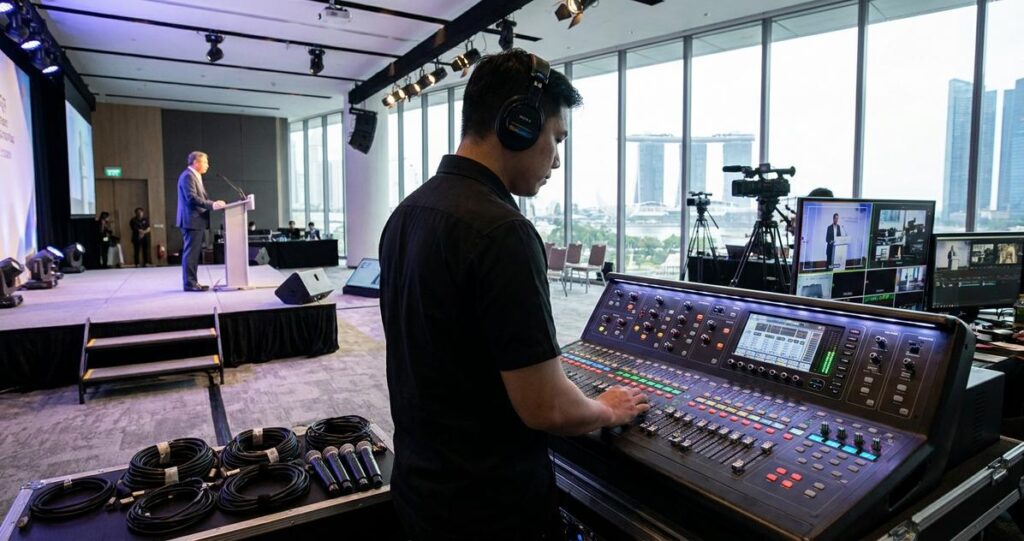
Hybrid events have become a practical standard for many organisations in Singapore, from corporate town halls and product launches to conferences, training sessions, and government-linked engagements. The format is attractive because it brings together in-room participants and remote audiences, but it also raises a simple truth that many planners discover only on event day: a hybrid event is only as strong as its audio. If the sound is unclear, unbalanced, delayed, or inconsistent, the audience experience suffers immediately, whether people are seated in the room, joining from home, or watching on a mobile device during a commute on the MRT.
This is where professional audio engineers play a critical role. In a hybrid environment, audio work is not limited to turning microphones on and off. It involves signal flow design, microphone selection, gain structure, acoustic management, live mixing, monitoring, platform integration, and contingency planning. For Singapore organisations that often work in varied venues, hotel ballrooms, convention halls, office auditoriums, co-working spaces, and heritage venues, these responsibilities matter even more because each location presents its own acoustic and technical constraints. Professional audio engineers help ensure that speech remains intelligible, that remote participants hear the same message as the audience in the room, and that the event feels polished and credible.
For businesses, the stakes are not just technical. Clear audio affects comprehension, engagement, and perceived professionalism. In a multilingual environment like Singapore, where events may involve English, Mandarin, Malay, Tamil, or other languages, precision in sound reproduction is especially important. A small issue such as a poorly placed microphone, excessive room reverberation, or an over-compressed mix can make a keynote difficult to follow or a panel discussion tiring to listen to. Professional audio engineers reduce that risk by translating production goals into reliable technical execution.
Understanding hybrid audio starts with one basic principle: remote audiences do not experience the room the way on-site attendees do. People in the venue can compensate for some issues through sight, context, and proximity to speakers. Remote viewers rely almost entirely on the audio feed. That is why hybrid production demands more than a live speaker and a streaming platform. It requires a dedicated audio strategy that serves both physical and digital audiences without compromising either one.
What Professional Audio Engineers Actually Do in a Hybrid Setup
In a hybrid event, the audio engineer is responsible for capturing, shaping, and delivering sound across multiple environments at once. This includes the main room, the broadcast feed, and often the communication paths used by presenters, interpreters, moderators, and producers. The work begins long before the audience joins, because good audio is usually the result of preparation, not improvisation.
Designing the signal path
The signal path is the route sound takes from the source to the audience. In practical terms, it includes microphones, mixing consoles, processors, routing systems, recording devices, and streaming encoders. A professional engineer maps this path so that each source reaches the correct destination at the correct level. This prevents common problems such as feedback, clipping, dropped channels, or unbalanced audio between speakers.
For hybrid events in Singapore, signal path design often has to account for more than one output. There may be a mix for the in-room public address system, a separate mix for the livestream, a feed for recordings, and sometimes additional feeds for interpretation or remote speakers. Each output may need different processing. For example, a stream mix often needs more vocal clarity and tighter control of ambient noise than the room mix.
Managing microphones and speaker coverage
Microphone selection is a central responsibility. A lapel microphone, also called a lavalier microphone, may suit a presenter who moves frequently. A handheld microphone can work well for audience questions. Gooseneck microphones, which are fixed, flexible stems often used on podiums or conference tables, can be appropriate for panels or formal proceedings. Each type has trade-offs in handling noise, visibility, mobility, and speech pickup.
Engineers also think carefully about speaker coverage in the room. Poor speaker placement can cause reflections, dead zones, or feedback. In a hybrid setup, these issues matter because room acoustics can leak into the broadcast feed. If a hall is highly reverberant, the remote audience may hear speech with a hollow or echoing quality even when people on site can follow the talk reasonably well. A professional engineer works to reduce that gap through microphone technique, equalisation, and acoustic awareness.
Controlling gain and preventing distortion
Gain is the amount of signal strength applied to an audio source. Proper gain structure ensures that microphones are loud enough to be clear but not so loud that they distort. Distortion, in simple terms, is unwanted sound damage caused when the signal exceeds the system’s capacity. In live hybrid production, gain staging matters because inconsistent speaking volume, audience applause, and sudden laughter can all affect the mix.
Professional audio engineers monitor levels throughout the event and adjust them in real time. They use limiters, compressors, and equalisation tools when appropriate. Compression reduces the dynamic range between soft and loud sounds, which can help maintain consistent speech intelligibility. Equalisation, or EQ, adjusts the balance of frequencies so voices sound clear without being harsh or muddy. These tools are most effective when used with restraint and experience, because excessive processing can make a stream sound unnatural.
Why Hybrid Audio Is More Demanding Than Traditional Event Sound
Traditional in-room events already require technical skill, but hybrid production adds a second audience with different expectations and listening conditions. That shift creates several challenges that audio engineers must solve simultaneously. The engineer is not merely amplifying a speech, they are creating a communication product that has to work in multiple formats.
Different listening environments require different mixes
On-site attendees listen in a controlled venue with speakers placed to reinforce sound. Remote participants might be listening through laptop speakers, earbuds, car audio, or mobile phones. These devices have limited frequency response and can mask lower-level speech detail. As a result, a mix that sounds acceptable in a ballroom may sound muddy or quiet online.
To address this, engineers often create a dedicated broadcast mix. This mix is typically more focused on voice clarity, with careful control over room ambience, audience noise, and music levels. The goal is not to remove atmosphere completely, because some live feeling is useful, but to preserve clarity so the remote audience does not feel disconnected or strained.
Latency and synchronisation matter
Latency is the delay between an audio event occurring and it being heard or seen elsewhere. In hybrid environments, audio latency can become visible when sound from the room does not align with the video feed or with remote participant responses. Even a short delay can make a presenter sound out of sync, especially during question-and-answer sessions or when remote speakers join live.
Audio engineers work with producers and video teams to reduce latency where possible and to maintain acceptable synchronisation. This may involve managing digital audio routing, choosing low-latency equipment, and aligning audio and video systems carefully. The result is a smoother experience that feels natural to both audiences.
Acoustics influence clarity more than many planners expect
Acoustics refer to how sound behaves in a room. Hard surfaces, high ceilings, glass walls, and large open spaces can create reflections that blur speech. In Singapore, many venues are multipurpose and visually impressive, but not all are acoustically ideal. Hotel ballrooms, exhibition halls, and office event spaces may require additional treatment or careful system tuning to avoid excessive reverberation.
Professional engineers assess the venue early, identify potential acoustic issues, and plan accordingly. Sometimes the solution is technical, such as directional microphones or digital signal processing. Sometimes the solution is operational, such as positioning speakers away from reflective surfaces or adjusting the stage layout. The best results usually come from a combination of both.
How Audio Engineers Support Event Quality, Accessibility, and Brand Trust
Good hybrid audio is not only a technical feature. It also supports accessibility, audience inclusion, and brand reputation. When the sound is clear, participants are more likely to stay engaged and absorb the content. When the sound fails, even strong speakers can appear less competent than they really are. That is why experienced organisers often treat audio as a core part of event strategy rather than a last-minute production detail.
Supporting accessibility and inclusion
For people with hearing loss, inconsistent or poorly mixed audio can create a serious barrier to participation. Clear speech, balanced volume, and properly managed background noise can make an event easier to follow for a wider audience. This is especially relevant in corporate and public-sector settings where inclusivity is important.
Accessibility also extends to remote participants who may be joining under less-than-ideal conditions, such as on a phone in a noisy environment. A well-mixed stream with stable speech levels helps people stay connected even when they cannot control their surroundings. While audio alone does not replace formal accessibility features such as captions or interpretation, it supports them by improving the baseline experience.
Protecting brand credibility
Audiences often judge professionalism quickly. A crackling microphone, feedback burst, or muffled webcast can create the impression that the event was rushed or poorly prepared. For organisations in Singapore that regularly host clients, partners, regulators, or employees, that impression can affect trust. Professional audio engineers help protect the brand by keeping the production consistent and reliable.
In practice, this means more than fixing problems as they happen. It means doing site checks, rehearsals, backup planning, and final system verification before guests arrive. It also means coordinating with the broader production team so that presenters know how to use microphones correctly and moderators understand how to manage questions, mute control, and transitions.
Handling bilingual and multilingual programme needs
Singapore events often involve more than one language or a mixture of accented English speakers. This creates a specific audio challenge: each voice has different timbre, projection, and speech rhythm. A trained engineer listens for these differences and adjusts levels so no speaker dominates unfairly or disappears into the mix. If interpretation is involved, the engineer must also ensure that interpreter channels are clean, separate, and technically stable.
That kind of precision is one reason professional audio support is so valuable. Multilingual events place greater pressure on intelligibility, and the audience may include senior stakeholders, international guests, or frontline staff who need the message to be accurate and easy to hear.
What Good Audio Engineering Looks Like Before, During, and After the Event
Reliable hybrid audio is built through disciplined workflow. The best engineers treat each phase of the event as part of one system, from planning and testing to live monitoring and post-event review.
Before the event: planning and rehearsal
Before doors open, the engineer reviews the programme, speaker list, microphone plan, venue layout, and streaming destination. This includes identifying which speakers need hands-free microphones, which sessions require panel support, and whether remote contributors need separate routing. Rehearsals are valuable because they reveal practical issues such as awkward mic handling, weak presenter technique, or unexpected changes in speaking order.
In Singapore, where event schedules are often tightly managed and venue turnover can be fast, pre-production preparation is especially important. A well-run technical rehearsal reduces the chance of last-minute fixes under pressure.
During the event: monitoring and adaptation
Live production demands active listening. The engineer must monitor not only the main mix but also the online feed, headset comms, backup sources, and any video sync points. This is where experience matters, because problems often appear subtly at first. A panelist may drift away from the microphone, a remote speaker may join with a noisy background, or applause may overwhelm a delicate segment. The engineer responds in real time, often without drawing attention to the correction.
That responsiveness is part of the invisible value of professional audio work. When it is done well, the audience simply experiences a smooth event and focuses on the content.
After the event: review and improvement
Post-event review is important for organisations that host recurring programmes. Reviewing recordings, noting problem points, and documenting technical settings helps improve future events. It also supports consistency across venues and teams. For businesses running regular webinars, hybrid town halls, or training sessions, this feedback loop can raise production standards over time.
Choosing the Right Audio Approach for Singapore Events
Singapore’s event landscape is diverse, and the right audio solution depends on venue size, audience composition, programme format, and technical expectations. A small boardroom webcast has different needs from a regional conference with panel sessions, live demonstrations, and remote speakers. The role of the audio engineer is to translate those needs into a practical, stable setup.
When selecting a professional service, organisations should look for experience with hybrid workflows, not just general sound reinforcement. They should ask about microphone strategy, livestream audio routing, backup options, and the team’s familiarity with common venue types. It is also useful to confirm how the audio team works with video, staging, interpretation, and streaming operators, because hybrid events succeed through coordination rather than isolated expertise.
For organisers, the most important question is not whether the audio sounds loud enough. It is whether every audience member can hear the message clearly, consistently, and comfortably. That standard captures the real value of professional audio engineering in hybrid environments. It supports communication, reduces avoidable friction, and helps events feel credible across both physical and digital spaces.
If your organisation plans hybrid events in Singapore, treat audio as a strategic element from the earliest planning stage. Involve the audio engineer during site selection, programme design, and rehearsal planning, not only on event day. That approach improves reliability, protects the audience experience, and makes your event more effective for everyone involved.
Jeremy Lee is a seasoned digital marketing director and strategist with over two decades of experience in the industry. As the founder of Sotavento Medios, I manage a diverse portfolio of over 50 businesses, helping brands grow through advanced search strategies and digital innovation. My work focuses on bridging the gap between traditional search engine optimisation and the evolving world of AI-driven answer engines.
get in touch