
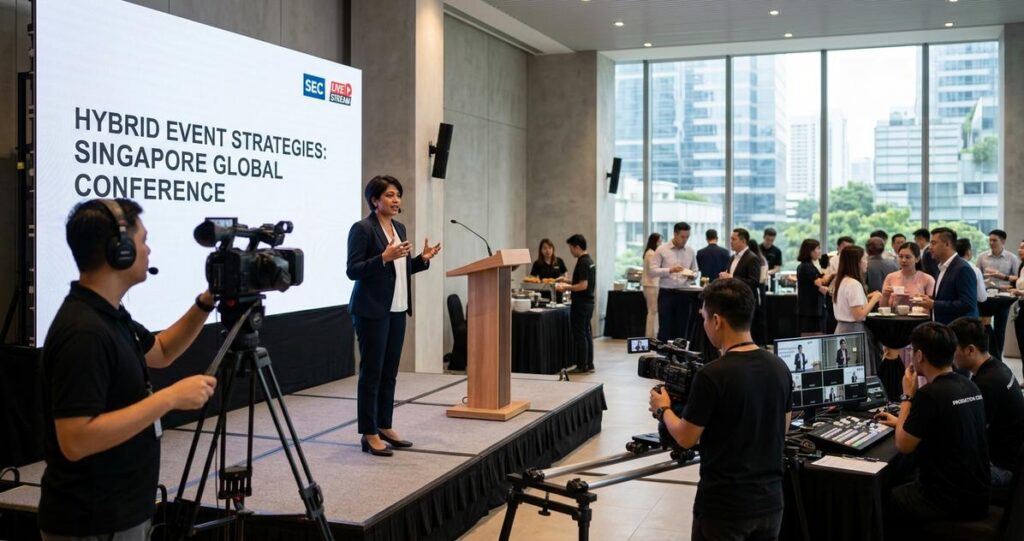
Live streaming has changed how Singaporean audiences discover, evaluate, and commit to events. For many people, the first touchpoint with a conference, product launch, seminar, church service, concert, or community forum now happens on a screen, not at the venue. That does not mean live streaming replaces in-person experiences. Used well, it can strengthen trust, reduce uncertainty, and give people a clear reason to attend the next physical event. For organisers in Singapore, where schedules are tight, travel time matters, and expectations for professionalism are high, live streaming can become a practical bridge between online interest and future footfall.
The main challenge is simple: how do you stream an event without making the live version feel like a substitute that removes the need to attend in person? The answer lies in using live streaming strategically. Instead of treating the stream as a full replacement, it should function as a preview, a relationship-building tool, and a conversion pathway that helps audiences understand the value of being physically present. When framed correctly, live streaming can expand reach now and increase attendance later.
In Singapore, this approach is especially relevant because event audiences are highly connected, digitally literate, and discerning. They are likely to compare formats, weigh convenience, and look for clear value before committing time and money. If your stream helps them experience the energy, relevance, and credibility of your event, it can move them from passive viewers to active attendees at the next edition.
Why live streaming can support future attendance
Live streaming works best when it is treated as part of a broader attendance strategy, not as a separate media channel. A strong stream gives people a sense of what they missed, what they could gain by attending next time, and why the in-person version offers something different from watching at home. This is important because physical attendance delivers benefits that are difficult to replicate online, such as direct networking, hands-on demos, spontaneous conversations, and stronger emotional engagement.
For Singapore audiences, these benefits matter across business and community settings. A corporate buyer may want to see a solution in action and then decide to attend a product showcase. A professional may watch part of a seminar online, then choose to join the next session in person for deeper interaction. A community member may stream an event once, then decide that the live atmosphere, face-to-face access, and social experience are worth the trip.
Live streaming reduces uncertainty
Many people avoid attending events because they are unsure whether the content will be relevant, the programme will be well run, or the experience will justify the effort. A live stream lowers that uncertainty by letting them observe the quality of the speakers, the pacing, the venue setup, and the audience response. In behavioural terms, it provides a low-risk preview that can increase confidence in future attendance decisions.
This is especially useful for first-time attendees. A person who has never visited your event may feel more comfortable attending after seeing the structure, tone, and professionalism of the live programme. If the stream shows that sessions start on time, the audio is clear, and the presenters are credible, viewers are more likely to trust the experience and plan to attend physically next time.
Live streaming can create a stronger sense of missing out
People are more likely to attend future events when they can see that the live experience offered something meaningful. A good stream does not hide the event. It shows enough of the atmosphere to create curiosity and interest. Viewers should see packed sessions, engaged participants, and moments of insight or excitement. When this is done responsibly and without exaggeration, it can create a genuine sense that the in-person event is worth prioritising.
For Singapore audiences, this effect can be powerful when combined with practical convenience. If someone watching from home sees that the event is relevant and well produced, they may be more willing to make the time for a physical visit next time, especially if the location is accessible by MRT, bus, or a central business district venue.
Design your livestream to promote the next physical event
The most effective way to use live streaming for future attendance is to build the stream around a clear post-event objective. That means every livestream should answer one question: what should the viewer do next? The answer might be register for the next session, join a mailing list, follow the event brand, or save the date for the in-person edition. Without a clear next step, the stream may generate attention but fail to convert that attention into attendance.
Organisers in Singapore should also think about how the stream will be repurposed. A well-planned live production can become promotional material for the next event, short clips for social media, testimonial content, and a highlight reel that shows the value of attending in person. These assets extend the life of the event and continue influencing attendance decisions long after the live day ends.
Show the in-person value that cannot be streamed
If you want people to attend physically in future, the stream must make the offline advantages visible. That does not mean giving away every moment. It means showing enough to communicate the unique value of being there. For example, film audience reactions, networking interactions, product demonstrations, Q and A segments, and behind-the-scenes moments that reveal the energy of the room.
In a Singapore business event, this may include a panel discussion followed by corridor networking, a live demo of a product with tactile features, or a closed-door segment with a speaker taking questions from attendees. Viewers need to understand that the full value of the event is not only the presentation itself, but the access, environment, and relationships that happen around it.
Include clear calls to action during and after the stream
Call to action means a prompt that tells viewers what to do next. During the stream, these prompts should be simple and natural. You can invite people to register interest for the next event, subscribe for updates, or download event information. After the stream, follow up with content that reinforces the benefits of being there in person, such as a recap email, a replay with selected highlights, or early-bird registration for the next edition.
In Singapore, where audiences are careful with their time and inboxes, the call to action should be relevant and specific. Avoid vague prompts. Instead of asking viewers to simply “stay connected,” invite them to take a concrete step such as joining a priority list for the next physical session or signing up for an in-person workshop waitlist.
Use audience data responsibly to improve attendance outcomes
Live streaming creates useful behavioural signals. You can observe how long viewers stay, which sessions draw the most attention, when engagement peaks, and what type of content leads to registration interest. These insights can help you refine both the live stream and the in-person event experience. The goal is not surveillance. It is to understand audience preferences so you can design better programmes that encourage attendance.
For Singapore-based organisers, this is particularly valuable because event audiences often have specific expectations around efficiency, relevance, and production quality. If viewers consistently drop off during long introductions, that suggests future in-person programming should open more strongly. If viewers engage most during practical demonstrations, future event agendas should allocate more time to hands-on learning and live interaction.
Learn from engagement patterns
Engagement patterns can tell you which topics are compelling and which formats hold attention. For example, if questions from the audience spike during case study segments, you may want to feature more real-world examples in your next physical event. If viewers stay longer when a speaker gives practical advice instead of general theory, the audience is signalling a preference for usable information.
This kind of analysis helps improve attendance because it aligns the next in-person event with what audiences already value. People are more likely to attend when they believe the programme will solve a problem, answer a pressing question, or provide access to expertise that feels relevant to their needs.
Respect privacy and consent
Any use of viewer data must be handled responsibly. In Singapore, organisations should be mindful of the Personal Data Protection Act, which governs how personal data is collected, used, and disclosed. If you are capturing registration details, using chat transcripts, or retargeting viewers with marketing messages, your consent language and data handling practices should be clear and lawful.
Trust is central to attendance. If your audience feels their data is being handled carelessly, they are less likely to register for future physical events. Clear privacy notices, sensible data retention, and transparent communication support a more credible brand and a healthier long-term relationship with your audience.
Make the livestream experience itself high quality
A weak stream can do more harm than good. Poor audio, unstable internet, bad camera framing, and confusing transitions can make an event look disorganised. If the stream feels amateurish, viewers may assume the in-person event is also poorly managed. In contrast, a polished stream can improve confidence in the organiser and strengthen the impression that attending physically will be worthwhile.
In Singapore, where audience expectations for professionalism are high, production quality matters. This does not mean every event needs expensive multi-camera coverage. It does mean the basics should be done properly. Clear sound is more important than elaborate visuals. Stable connectivity is more important than flashy graphics. Good planning is more important than overproduction.
Prioritise audio, camera framing, and pacing
Audio quality is often the most important element of a livestream. If people cannot hear the speaker clearly, they will stop watching and are less likely to consider attending next time. Use reliable microphones, monitor sound levels, and test the full signal path before going live. Camera framing should make the speaker easy to follow, while also capturing the room in a way that conveys atmosphere.
Pacing matters too. Long pauses, excessive housekeeping, and awkward transitions can reduce attention. Keep introductions concise, move between segments smoothly, and make sure viewers understand where they are in the programme. A stream that respects time reflects well on the in-person event and the organiser.
Use production to highlight the live atmosphere
One of the strongest reasons to attend in person is atmosphere. The stream should help viewers sense that energy. Capture applause, live reactions, audience participation, and the natural rhythm of the room. When appropriate, show networking moments, exhibitor activity, or audience interactions that demonstrate how different the physical event feels from watching alone.
This is particularly effective for Singapore events that bring together professionals, entrepreneurs, educators, or community groups. The audience should leave the livestream with a clear impression that the event is active, credible, and socially engaging. That impression can be the difference between casual interest and actual registration for the next in-person edition.
Convert livestream viewers into future attendees after the event
The period after the stream is where many organisers lose momentum. Viewers may have been interested during the live event, but without timely follow-up, that interest fades. A structured post-stream strategy helps maintain attention and guide people toward physical attendance later. This follow-up should be helpful, not pushy. Its purpose is to remind people of the value they saw and show them how to be part of the experience next time.
In Singapore, where people receive a large volume of digital messages, relevance is critical. Generic follow-up emails are easy to ignore. Content that reflects what the viewer actually watched, asked about, or engaged with is more likely to be effective.
Repurpose the strongest moments
Short clips, quote cards, highlight reels, and recap articles can keep the event visible. Use moments that show expertise, audience reaction, or practical takeaways. These assets can be shared on LinkedIn, Instagram, Facebook, email newsletters, and event landing pages to remind people that your future physical event offers a useful and engaging experience.
For business audiences in Singapore, LinkedIn is especially relevant for reinforcing professional credibility. For community and consumer audiences, other channels may perform better. The key is to match the content format to the audience and the reason they would attend in person.
Build a registration pathway early
Do not wait until the next event is announced to begin building interest. Even during or immediately after the livestream, give viewers a path to join your future audience. That may include a simple registration interest form, a pre-sale waiting list, or a notification list for venue and programme updates. The easier it is to express interest, the more likely viewers are to convert later.
This is where live streaming becomes a bridge rather than a one-time broadcast. The stream creates awareness, the follow-up sustains interest, and the registration pathway turns that interest into attendance.
Live streaming can absolutely increase future in-person attendance, but only when it is used with intention. The stream should show enough value to build trust, enough atmosphere to create desire, and enough structure to guide people toward the next physical event. For Singapore organisers, this means focusing on reliable production, clear messaging, respectful data use, and practical follow-up. It also means recognising that in-person events and livestreams are not competitors. They are complementary formats that can support each other when planned well.
If you want more people to show up at your next physical event, start by treating the livestream as part of the attendance journey. Show what makes the live experience worthwhile, follow up with useful content, and make it easy for viewers to take the next step. When audiences can see the value clearly, they are far more likely to make time to attend in person.
General information only: This article is intended for awareness and event strategy planning. For data protection, contract, venue, or compliance questions in Singapore, seek advice from the relevant qualified professionals or the appropriate authorities.
Jeremy Lee is a seasoned digital marketing director and strategist with over two decades of experience in the industry. As the founder of Sotavento Medios, I manage a diverse portfolio of over 50 businesses, helping brands grow through advanced search strategies and digital innovation. My work focuses on bridging the gap between traditional search engine optimisation and the evolving world of AI-driven answer engines.
get in touch