
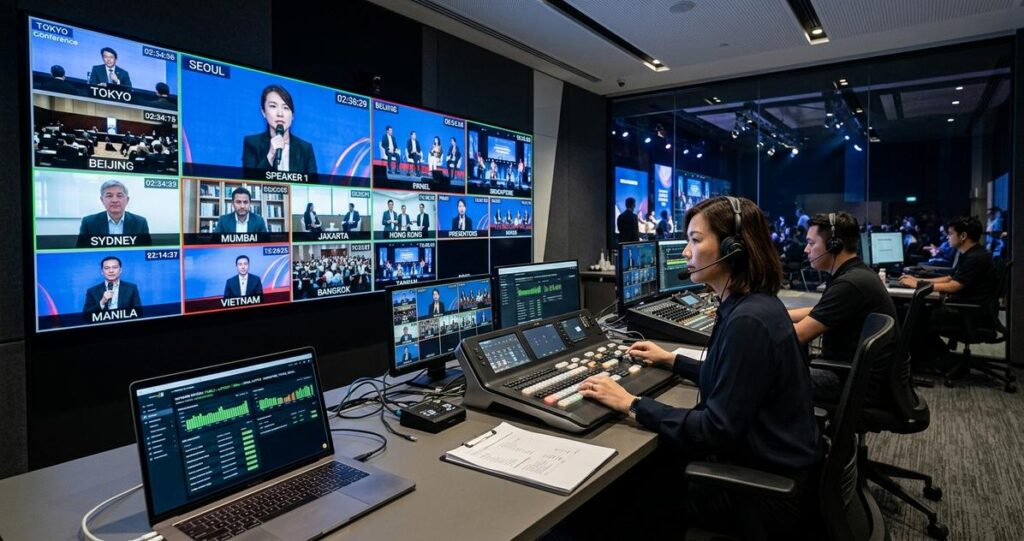
Hybrid events have changed how Singapore businesses, associations, and institutions connect with audiences. A product launch in Marina Bay, a medical seminar in Novena, or a regional town hall with speakers joining from Johor Bahru, Jakarta, and Manila can now reach people in the room and viewers online at the same time. The challenge is that internet speed is not uniform across regions, even within Southeast Asia. A stream that looks perfect in Singapore may still face latency, jitter, or packet loss when remote speakers, panelists, or production teams join from locations with different connectivity conditions. For event organisers, the goal is not simply to buy more bandwidth, but to design a resilient workflow that keeps the audience experience stable when internet conditions vary.
For Singapore readers, this issue matters because the country often serves as a regional hub. Teams here frequently coordinate with partners in Malaysia, Indonesia, Thailand, India, Australia, and beyond. In practice, a hybrid production can be affected less by the venue’s local connection and more by the weakest link in the chain, which may be a remote speaker’s home broadband, a hotel network, a corporate firewall, or a mobile hotspot used as backup. Understanding how regional differences affect stream quality helps planners make better technical choices, reduce live-event risk, and set realistic expectations with stakeholders.
There is also a broader operational benefit. When you plan for inconsistent internet conditions, you improve the reliability of your event, protect brand reputation, and reduce last-minute stress for presenters and producers. The most successful hybrid streams are rarely the ones that depend on ideal conditions. They are the ones built to survive imperfect ones.
Why internet speed varies so much across regions
Internet speed is often treated as a single number, but in live streaming it is only one part of a larger set of network conditions. A connection may report high download speed and still perform poorly for live contribution if upload speed is weak, latency is high, or the network fluctuates under load. For hybrid streams, upload performance usually matters more than download performance, because remote speakers and field contributors must send live video and audio back to the production platform.
Bandwidth, latency, jitter, and packet loss
Bandwidth is the amount of data a network can carry, usually measured in megabits per second. Latency is the delay between sending and receiving data. Jitter is the variation in latency over time, and packet loss happens when parts of the data fail to reach their destination. In live video, all four matter. A connection with enough bandwidth but unstable latency can still cause frozen video, choppy audio, or desynchronised speech.
For hybrid events, audio quality is often more important than ultra-high video resolution. A speaker can still be understood if the video drops to a lower resolution temporarily, but if the audio breaks up or the connection disconnects, the audience experience deteriorates quickly. This is why experienced production teams design systems to prioritise stable audio and graceful video adaptation over visual perfection.
Regional infrastructure differences
Internet performance depends on local infrastructure, last-mile delivery, mobile network congestion, and the quality of international routing. Singapore benefits from strong digital infrastructure and generally high connectivity standards, but hybrid productions often involve contributors from markets with less predictable speeds, or from locations with shared networks such as hotels, coworking spaces, event venues, or residential buildings. Even within the same city, one speaker may have fibre broadband while another relies on a busy wireless connection.
Regional differences also matter because data often travels across borders and through multiple network paths before reaching the production platform. That means a speaker in Bangkok may connect well to one server region and poorly to another, depending on routing and peering conditions. In live production, the exact route can matter as much as the nominal internet package.
How to assess connectivity before the live event
The best time to identify network risk is before the event begins. A proper technical rehearsal should include a real-world test of the stream path, not just a quick video call. This means checking the speaker’s actual setup, the software or browser-based contribution method, the camera and microphone being used, and the network conditions at the exact location from which they will present.
Run tests from the same location and device
Internet performance can change significantly depending on where the test is run. A speaker may test at home in the evening, then present from a hotel room, office meeting room, or conference space on event day. To reduce surprises, ask remote contributors to test from the same room, same device, and same network they will use live. If they plan to use a company laptop connected through VPN, test that exact setup, because VPNs can add routing overhead and sometimes restrict traffic.
Production teams should also confirm whether the speaker will be using Wi-Fi or Ethernet. Wired Ethernet is usually more stable for live contribution because it avoids interference and congestion from nearby devices. If Wi-Fi is the only option, the team should check signal strength, network congestion, and whether the speaker can stay close to the router during the live segment.
Measure more than speed
Speed tests are useful, but they do not tell the full story. A complete network check should include upload bandwidth, latency, jitter, and packet loss. Professional streaming platforms and contribution tools often provide built-in diagnostics, and those should be reviewed during rehearsal. If a platform supports statistics for connection stability, audio/video frame rate, and dropped frames, use them. If a contribution link repeatedly drops frames or delays audio, that is a warning sign even if the speed test looks acceptable.
In Singapore, event teams often work under tight schedules, so a structured checklist helps. Confirm the contributor’s location, internet source, backup plan, microphone, camera, lighting, and power supply. Make sure a technician documents what works during rehearsal and uses the same settings on show day. Small changes, such as switching browsers or moving to a different room, can affect performance.
Practical production strategies for inconsistent regional networks
Once you understand the network conditions, you can design a hybrid stream that is more tolerant of variation. The key principle is redundancy. Do not rely on a single point of failure for connectivity, contribution, or playback. Build options into the workflow so that one weak link does not derail the event.
Choose encoding settings that match real-world conditions
Bitrate, resolution, and frame rate should be matched to the least stable connection in the chain. A higher bitrate may look better on paper, but it is more vulnerable to instability. For many hybrid talks and panel sessions, a moderate video resolution with stable audio is more effective than pushing for the highest possible image quality. Adaptive bitrate streaming can also help the audience side by delivering a stream that adjusts to viewer bandwidth, although remote guest contribution may still require a separate stable uplink.
When speaking with clients in Singapore, it helps to explain that stream quality is a balance between ambition and reliability. A 4K presentation is not useful if the remote speaker cannot maintain a stable feed. For most live events, consistency matters more than maximum resolution.
Use backup contribution paths
Backup internet options are essential for contributors in variable regions. Common examples include a secondary wired line, a mobile hotspot, or a different contribution route through a browser-based platform. If the primary connection fails, the production team should already know which backup is available and how quickly it can be activated.
For speakers in Singapore, 4G and 5G mobile networks can be useful as contingency options, especially in urban areas where coverage is usually strong. However, mobile networks are still subject to congestion and signal variation, so they should be treated as backups rather than primary solutions for high-stakes live segments unless testing proves otherwise. For regional speakers, a pre-arranged hotspot can be a practical safeguard when local broadband is inconsistent.
Design the run-of-show with flexibility
A rigid live script increases risk. A flexible run-of-show gives the production team room to rearrange segments if one remote speaker has technical trouble. For example, the host can move to a pre-recorded video, take audience questions, or bring in a second presenter while a delayed contributor reconnects. This approach preserves momentum and reduces visible downtime.
It also helps to separate essential content from optional content. If a keynote speaker is joining remotely from another country, decide in advance what portion of the message must be delivered live and what can be pre-recorded as a fallback. This is particularly useful for regional events where contributors may be in different time zones and network environments.
Managing audience experience when internet quality differs
Viewers do not usually care why the stream stutters. They care whether they can hear clearly, see the presentation, and follow the discussion without interruption. That means hybrid production teams need to think from the audience’s point of view, not only from the technical side. Clear communication, sound management, and steady visual pacing can make a major difference even when network conditions are uneven.
Prioritise audio clarity
Audio is often the most important element in a live hybrid stream. If the video momentarily softens but the voice remains clear, the audience can still follow the conversation. Use good microphones, reduce background noise, and ask remote speakers to present in quiet environments. If possible, encourage headsets or external microphones rather than built-in laptop microphones, which often pick up room echo and ambient noise.
For Singapore-based events, this is especially relevant in shared office spaces, co-working locations, and hotel rooms where HVAC noise, corridor traffic, or nearby conversations can interfere with the sound. A speaker standing near a quiet window is usually better than one sitting next to an air-conditioning unit.
Prepare presenters for low-bandwidth behavior
Speakers should know what to do if the connection weakens. They should speak at a steady pace, avoid talking over others, and pause briefly if audio is delayed. If the event uses slides, presenters should send a copy in advance so the production team can advance them locally if the remote screen share becomes unstable. This reduces dependence on live screen-sharing, which can be bandwidth-heavy and less reliable over long distances.
It also helps to brief presenters on the importance of camera framing, lighting, and device notifications. A simple phone call, alert sound, or moving background can be distracting on stream. Small details become more noticeable when the audience is already dealing with latency or audio variation.
Building a resilient hybrid workflow for Singapore and the region
For Singapore organisations that run regional events, the strongest strategy is to treat connectivity as part of the production design, not as an afterthought. This includes venue selection, contributor onboarding, rehearsal planning, and technical contingency design. A reliable hybrid event is usually the result of disciplined preparation, not a single piece of expensive equipment.
Use local strengths wisely
Singapore’s infrastructure, central regional position, and business connectivity give event teams a strong base. Use that advantage to anchor the production. Keep the main gallery, streaming encoder, and most critical staff in a stable location with wired connectivity and power backup where possible. Then build controlled contribution pathways for remote guests. This allows the core of the event to remain steady even if regional guest connections vary.
Where possible, ask regional participants to join through a nearby professional venue or studio rather than an unpredictable home line. For executive sessions, board briefings, or investor communications, this can significantly reduce risk. If a remote contributor must join from home, provide clear technical guidance and perform a proper rehearsal well in advance.
Document and standardise the process
Teams that run multiple hybrid events should standardise their network checklist, rehearsal process, and escalation plan. Record what settings worked, which platforms handled unstable links best, and what backup routes were available. Over time, this creates an internal knowledge base that improves reliability and shortens setup time.
For Singapore businesses working across the region, this process is especially useful because different markets often require different assumptions. A workflow that performs well for a speaker in Singapore may need adjustment for a colleague in Indonesia, the Philippines, or India. Standardisation does not mean using the same setup everywhere. It means having a consistent method for identifying what works in each location and adapting accordingly.
In practice, the most effective hybrid streams are built on three habits: test early, design for backup, and prioritise clarity over perfection. Those habits are simple, but they solve many of the problems caused by regional internet differences. When production teams keep the audience experience at the centre, they can deliver stable, professional events even when the network environment is far from ideal.
General information only: This article is intended to support awareness and event planning. For urgent medical or technical issues affecting a live event environment, engage qualified professionals and follow the guidance of the relevant platform, venue, or service provider.

Jeremy Lee is a seasoned digital marketing director and strategist with over two decades of experience in the industry. As the founder of Sotavento Medios, I manage a diverse portfolio of over 50 businesses, helping brands grow through advanced search strategies and digital innovation. My work focuses on bridging the gap between traditional search engine optimisation and the evolving world of AI-driven answer engines.
get in touch