
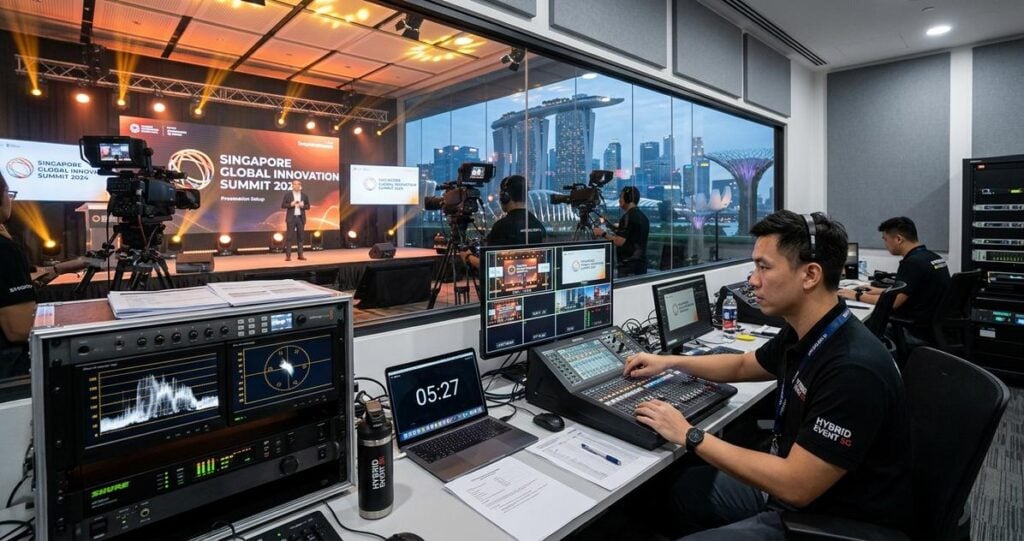
For many organisations in Singapore, a hybrid event is no longer a novelty. It is now a practical format for product launches, town halls, education sessions, conferences, and stakeholder briefings. The challenge is not only getting people into a room at Suntec, Marina Bay Sands, a hotel ballroom, or an office auditorium. It is also making sure the online audience receives a smooth, professional, and engaging experience at the same time. The final countdown before event day is where the quality of the whole production is either secured or compromised. Good planning at this stage reduces technical surprises, protects the experience of both in-person and remote participants, and helps every team member work with clarity.
In Singapore, hybrid event preparation has its own practical realities. Venue internet policies, building access rules, transport timing, weather interruptions, and the expectations of a highly connected audience all matter. A well-run hybrid event depends on more than a camera and a livestream link. It requires disciplined coordination among the client, venue team, presenters, moderators, technical crew, and content owners. The last stretch before the event is the moment to confirm details, remove ambiguity, and rehearse the full run as closely as possible to the real thing. For organisers who want reliable delivery, this is where professional event streaming and hybrid production planning becomes most visible.
Why the final countdown matters in a Singapore hybrid event
The days and hours before an event are the point where smaller decisions become operational risks. A missing presenter slide, an untested microphone, or an unclear stream handover can affect both the live room and the digital audience. In a hybrid format, the stakes are higher because the event has two audiences with different needs, and both should feel included. The in-room audience expects clear sound, visible screens, efficient pacing, and strong facilitation. The online audience expects stable video, intelligible audio, timely transitions, and a feed that does not feel like an afterthought.
Singapore’s event environment is also fast-moving and tightly scheduled. Venues often have defined load-in windows, strict fire safety procedures, and limited setup time between bookings. Traffic patterns around business districts, weekend public transport volumes, and weather conditions can affect arrival timing for equipment, speakers, and guests. A strong final prep process helps the team absorb these variables without letting them spill into the program itself.
What can go wrong without a proper countdown plan
The most common issues are usually not dramatic, but they are disruptive. Audio levels can be inconsistent, presentation files can differ from the approved version, camera framing can be off, or a moderator may not know the backup plan if a speaker is delayed. When the online stream is involved, even a short interruption can weaken audience confidence. A smooth event depends on checking the basics repeatedly, not assuming they are already settled.
There is also a human factor. Presenters under pressure can speak too quickly, ignore the microphone, or struggle with remote interaction if they have not been briefed properly. A good countdown process prepares people as well as equipment. It gives everyone a shared understanding of the sequence, the roles, and the escalation path if something changes.
Locking down the technical setup before event day
Technical preparation is the backbone of hybrid production. The final checks should confirm that the venue, internet connection, cameras, audio system, presentation playback, and streaming platform all work together as one system. Each component may function well on its own, but a hybrid event depends on the integration between them. That is why a complete systems test matters more than isolated equipment checks.
Audio is the first priority
For hybrid events, audio quality is often more important than video quality. Online audiences may tolerate modest visuals, but poor sound quickly leads to fatigue and drop-off. Test all microphones, including handheld, lapel, boundary, and podium microphones if used. Check for feedback risk, microphone gain, room echo, and whether voices are clear at the back of the hall and through the livestream. The operator should also test how music, videos, and presentation audio will be mixed, because level changes during the program can become obvious to viewers.
In Singapore venues, acoustics can vary significantly depending on ceiling height, wall finishes, and room dividers. A ballroom with multiple partitions behaves differently from a purpose-built conference space. The sound check should therefore be done in the actual event configuration, not a generic setup. If the audience is expected to move between a main session and a breakout room, both areas need separate attention.
Video, framing, and visual consistency
Video should support the event message without distracting from it. Confirm camera positions, the cleanliness of the lens, the stability of tripods or mounts, and the correct framing of speakers, panels, and screen content. If the event includes slides, make sure the screen content is legible from the camera feed and not overly dense. Small text that works on a speaker laptop may become unreadable once compressed for streaming.
Also confirm that branding elements are consistent across lower-thirds, holding slides, and any pre-event or transition graphics. Hybrid audiences notice visual inconsistency quickly. A polished look is not only about aesthetics, it also communicates competence and care.
Internet resilience and backup planning
Reliable connectivity is essential in any livestream. Confirm the venue’s wired internet provision, bandwidth allocation, and any restrictions on network access. If the event depends on online participation, ask how the production team will monitor the connection before and during the session. A backup path should be prepared, which may include a separate connection method or an alternate streaming workflow, depending on the production design.
Backup planning is not pessimism, it is good operational discipline. In a real event, equipment can be delayed, a network can fluctuate, or a platform issue can appear unexpectedly. A team that has agreed on backup actions in advance will recover more calmly and protect the audience experience.
Preparing speakers, hosts, and moderators for the hybrid format
Even a technically solid event can feel disjointed if presenters are not prepared for the hybrid environment. Speakers often focus on their content, while hosts and moderators carry the responsibility of bridging room and screen. The final prep stage should align everyone on timing, delivery style, and interaction rules. This is especially important for corporate sessions in Singapore, where audiences usually value clarity, efficiency, and professionalism.
Brief presenters on timing and delivery
Each speaker should know their speaking slot, cue points, slide handover process, and expected style of delivery. Encourage concise phrasing and clear pacing, particularly if the event includes simultaneous interpretation, captioning, or remote Q&A. If speakers are joining from different locations, confirm their setup, lighting, microphone, and backup contact details. A presenter at home or in another office still needs to be treated as part of the live production, not as an informal add-on.
For in-room speakers, remind them that the microphone matters even when they feel audible in the room. Many presenters naturally project to the local audience and forget the online viewers. The moderation briefing should include a simple reminder that the stream audience hears only what the system captures, not what the room naturally carries.
Define the role of the host and moderator
The host keeps the event moving, while the moderator protects the experience of both audiences. In a hybrid environment, the moderator often manages audience questions, transition timing, speaker order, and contingency plans. They should know when to pause, when to fill time, and how to acknowledge technical changes without making the audience feel unsettled. A calm moderator can make a difficult moment feel controlled.
It helps to prepare moderator notes with approved names, titles, pronunciation guidance, and the exact sequence of segment transitions. This is especially useful for events involving international speakers, government guests, industry leaders, or technical subject matter where accuracy matters.
Content readiness, audience flow, and day-of logistics
Hybrid event success depends on more than equipment and presenters. The content itself must be ready in a form that suits both the physical room and the online audience. This means checking the run-of-show, final slide deck, media files, speaker biographies, audience interaction tools, and any sponsor or partner acknowledgements. It also means planning how attendees will move through the experience before, during, and after the session.
Run-of-show discipline
A detailed run-of-show is one of the most useful production documents. It should list the sequence of every segment, the responsible person, the planned start and end time, cue points, media triggers, and contingency actions. In a hybrid event, the run-of-show should also show which moments are visible to the online audience and which are room-only. If the event includes backstage changes, panel adjustments, or setup breaks, the digital audience needs a planned holding strategy so they are not left staring at an empty stage without explanation.
Every department should be using the same version of the schedule. Version control matters because a small timing shift in one document can create confusion across the team. The final pre-event review should confirm that everyone is working from the current file.
Check audience communication and registration details
For Singapore audiences, convenience and clarity are important. Confirm that registration information is accurate, joining links are tested, venue directions are clear, and check-in instructions are simple to follow. If the event includes QR code entry, digital tickets, or badge collection, test the process ahead of time. For online participants, the reminder emails should contain the correct time zone, access instructions, and support contact route.
It is also sensible to plan for late arrivals and last-minute changes. In Singapore, traffic, rain, work commitments, and packed schedules can all affect attendance. A straightforward entry process and a responsive support team help reduce friction.
Accessibility and audience inclusion
Accessibility should be considered part of production quality. This may include clear audio, visible captions where appropriate, readable slides, and enough time for questions to be heard and answered properly. For mixed audiences, think about how remote attendees will ask questions and whether the room audience can hear them. A good hybrid format makes participation feel balanced rather than divided.
If your audience includes non-native English speakers or senior stakeholders who prefer slower pacing, the production and moderation style should reflect that. Clarity and structure are more valuable than speed.
The practical Singapore checklist for the last 48 hours
The final two days before a hybrid event should be reserved for confirmation, not experimentation. This is the time to lock the design, test the full workflow, and eliminate avoidable uncertainty. A focused checklist prevents small omissions from becoming event-day problems.
- Confirm the latest slide deck, video clips, speaker names, titles, and pronunciation notes.
- Test all microphones, cameras, playback devices, and streaming connections in the event venue or a close simulation of it.
- Review the full run-of-show with the host, moderator, technical director, and client lead.
- Verify internet access, backup connectivity, and escalation contacts.
- Check venue access timing, loading procedures, parking or drop-off arrangements, and equipment storage areas.
- Prepare printed or digital cue sheets for the production and front-of-house teams.
- Brief presenters on arrival time, backstage procedures, and microphone etiquette.
- Confirm the support path for online participants, including how questions, technical issues, or access problems will be handled.
In Singapore, it also helps to keep an eye on weather and transport timing. Heavy rain can affect arrival schedules, equipment handling, and guest flow. If your venue is in a busy area such as the Marina Bay, Orchard, or city-fringe business districts, allow more time for delivery access and on-site movement. These small allowances can make the difference between a rushed setup and a controlled one.
How to keep the event calm, even when something changes
Change is normal in live production. A speaker may arrive late, a slide may need replacement, or a remote guest may have connection trouble. The aim is not to eliminate every possible change, because that is unrealistic. The aim is to ensure the team has a clear response pattern so the event stays composed. This is why final prep should always include a contingency discussion, not only a technical rehearsal.
A useful approach is to identify the most likely issues and decide who makes the decision, who communicates it, and what the audience hears. If the online stream needs a short pause, the holding message should be prepared in advance. If a speaker is missing, the host should know which approved content can fill the gap without damaging the flow. The more these responses are rehearsed, the less likely the team is to improvise under pressure.
Professional hybrid production is not about creating an illusion that nothing can go wrong. It is about making the event resilient enough that the audience experiences confidence, clarity, and continuity. When that happens, the event feels polished, even if the team has quietly solved several problems behind the scenes.
For organisers in Singapore, the best way to approach the final countdown is to treat it as the last quality control window. Check the sound, test the visuals, confirm the links, brief the people, and keep the run-of-show tight. If you are managing a hybrid event with serious reputational value, this is also the moment to involve specialists who understand event streaming, venue coordination, and live production workflow. The objective is simple: give both your room audience and your online audience a dependable experience from the first cue to the last sign-off.
Important note, this article provides general information on hybrid event preparation and does not replace venue-specific technical guidance or professional production advice. For events with high visibility, sensitive content, or complex technical requirements, a qualified event production team should review the setup in advance.
Jeremy Lee is a seasoned digital marketing director and strategist with over two decades of experience in the industry. As the founder of Sotavento Medios, I manage a diverse portfolio of over 50 businesses, helping brands grow through advanced search strategies and digital innovation. My work focuses on bridging the gap between traditional search engine optimisation and the evolving world of AI-driven answer engines.
get in touch