
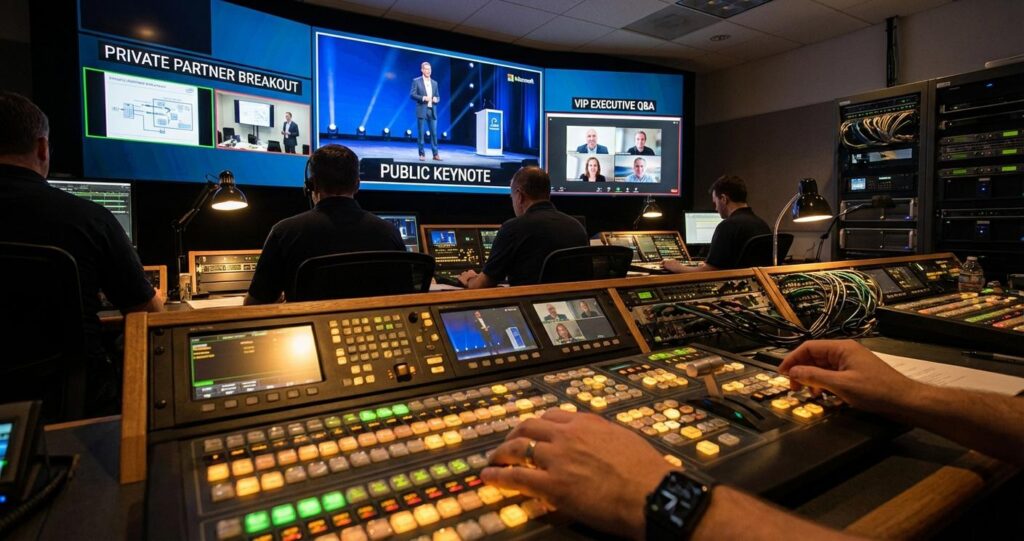
Architecting Signal Flow for Multi-Tiered Corporate Events
In modern corporate communication, a single event broadcast is rarely a one-size-fits-all solution. Enterprise events, from all-hands meetings to global product launches, increasingly require a tiered access structure. This model allows for a public-facing keynote, specialized sessions for partners or paid attendees, and confidential briefings for internal executives, all originating from a single, cohesive production. Successfully executing this strategy requires a robust technical architecture that extends beyond simple streaming to encompass signal routing, protocol selection, and enterprise-grade security integration. The core challenge lies in creating and managing multiple, simultaneous, and secure distribution paths from a central production core, ensuring each audience tier receives only its designated content with broadcast-grade reliability.
This technical brief outlines the engineering principles and workflows required to manage public versus private access for tiered corporate events. We will examine the process from the foundational production switcher and matrix router setup, through the strategic implementation of encoding and transport protocols like RTMP and Secure Reliable Transport (SRT), to the final delivery and authentication via enterprise-grade Content Delivery Networks (CDNs) and Online Video Platforms (OVPs). The focus is on building a scalable and secure infrastructure capable of handling the distinct requirements of each audience segment without compromising production quality or data integrity. For corporate event planners and IT directors, understanding this architecture is critical to delivering a flawless, high-impact hybrid event experience that serves diverse stakeholder groups effectively.
Foundational Architecture: The Centralized Production Core and Signal Matrix
The integrity of a tiered streaming event is established at the very beginning of the signal chain. A flexible and powerful production core is non-negotiable. This core is responsible for ingesting all sources, creating the primary program feed, and then creating derivative feeds for different destinations. This is not accomplished with a single output, but with a sophisticated signal routing and management strategy.
Designing the Production Hub with a Video Switcher and Router
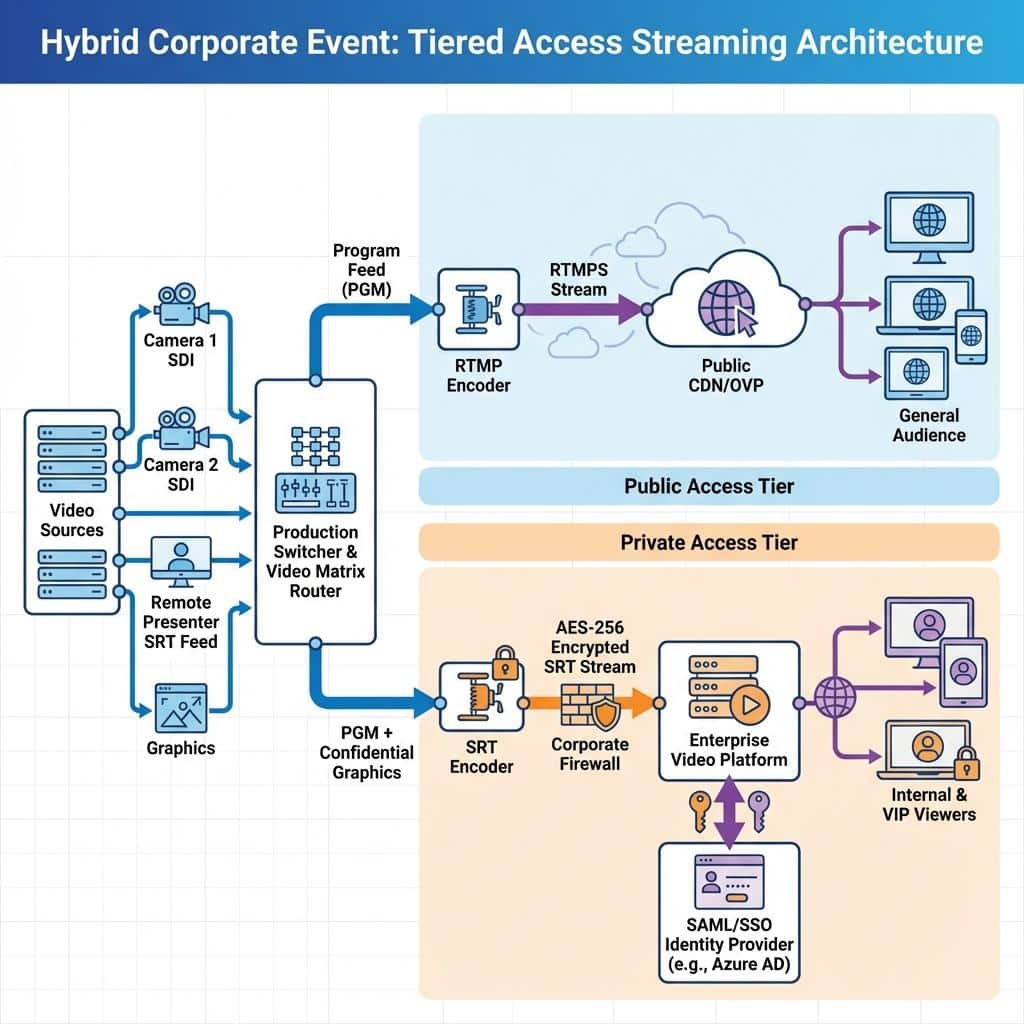
The nucleus of the operation is the production switcher, often a professional broadcast-grade unit like a Ross Carbonite or Blackmagic Design ATEM Constellation. This device handles the real-time mixing of video sources, including on-site cameras connected via 12G-SDI for 4K/UHD content, remote presenter feeds delivered via SRT or Network Device Interface (NDI), and graphics from systems like Ross XPression or Chyron. The primary output of the switcher is the main Program (PGM) feed, which constitutes the content for the highest-access tier or the main public show. However, for a tiered event, relying solely on the PGM output is insufficient. This is where a video matrix router, such as an AJA KUMO or Ross Ultrix, becomes indispensable. The router takes in all sources, including the switcher’s PGM feed, individual camera International Standards Organization (ISO) recordings, and clean feeds (PGM without graphics), and allows for any input to be routed to any output. This creates a flexible signal distribution matrix, enabling the creation of multiple, distinct signal paths for different audience tiers. For instance, the main PGM can be routed to the public stream encoder, while a clean feed is routed to a different encoder for internal archival, and specific ISO camera feeds are sent to a multiviewer for remote director monitoring.
Advanced Audio Routing: Mix-Minus, Language Tracks, and Dante Integration
Audio complexity increases exponentially with tiered events. The main program mix, created on a digital audio console like a Yamaha QL series, must be flawless. However, remote presenters require a mix-minus feed, which is the full program mix minus their own audio to prevent echo and feedback. Each remote participant requires their own unique mix-minus. For global events, different tiers may require different languages. This involves creating multiple audio mixes and embedding them into the correct SDI video signals using an audio embedder. Audio transport protocols like Dante or MADI (Multichannel Audio Digital Interface) are critical for moving dozens of audio channels between the audio console, video router, and other devices with high fidelity and low latency. The video router must be capable of de-embedding and re-embedding audio to ensure the correct audio mix is paired with the correct video feed for each specific tier. For example, the English program audio is embedded into the SDI signal path for the public North American stream, while a Spanish translation mix is embedded into a separate SDI signal sent to an encoder targeting a Latin American audience.
Implementing Tiered Access: Protocol Selection and Encoder Strategy
Once the core signals are routed, the next critical stage is encoding and transport. The choice of streaming protocol and the encoder configuration directly enforces the security and reliability of each tier. A multi-encoder strategy is the professional standard for this application, as it provides physical separation and tailored settings for each distribution path.
Strategic Protocol Deployment: RTMP vs. SRT
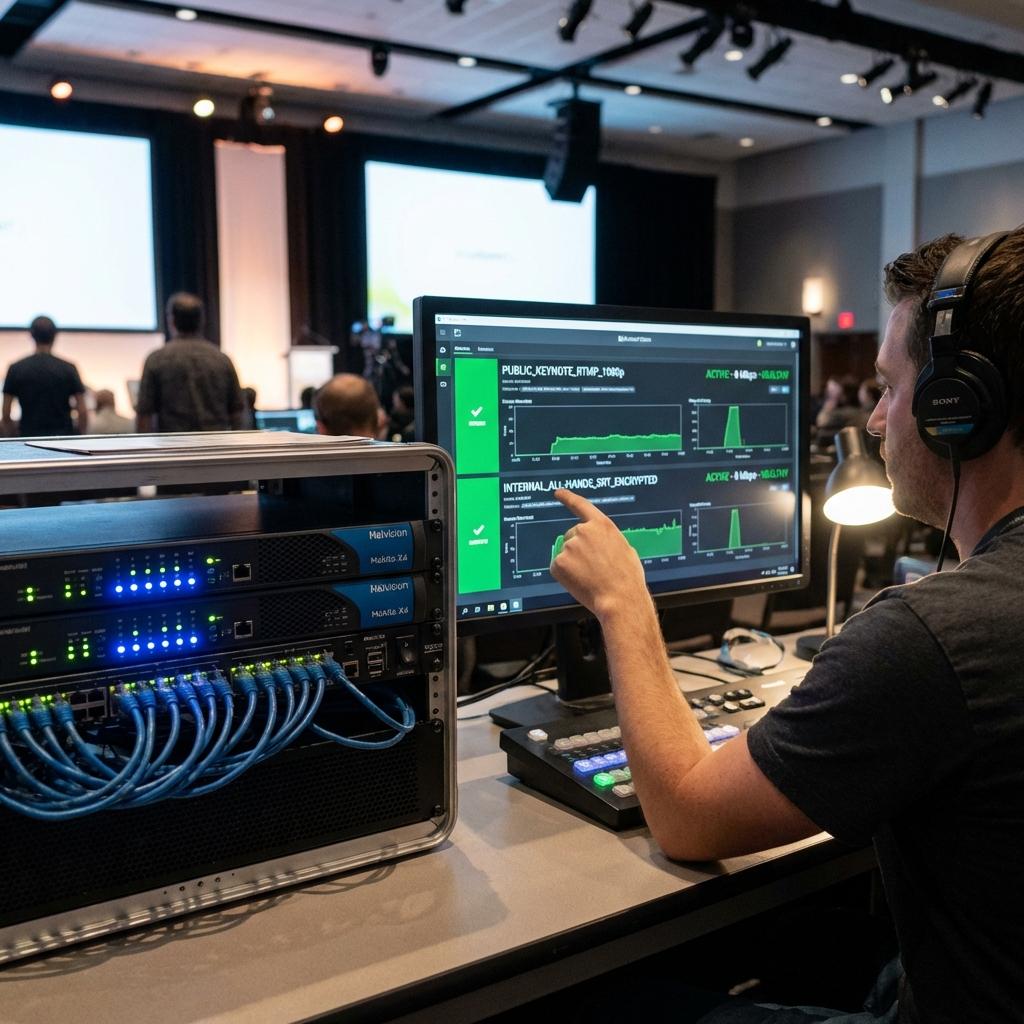
The most common protocol for public-facing streams is RTMP (Real-Time Messaging Protocol) or its encrypted variant, RTMPS. Its primary advantage is universal compatibility with major OVPs like Vimeo, YouTube, and generic CDNs. For the public keynote of a corporate event, RTMPS provides a reliable method to reach the widest possible audience. However, for private, high-value tiers, RTMP is technically inadequate due to its lack of robust security and its sensitivity to network packet loss. This is where SRT (Secure Reliable Transport) is essential. SRT is an open-source protocol that provides end-to-end AES-128/256 bit encryption, making the stream content unintelligible to unauthorized parties. Furthermore, it incorporates advanced error correction to handle packet loss on unreliable networks, making it far more resilient than RTMP for transport over the public internet. For a C-suite briefing or a paid technical workshop, a dedicated hardware encoder (e.g., a Haivision Makito X4) will be configured to send an SRT stream with a strong passphrase to a specific SRT-capable endpoint, ensuring both security and quality.
Configuring the Delivery Chain: CDN and OVP Security Layers
The streaming protocols are the first line of defense, but the OVP or CDN provides the final, user-facing access control. For the public tier, the CDN can be configured with geo-fencing to restrict viewing to certain countries or basic password protection on the viewing page. For the private tiers, enterprise-grade security is mandatory. This is achieved through Single Sign-On (SSO) integration using protocols like SAML 2.0 or OAuth 2.0. The OVP (such as Brightcove, Kaltura, or Panopto) is linked to the corporation’s identity provider, like Azure Active Directory or Okta. When an employee attempts to view the private stream, the OVP redirects them to their corporate login page for authentication. Only upon successful authentication is the viewer granted access to the video player. This ensures that only verified employees or registered partners can view sensitive internal content. Additional layers like IP address whitelisting can be added, restricting access to only corporate office networks for the highest level of security.
Hybrid Event Workflows: Integrating Remote Participants and On-Site Production
Tiered events are almost always hybrid, involving a mix of on-site presenters and remote participants who may belong to different access tiers. Integrating these remote sources seamlessly into the main production while providing them with appropriate return feeds is a significant technical undertaking that requires careful network planning and signal management.
Bridging Broadcast and Unified Communications Platforms
A common requirement is to feature a remote VIP, perhaps a CEO dialing in from a different location, in a main stage session. Bringing a feed from a Unified Communications and Collaboration (UCC) platform like Microsoft Teams or Zoom into a broadcast production environment requires a professional conversion process. Simply screen-capturing a laptop is not a broadcast-quality solution. The professional method involves using hardware or software that can convert the UCC participant feeds into a standard broadcast signal. For example, a system can output individual participant feeds as NDI sources. These NDI sources can then be brought over the network into the production switcher as inputs, just like a physical camera. This allows the remote participant to be switched, keyed over graphics, and integrated into the program feed with high quality. For the highest quality, a dedicated hardware endpoint can be sent to the remote VIP, which takes their camera and microphone and transmits a high-bitrate SRT feed back to the production facility, bypassing the UCC platform’s compression entirely.
Managing Return Feeds, Multiviews, and Latency
Every participant, whether on-site or remote, needs to see and hear what is happening. This is accomplished through return feeds and confidence monitoring. On-site presenters have stage monitors. Remote participants need a custom return feed sent back to them over the internet. A generic program feed is often insufficient. A remote presenter typically needs a custom multiview feed that includes the live program output, their own camera feed (for framing), a presentation timer, and a view of the next slide or speaker. This custom multiview is built using the production switcher’s auxiliary (AUX) outputs and sent to a dedicated encoder transmitting a low-latency SRT stream back to the remote presenter. Latency management is key. The round-trip delay must be kept to a minimum, typically under 500ms, to enable natural conversation between on-site and remote participants. This is achieved by using low-latency protocols like SRT and ensuring a high-quality, uncontended network path for both the incoming and outgoing feeds.
Network Infrastructure: Segmentation and Quality of Service
The network is the backbone of any hybrid event. It is a critical point of failure that must be engineered for resilience. At the event venue, the production network must be physically or virtually (using VLANs) isolated from the venue’s house network and any public guest Wi-Fi. This prevents traffic contention and enhances security. All critical production traffic, such as SRT feeds, NDI signals, and Dante audio, should be prioritized using Quality of Service (QoS) policies on managed network switches. This ensures that these real-time media streams are not affected by other network activity, such as file transfers or general internet browsing. A minimum dedicated, symmetric internet bandwidth of 100 Mbps is a starting point, with requirements increasing based on the number of simultaneous incoming and outgoing SRT streams. For a high-stakes event, redundant internet connections from different providers with automatic failover are a standard best practice to ensure the broadcast is not interrupted by a single provider outage.
In conclusion, managing tiered public and private access for corporate events is a complex broadcast engineering discipline. It demands a holistic approach that begins with a flexible signal routing core, employs a strategic mix of transport protocols like RTMPS and SRT for security and reliability, and integrates seamlessly with enterprise authentication systems. By architecting the production and distribution workflow with these principles in mind, organizations can deliver a secure, tailored, and high-quality viewing experience to every audience segment, maximizing the value and impact of their most important events. This level of technical execution requires deep expertise in both live production and enterprise IT infrastructure, a combination that defines the modern standard for professional B2B event streaming.
Jeremy Lee is a seasoned digital marketing director and strategist with over two decades of experience in the industry. As the founder of Sotavento Medios, I manage a diverse portfolio of over 50 businesses, helping brands grow through advanced search strategies and digital innovation. My work focuses on bridging the gap between traditional search engine optimisation and the evolving world of AI-driven answer engines.
get in touch