
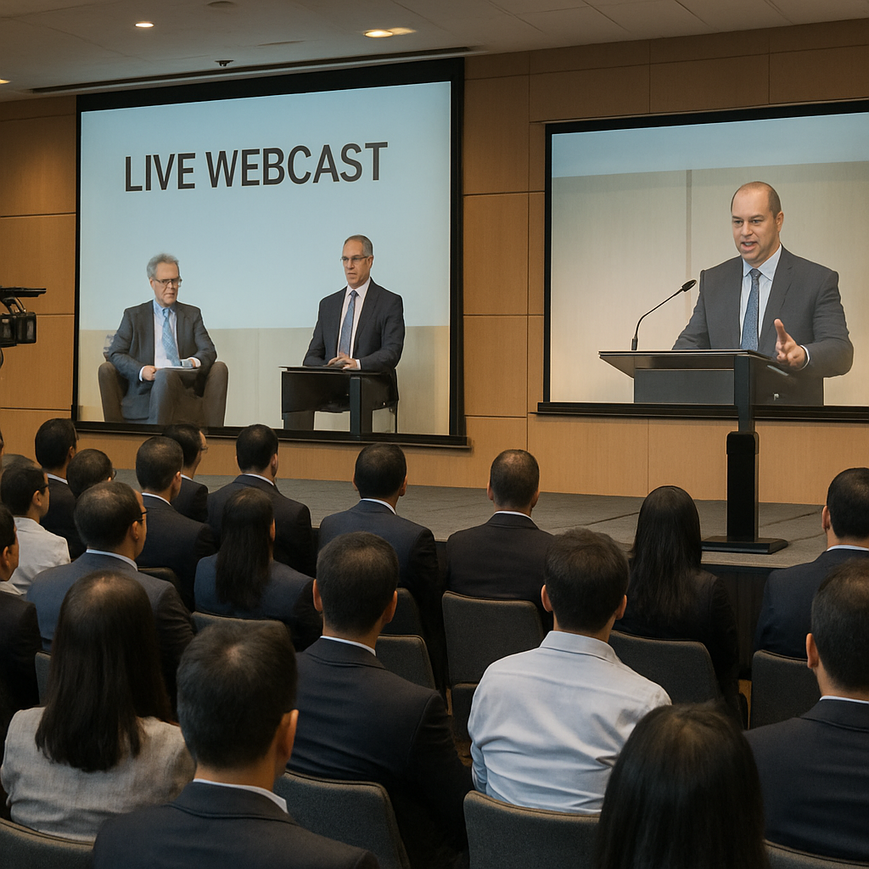
Long-format B2B streams are very different from a short product teaser or a quick panel clip. When a webcast runs for an hour, two hours, or even across a half-day programme, participant attention naturally rises and falls. That is especially relevant for Singapore audiences, who often attend online business events while balancing work meetings, client calls, and family commitments. If the stream does not feel structured, useful, and easy to follow, even a well-planned event can lose momentum halfway through.
Participant engagement is not just about keeping a chat box active. In a B2B setting, engagement affects whether attendees stay for key segments, absorb technical information, ask relevant questions, and leave with enough confidence to act. For organisers in Singapore, this matters because audiences are generally time-conscious, professionally savvy, and accustomed to clear standards of delivery. Whether the stream is for healthcare, finance, technology, education, logistics, or government-related sectors, engagement has to be designed with purpose rather than left to chance.
Managing engagement in long-format streams requires more than good cameras and stable internet. It depends on event design, pacing, speaker preparation, visual clarity, interactive tools, and moderation discipline. It also benefits from an understanding of how adults process information over time. The most effective streams respect audience attention spans, reduce friction, and create repeated moments that invite participation without feeling forced. In Singapore, where audiences often join remotely from offices, co-working spaces, or home, the practical details matter just as much as the content itself.
Why long-format B2B streams lose attention
The first step in improving engagement is understanding why audiences disengage. In long-format webinars and hybrid broadcasts, attention drops for predictable reasons. The content may be too dense, the pace may be uneven, the production may be visually flat, or the event may not provide enough reason for viewers to stay until the end. In many cases, the issue is not the subject matter itself, but the way the subject matter is delivered.
B2B audiences usually join with a clear objective. They want insights, proof, practical guidance, or access to experts. If the event spends too long on introductions, sponsor messages, or generic context that does not advance that objective, participants may mentally switch off. This is especially true for Singapore professionals, who often attend streamed events during packed workdays and expect efficient use of time. Long-format streams need to earn attention continuously, not only at the start.
How attention naturally changes over time
Attention is not a fixed state. People focus more strongly when they encounter a new idea, a question, a visual change, or a direct invitation to respond. Over time, without a change in stimulus, concentration becomes harder to sustain. This is one reason why long sessions need deliberate transitions, audience interactions, and varied presentation styles. A stream that looks and sounds identical for 90 minutes gives the viewer very little cognitive support.
For B2B events, this means organisers should plan for rhythm. A speaker-led segment can be followed by a moderated question period, a poll, a short case study, a live demo, or a client story. These changes help reset attention without interrupting the overall message. They also create natural checkpoints that remind participants that their presence matters.
The Singapore audience context
Singapore audiences are familiar with high standards of service and communication. They often expect precise language, efficient moderation, and responsive technical delivery. Many participants also access events through mobile devices or through workplace networks with strict security policies, which means the stream experience should be simple, stable, and easy to navigate. Long registration forms, confusing login steps, or poor audio can quickly become barriers to sustained engagement.
In addition, Singapore’s working culture often involves time sensitivity across different industries and time zones. Regional stakeholders may join from Southeast Asia, while local attendees may need to switch between sessions and other obligations. This makes it important to communicate agenda timing clearly, flag key moments in advance, and avoid unnecessary filler. The audience should feel that every segment has a role.
Designing the stream to support participation
Engagement starts before the live broadcast begins. A well-designed long-format stream is built around structure, not improvisation. That structure should make it easy for participants to know what is happening, when to expect interaction, and why they should remain attentive. The best events do not rely on one strong speaker alone. They create a sequence of moments that distribute energy across the full programme.
Open with clear value
The opening should tell participants exactly what they will gain. Instead of a generic welcome, use a direct explanation of the session’s purpose, audience, and practical outcomes. If the stream includes technical demonstrations, policy updates, or case discussions, identify these early. When the audience can see immediate relevance, they are more likely to stay engaged through the rest of the programme.
This is particularly important in Singapore, where professional audiences often evaluate events quickly and expect substance. A strong opening can also reduce drop-off by making the time commitment feel worthwhile. If the session is two hours long, say what will happen in each major section, and when questions, breaks, or interactive portions will appear.
Use segment planning instead of one long block
Long-format B2B streams work better when broken into clearly defined sections. Each segment should have a purpose, a speaker type, and a visual style if possible. For example, an opening keynote can be followed by a panel, then a case study, then an audience Q&A. Even if the topic is technically complex, segmenting the content helps participants mentally reset and stay oriented.
From a production point of view, segment planning also makes moderation easier. The host can transition between speakers smoothly, introduce the next theme, and remind participants of upcoming interaction. This reduces dead air and keeps the session moving. It also creates more opportunities to use graphics, lower-thirds, on-screen prompts, and short transition slides that signal a change in pace.
Build in meaningful interactivity
Interactivity should be used with intent. Random polls or generic “Are you enjoying the session?” prompts add little value. Better engagement comes from questions that connect directly to the content. For example, an audience poll can test a common industry assumption, identify the most relevant challenge, or help the presenter tailor the next part of the discussion.
In Singapore-based B2B events, interactivity works best when it feels practical and professional. Audience members are more likely to respond when the question is relevant to their work, simple to answer, and clearly tied to the ongoing discussion. Moderators should also acknowledge the responses on screen or verbally, so the audience knows participation has been seen and valued.
Content and presentation techniques that hold attention
Even a technically strong stream can become tiring if the content is delivered in a monotonous way. Long-format streams need variety in both substance and presentation. That does not mean sacrificing depth. It means presenting depth in a way that remains accessible across the full session.
Explain complex ideas in layered form
Many B2B audiences include people with different levels of familiarity. Some may be subject-matter experts, while others are decision-makers, sales leaders, operations managers, or external partners. A layered approach helps everyone stay with the content. Start with the main takeaway in plain language, then move into technical detail, examples, and implications. This reduces the risk of losing less specialised viewers early.
For instance, if the discussion concerns streaming security, the speaker can first explain why secure authentication matters, then describe common risks, then outline operational practices such as access control, approved devices, and content handling. This kind of progression helps viewers follow along without oversimplifying the topic.
Use visual variation to refresh attention
Visual monotony is one of the fastest ways to reduce engagement. A single static camera for an entire session may be technically acceptable, but it is rarely ideal for long-format B2B content. Production teams should plan for camera changes, on-screen graphics, slides, data visualisations, speaker close-ups, and live demonstration segments where relevant.
The goal is not to overproduce the event. It is to create visual cues that match the information being shared. When the speaker changes topic, the visuals should change too. When a statistic or framework is introduced, the screen should support it clearly. This reduces cognitive strain and helps participants remember the message.
Train speakers to communicate for live streaming
Subject-matter expertise does not automatically translate into effective live delivery. Speakers may be brilliant in a boardroom or technical workshop but less effective on camera if they speak too quickly, read slides word for word, or fail to pause for audience processing. Speaker preparation is essential.
Speakers should be coached to use shorter sentences, emphasise key points verbally, and leave space for questions. They should also understand how to respond when engagement drops. A well-prepared speaker can use a direct question, a real-world example, or a transition to a new section to restore momentum. In Singapore, where business communication is often direct and efficient, clarity tends to be more persuasive than performance flourishes.
Moderator and production choices that sustain momentum
Moderation is often underestimated in long-format streams, yet it is one of the strongest drivers of engagement. A good moderator is not merely an announcer. They manage timing, participation, transitions, and audience energy. They also help speakers stay focused and make sure the event serves the audience rather than drifting off course.
Moderate actively, not passively
An active moderator guides the session with purpose. They introduce speakers concisely, frame audience questions clearly, and recap important points before shifting to the next section. When a discussion becomes too technical or too broad, the moderator can bring it back to the audience’s needs. This keeps the event practical and useful.
For Singapore audiences, active moderation also supports professionalism. It shows that the organisers value time and structure. It also helps multilingual or cross-regional audiences because the moderator can clarify terminology, summarise takeaways, and keep the conversation accessible without diluting expertise.
Manage live questions with discipline
Live Q&A is one of the most effective engagement tools, but it needs structure. Questions should be screened, grouped by theme, and delivered at the right point in the agenda. If every question interrupts the flow, the session can become fragmented. If questions are held too long, the audience may feel ignored. A balanced approach works best.
A practical method is to collect questions throughout the session, then group them into themes such as strategy, operations, implementation, or risk. The moderator can then choose representative questions that move the discussion forward. This approach keeps the conversation coherent and makes better use of expert time.
Support interaction through technical reliability
Engagement suffers when viewers struggle with buffering, audio delay, broken slides, or unstable connections. Technical quality is not a luxury in long-format streaming. It is part of the audience experience. Clear sound is especially important because many participants will continue listening even if they are not watching the screen every second. Poor audio makes long sessions harder to follow and more tiring.
For Singapore-based productions, this means planning for network stability, backup connectivity, proper audio checks, and a dedicated team watching the stream in real time. It also means testing the viewer journey on common devices and browsers before the event starts. The smoother the technical experience, the less cognitive effort the audience spends on troubleshooting, and the more energy remains for the content itself.
Measuring engagement and improving future streams
Managing engagement is not only about what happens during the broadcast. It also depends on how organisers review performance afterwards. Without post-event analysis, it is difficult to know whether participants stayed because the content was compelling, because the platform made participation easy, or because a particular segment resonated more strongly than others.
Review the right signals
Useful engagement signals include attendance patterns, drop-off points, poll responses, question volume, chat activity, replay behaviour, and feedback from follow-up surveys. Each of these indicators gives a different view of what held attention and what did not. For example, if attendees consistently leave after a specific section, the issue may be agenda length, pacing, or topic relevance rather than the whole event concept.
Organisers should also look at qualitative feedback, not only numerical engagement. Comments from participants often reveal whether the session felt too fast, too theoretical, too sales-oriented, or too passive. These observations are especially valuable for B2B streams because audience members usually know precisely what would have made the session more useful.
Adapt to different formats and industries
What works for a software launch may not work for a regulatory briefing or a healthcare conference. Long-format engagement strategies should be adapted to the nature of the audience and the level of technical depth required. A finance audience may appreciate tighter structure and formal moderation, while a learning or innovation audience may respond well to more discussion and live demos.
For Singapore organisations that serve regional or international stakeholders, it is also important to consider time zone differences and communication style preferences. The same stream can be effective across markets if the organisers plan for clear pacing, concise transitions, and flexible interaction points.
As a practical takeaway, organisers should treat engagement as a production discipline, not a single feature. That means planning the agenda carefully, preparing speakers, using visuals intelligently, moderating actively, and reviewing data after the event. It also means recognising that Singapore audiences tend to reward professionalism, clarity, and relevance. If a long-format stream respects those expectations, it has a much better chance of holding attention from start to finish.
For businesses producing B2B streams in Singapore, the most effective approach is to design for sustained participation from the very beginning. Build in rhythm. Make every section matter. Keep the viewing experience technically stable. And make the audience feel that their time has been used well. That is what turns a long stream from a passive broadcast into a credible, high-value business communication channel.
Jeremy Lee is a seasoned digital marketing director and strategist with over two decades of experience in the industry. As the founder of Sotavento Medios, I manage a diverse portfolio of over 50 businesses, helping brands grow through advanced search strategies and digital innovation. My work focuses on bridging the gap between traditional search engine optimisation and the evolving world of AI-driven answer engines.
get in touch