
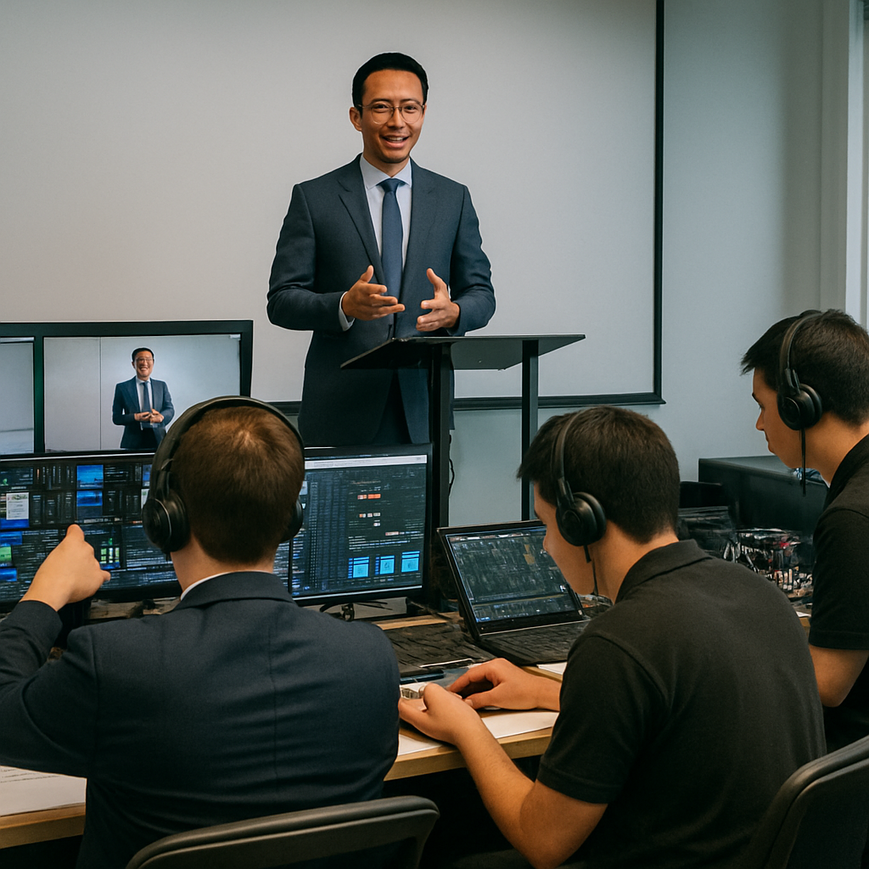
For many Singapore businesses, a B2B webcast is no longer a backup option for in-person events. It is a core communication channel for product launches, executive briefings, training sessions, investor updates, and client engagement. As more organisations serve regional and global audiences from Singapore, the quality of a webcast can influence how credible a company appears, how clearly its message lands, and whether busy decision-makers stay engaged from start to finish.
What often separates a polished webcast from a forgettable one is not only the camera, microphones, or platform. It is professional directing. Direction brings together the timing, pacing, visuals, speaker coordination, transitions, and technical cues that turn a series of individual elements into a coherent live or recorded experience. For B2B audiences, where attention is limited and the purpose is usually specific, professional directing is not a luxury. It is one of the main reasons the event feels organised, trustworthy, and worth the attendee’s time.
In Singapore, this matters even more because many B2B webcasts serve multicultural, multilingual, and cross-border audiences. A director helps ensure that the webcast is clear for local viewers in Singapore and effective for regional stakeholders joining remotely from different time zones. When the production is directed well, the message is easier to follow, the brand appears more competent, and the event is more likely to support business goals.
What professional directing actually does in a B2B webcast
Professional directing is the live control of the webcast’s editorial and production flow. The director is not simply watching the show happen. The director anticipates each segment, cues speakers, coordinates transitions, manages visual output, and responds to any change in real time. In a B2B setting, this role is especially important because many webcast formats are content-heavy, with multiple speakers, slides, demonstrations, Q and A sessions, and sponsor or partner elements.
A strong director ensures the webcast follows a deliberate structure. That structure helps the audience understand why each segment appears and how it connects to the business message. Without this oversight, even experienced speakers can talk over one another, pause too long, miss cues, or lose momentum. For a corporate audience that expects clarity and professionalism, those interruptions can weaken trust quickly.
Coordination of content, timing, and transitions
One of the director’s primary responsibilities is pacing. B2B audiences often join with a clear purpose, such as understanding a solution, hearing strategic updates, or learning from a specialist panel. If the webcast runs late, drifts off topic, or spends too long on a single slide, attention drops. The director keeps the programme moving while protecting the depth of content.
Transitions also matter more than many organisers realise. A webcast that switches abruptly from speaker to speaker, or from slides to video without a clean cue, can feel disorganised. Professional directing creates smooth handovers, clear visual sequencing, and a sense of continuity that reassures viewers that the event is being handled carefully.
Managing speakers and live communication
Directing also includes working with presenters before and during the webcast so they know what to expect. This is important because corporate speakers may be senior leaders, technical specialists, sales teams, or external partners who are not used to live broadcasting. The director gives cues for when to begin, when to wrap up, and when to shift to the next segment. This support reduces hesitation and makes speakers sound more confident.
In live settings, a director can also help protect the flow when something changes unexpectedly. A speaker may join late, a video file may need replacing, or an audience question may require a different order of answers. With a director coordinating behind the scenes, the event team can respond quickly without exposing internal confusion to the audience.
Why direction affects credibility, not just production quality
For B2B webcasts, the audience is often evaluating more than the content. They are also judging whether the organisation is reliable, detail-oriented, and capable of delivering on promises. That is why directing has a direct effect on credibility. A webcast that feels coordinated and calm sends a signal of competence. A webcast that feels rushed, poorly timed, or inconsistent may create doubts, even if the underlying message is strong.
This is especially relevant in Singapore, where business communication tends to value efficiency, clarity, and professionalism. Decision-makers do not usually attend a webcast to be entertained for its own sake. They want information that is accurate, useful, and presented without avoidable friction. Professional directing supports that expectation by reducing distractions and keeping the audience focused on the substance of the message.
Protecting attention in a high-distraction environment
Online audiences have many competing demands. They may be multitasking between meetings, checking messages, or joining from mobile devices while commuting. In such conditions, small production issues have a bigger impact than they would in a physical room. Long silences, awkward handoffs, unclear audio, or slides that appear out of sequence can make the audience disconnect quickly.
A director helps prevent these issues by maintaining rhythm. The webcast feels intentional rather than improvised. That sense of control helps viewers stay engaged long enough to absorb key points, ask questions, and remember the organisation positively after the event ends.
Supporting brand trust in regulated and technical sectors
In industries such as finance, healthcare, technology, logistics, and professional services, credibility is closely linked to precision. While a webcast is not a substitute for formal compliance processes, the way information is delivered still influences perception. A professionally directed webcast can make complex material easier to follow, which is important when the subject includes product features, data workflows, regulatory updates, or operational changes.
When teams in Singapore present to regional clients or internal stakeholders across Asia, polished direction also helps avoid misunderstandings caused by rushed delivery or unclear sequencing. This does not replace subject matter accuracy. Rather, it helps the audience receive accurate content in the clearest possible way.
The operational value of professional directing for Singapore organisations
Singapore companies often work across multiple markets, and that creates practical production challenges. Teams may have presenters based in different offices, audiences joining from various countries, and content that needs to work for local and regional stakeholders at the same time. Professional directing is what makes that complexity manageable.
The director acts as the central point of control, aligning technical crew, speakers, and event objectives. This is particularly useful for hybrid events, where some participants are in a physical venue and others are joining online. A webcast without strong direction can become fragmented because the in-room experience and the online experience are not aligned. Professional direction helps both audiences receive the same message with the same level of clarity.
Reducing risk during live execution
Live B2B webcasts carry operational risk. Audio feedback, unstable internet connections, missed cues, and unplanned speaker changes can all disrupt the programme. Direction does not remove every risk, but it helps organisations respond methodically rather than reactively. A director will often rehearse cue sequences, confirm who is responsible for each segment, and prepare fallback options if a problem occurs.
This preparation matters because live production issues become visible very quickly. What may seem like a small technical delay behind the scenes can create a sense of disorganisation on screen. By managing the flow tightly, the director reduces the chance that a solvable issue becomes a public distraction.
Creating consistency across multiple events
Many Singapore businesses run several webcasts a year for different audiences, such as clients, staff, channel partners, or investors. Professional directing helps build consistency across those events. When viewers recognise a company’s events as orderly, well-paced, and easy to follow, that reliability becomes part of the brand experience.
Consistency also makes future production easier. A team that develops clear directing routines, speaker briefings, and run-of-show processes can execute subsequent webcasts more efficiently. Over time, that can improve planning quality and reduce unnecessary friction for internal teams.
What effective directing looks like in practice
Good directing is visible through the audience experience, even if the audience never sees the director themselves. The webcast feels smooth, the speakers appear prepared, and the message comes across without unnecessary pauses or confusion. To achieve that, the director usually works closely with producers, technical operators, presenters, and sometimes client stakeholders well before the live date.
For a Singapore-based company hosting a webcast for regional partners, that preparation may include aligning speaker rehearsals with different time zones, checking slide compatibility, clarifying how Q and A will be moderated, and confirming where recordings will be published after the event. These are practical steps, but they are also essential to professional delivery.
Pre-production planning and rehearsal
Preparation is one of the strongest indicators of high-quality directing. A good director reviews the run-of-show, identifies where transitions are most likely to fail, and helps the team rehearse the critical moments. This is especially important when there are multiple speakers, live demonstrations, or interstitial videos.
Rehearsal also helps identify issues before the audience sees them. A speaker may need clearer cueing, a slide deck may need simplification, or a panel discussion may need tighter moderation. By addressing these details in advance, the director improves both the pacing and the confidence of the presenters.
During-show control and audience experience
Once the webcast is live, the director continuously monitors the programme. That means watching both the audience-facing feed and the backstage coordination. If a speaker overruns, the director may shorten a transition later. If a technical issue appears, the director can adapt the schedule while keeping the audience informed only when necessary and in a professional manner.
This live control is what helps the webcast feel deliberate rather than accidental. Viewers do not see the internal complexity. They simply experience a session that appears to flow naturally, which is exactly what effective directing is meant to achieve.
Choosing the right directing approach for B2B webcasts
Not every webcast needs the same level of complexity, but every B2B webcast benefits from some form of professional direction. A short executive update will need a different directing style from a multi-speaker conference panel or a product launch with live demonstrations. The right approach depends on the stakes, audience size, technical setup, and business objective.
For Singapore organisations, a practical way to assess the need is to ask whether the webcast will affect client confidence, employee alignment, investor communication, or brand perception. If the answer is yes, then professional directing is likely to add measurable value even if the audience does not explicitly mention it. The quality of direction often shows up indirectly through better engagement, fewer disruptions, and a stronger overall impression.
Questions to ask before production
- How many speakers are involved, and will they be in one location or several?
- Will the webcast include slides, videos, polls, or live demonstrations?
- Is the event purely online, or is it part of a hybrid production?
- Will the audience include local Singapore stakeholders, regional partners, or global viewers across time zones?
- What would happen if a speaker disconnects, overruns, or needs to be replaced?
These questions help organisers understand how much coordination is required. The more complex the event, the more important direction becomes.
Professional directing also pairs well with strong content planning. Clear messaging, concise slides, well-briefed speakers, and a realistic run-of-show all help the director do the job effectively. When those elements are aligned, the webcast is more likely to support business goals without unnecessary stress for the team.
For Singapore businesses that rely on webcasts to communicate with clients, colleagues, or stakeholders, professional directing should be treated as a core part of event strategy. It protects clarity, strengthens trust, and keeps the audience focused on the message rather than the mechanics of delivery. In a market where efficiency and professionalism are highly valued, that difference matters.
For organisations planning their next B2B webcast, the most practical takeaway is simple. Do not judge the production only by how attractive the visuals look. Consider whether the event has the directing support needed to guide the audience through every segment smoothly. When direction is strong, the webcast does more than stream content. It presents the organisation in the best possible light, with structure, confidence, and credibility.
General information only, not a substitute for legal, regulatory, or specialist advice. For content that involves compliance-sensitive, medical, financial, or other regulated matters, engage the appropriate qualified professionals before publication or broadcast.

Jeremy Lee is a seasoned digital marketing director and strategist with over two decades of experience in the industry. As the founder of Sotavento Medios, I manage a diverse portfolio of over 50 businesses, helping brands grow through advanced search strategies and digital innovation. My work focuses on bridging the gap between traditional search engine optimisation and the evolving world of AI-driven answer engines.
get in touch