
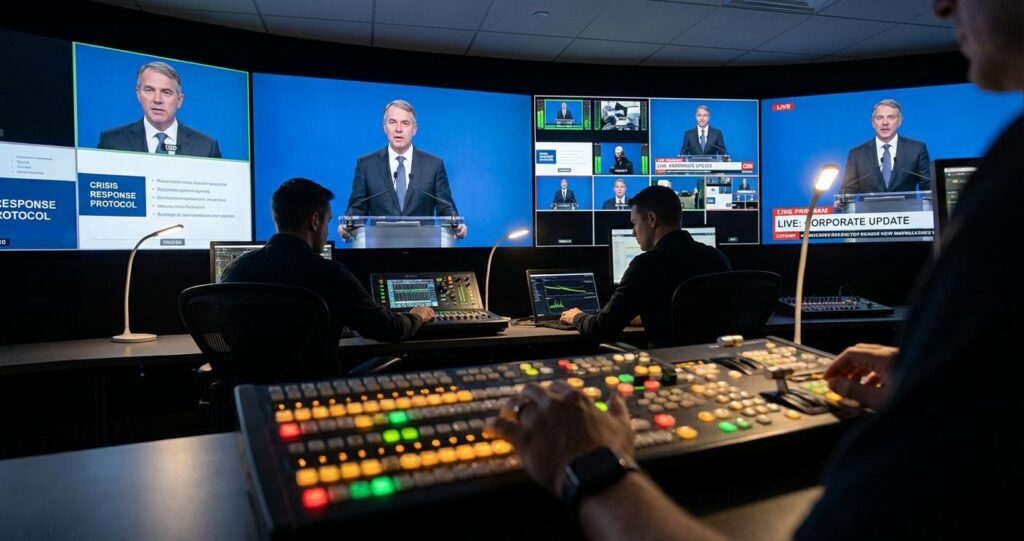
For a multinational corporation, the speed and clarity of communication during a crisis are paramount. The difference between containing a situation and escalating it often lies in the ability to disseminate accurate, authoritative information to a global network of stakeholders, employees, and the public instantly. Traditional press releases and text-based updates are no longer sufficient. Modern crisis management demands the immediacy and control of live video. However, executing a mission-critical broadcast under pressure requires more than a simple webcam and a consumer platform. It necessitates a broadcast-grade, resilient, and secure streaming infrastructure engineered for zero-failure scenarios. This is not a task for IT generalists; it is a complex challenge of broadcast engineering, network architecture, and production workflow design.
This technical guide, authored by the Spring Forest Studio Technical Team, provides enterprise decision-makers, IT directors, and AV professionals with an in-depth framework for establishing a robust live video ecosystem for crisis communications. We will move beyond high-level concepts to detail the specific protocols, hardware configurations, and operational workflows required to ensure your message is delivered with technical precision and unwavering reliability, regardless of external circumstances. We will explore the architectural decisions, from on-premise hardware to cloud-based signal routing, that form the backbone of a resilient corporate broadcasting solution.
Establishing a Resilient Streaming Infrastructure for Mission-Critical Broadcasts
The foundation of any crisis communications live stream is the physical and network infrastructure. Unlike a standard corporate webinar, a crisis broadcast has zero tolerance for downtime. The infrastructure must be designed with redundancy at every critical point, from power and internet connectivity to the core video processing hardware. This is the bedrock upon which the entire communication strategy rests.
Core Network Architecture and Redundancy
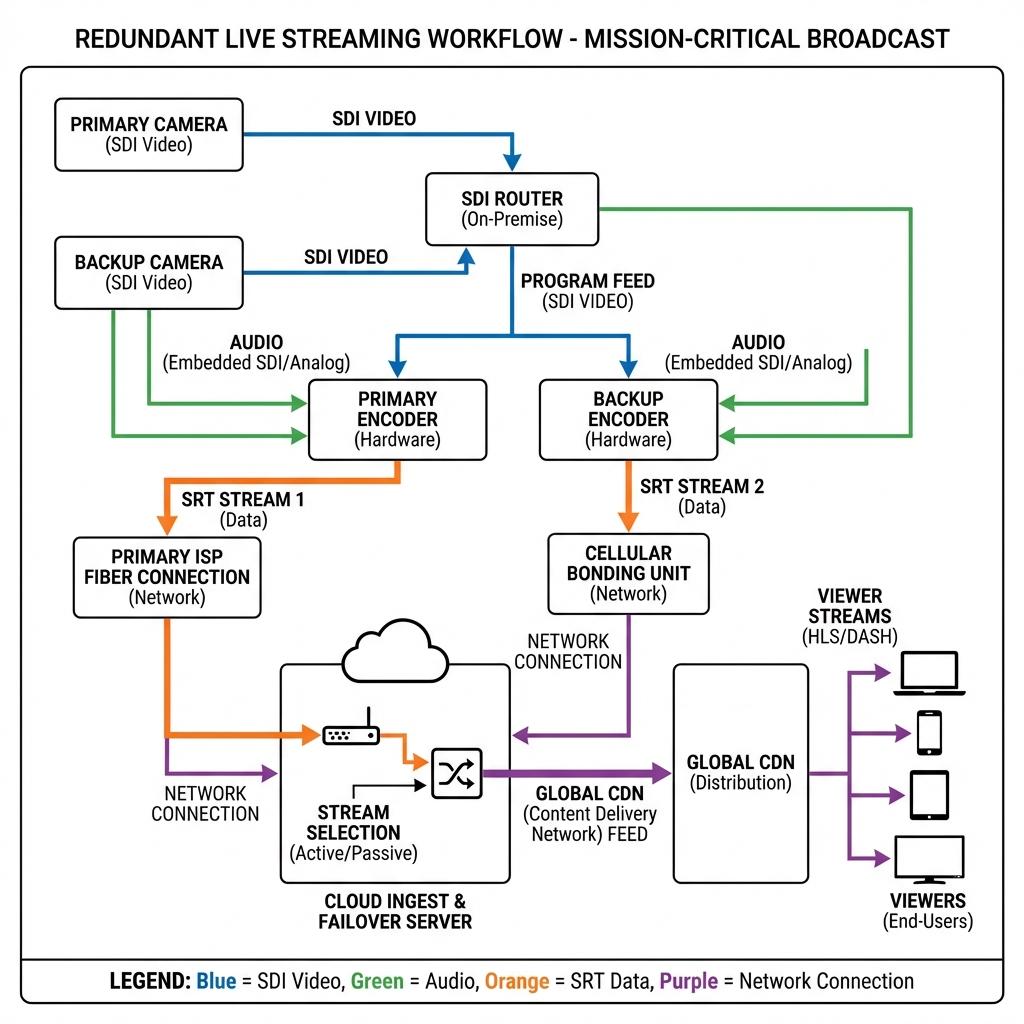
A single point of network failure is the most common vulnerability in enterprise streaming. For a mission-critical broadcast originating from a corporate headquarters, relying on a single Internet Service Provider (ISP) is untenable. A robust network architecture begins with dual, physically diverse internet connections from separate carriers. This ensures that a localized outage or fiber cut affecting one provider does not interrupt the outgoing stream. For ultimate resilience, cellular bonding technology should be integrated as a tertiary backup. Devices from manufacturers like LiveU or Teradek can aggregate bandwidth from multiple cellular carriers (e.g., AT&T, Verizon, T-Mobile) into a single, high-throughput connection. In a scenario where both terrestrial connections fail, this bonded cellular link can automatically take over, providing a seamless failover path capable of sustaining a high-bitrate 1080p stream, typically requiring a stable 8-10 Mbps upload speed.
Power Continuity and Hardware Failover
Hardware and power failures are just as critical as network outages. All core production equipment, including cameras, audio mixers, video switchers, and encoders, must be connected to an uninterruptible power supply (UPS) system. This UPS should be sized to handle the full load of the production gear for a minimum of 30-60 minutes, providing ample time to switch to a backup generator in case of an extended utility outage. For the encoding process, which converts the final video program into a streamable format, a primary and secondary encoder configuration is essential. This is typically an active/passive setup where two identical encoders receive the same Serial Digital Interface (SDI) program feed. If the primary encoder fails, a monitoring system can automatically trigger the secondary encoder to begin streaming to the same destination without manual intervention, minimizing signal interruption to just a few seconds.
On-Premise vs. Cloud-Based Encoding and Processing
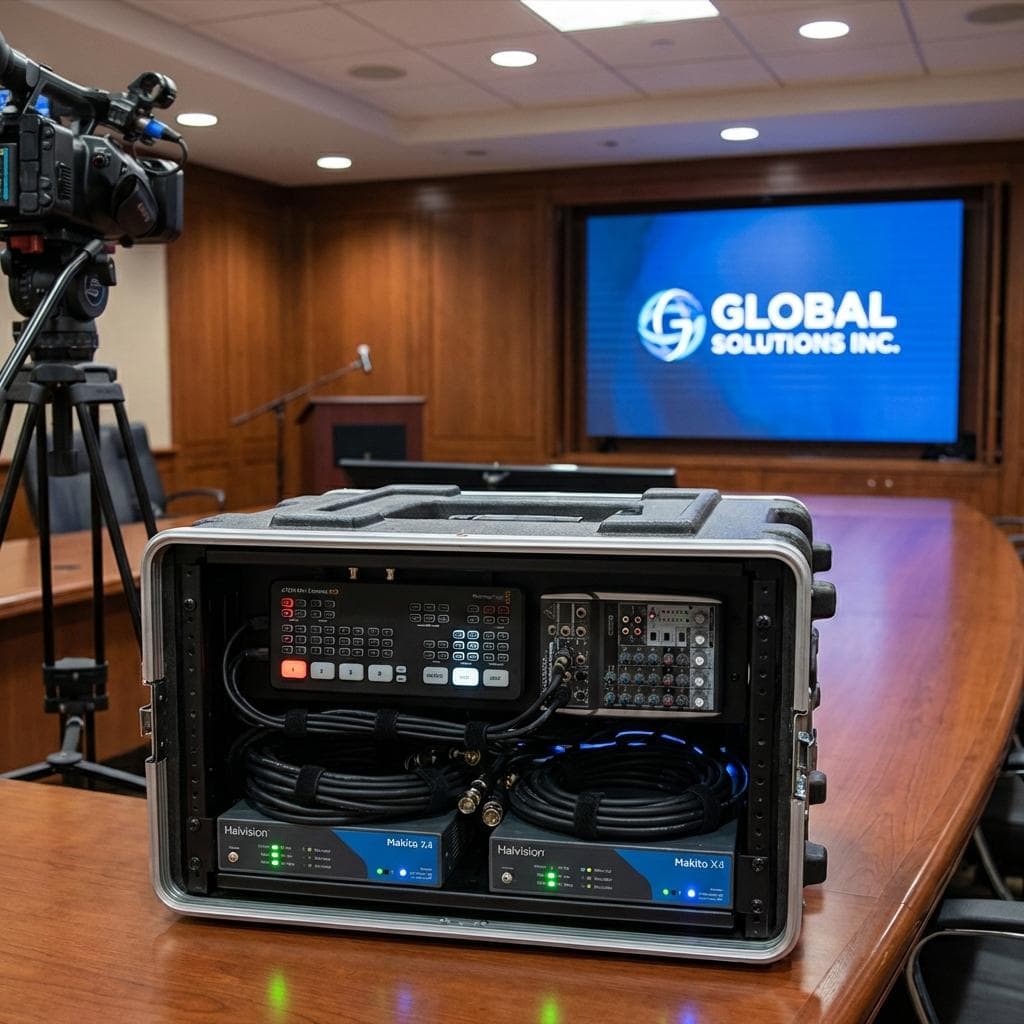
The decision to use on-premise hardware encoders versus cloud-based processing services involves a trade-off between control and flexibility. On-premise hardware encoders, such as those from Haivision or AJA, offer the lowest possible latency and maximum control over the signal chain. The program feed, typically a 3G-SDI or 12G-SDI signal, is encoded directly on-site and sent out. This is the preferred method for high-security environments. Cloud-based solutions, however, offer superior geographic flexibility and scalability. A high-quality contribution feed can be sent to a cloud media processor like AWS Elemental MediaLive. From there, the signal can be processed, transcoded into multiple bitrates for adaptive streaming, and distributed globally via a Content Delivery Network (CDN). For crisis communications, a hybrid approach is often optimal: use a robust on-premise encoder for the primary contribution feed and have a cloud-ingest point configured as a backup destination.
Secure Contribution and Distribution: Protocols and Workflow Design
Once the physical infrastructure is established, the focus shifts to the secure and reliable transport of video signals. The choice of streaming protocol directly impacts the latency, security, and reliability of the broadcast. In a crisis context, ensuring the signal is not just stable but also encrypted and protected from unauthorized access is a non-negotiable requirement. This involves a carefully designed workflow from the camera lens to the end-viewer’s screen.
Selecting the Right Contribution Protocol: SRT vs. RTMP
For professional contribution, the Secure Reliable Transport (SRT) protocol has become the industry standard, largely supplanting the older Real-Time Messaging Protocol (RTMP). While RTMP is still widely used for final delivery to social platforms, it lacks the sophisticated error correction and low-latency performance of SRT. SRT excels at transmitting high-quality video over unpredictable networks, such as the public internet. It uses advanced packet retransmission mechanisms to recover lost data, preventing the macroblocking and freezes common with RTMP over congested networks. Furthermore, SRT offers robust AES-128/256 bit encryption, ensuring the video feed from the corporate studio to the cloud or distribution point is secure. For a crisis broadcast, a point-to-point SRT stream from the on-premise encoder to the primary ingest server provides latency as low as 200-500ms while maintaining signal integrity.
Distribution Architecture and CDN Integration
After the secure contribution feed reaches the central ingest point, it must be prepared for mass distribution. This is the role of the CDN, such as Akamai, Cloudflare, or AWS CloudFront. The CDN takes the single high-bitrate stream and replicates it across a global network of edge servers. When a viewer accesses the stream, they connect to the geographically closest server, which dramatically reduces buffering and improves start-up times. The system should be configured for adaptive bitrate (ABR) streaming. This means the encoder or cloud transcoder creates multiple versions of the stream at different resolutions and bitrates (e.g., 1080p at 8 Mbps, 720p at 4 Mbps, 480p at 1.5 Mbps). The video player on the viewer’s device can then intelligently switch between these versions depending on their available bandwidth, ensuring a continuous viewing experience even on a weak connection.
Implementing Access Control and Geo-Fencing
Not all crisis communications are intended for the public. For internal announcements or sensitive investor briefings, robust access control is critical. This is implemented at the video player and CDN level. Token-based authentication is a common method, where a unique, time-limited token is required to load the video player. This prevents unauthorized embedding of the stream on other websites. For geographically sensitive information, CDN-level geo-fencing can be used to restrict access to the stream to specific countries or IP address ranges, ensuring that only the intended regional audience can view the broadcast.
The Crisis Communications Control Room: Production and Operational Readiness
Technology alone is not enough. The human element and the production workflow are what turn a collection of hardware into an effective communication tool. The crisis communications control room, whether a permanent installation or a rapidly deployed fly-pack, must be designed for clarity, speed, and precision under pressure. This is where the technical and editorial components of the message converge.
Signal Flow and Production Switching
The core of the control room is the production switcher. In a professional setup, all video sources (cameras, presentation laptops, remote feeds) are routed via an SDI router to the switcher. A typical setup for a CEO address would involve at least three cameras: a primary wide shot, a tight close-up, and a profile shot. These are typically connected via 3G-SDI or 6G-SDI for HD or UHD workflows. The switcher, operated by a technical director, cuts between these sources to create a dynamic yet professional program. The program output feed (PGM) is then sent to the encoders, while a separate multiview output allows the production team to monitor all sources simultaneously. ISO (isolated) recording of each camera feed directly from the switcher or router is a critical best practice, allowing for post-event edits or re-broadcasts.
Audio Integrity and Mix-Minus for Remote Participants
Audio is arguably more critical than video in a crisis broadcast. Poor audio quality can render the entire message unintelligible. The setup requires high-quality lavalier or boom microphones for the primary speaker, feeding into a professional audio mixing console. The audio engineer must carefully manage levels, ensuring clear, consistent dialogue. If remote speakers are involved (e.g., a legal expert joining via video call), a mix-minus feed must be generated. This is a custom audio mix sent back to the remote participant that contains the main program audio minus their own voice, which prevents distracting echo and feedback. This is a fundamental technique in broadcast that is often overlooked in basic enterprise streaming setups.
Real-Time Graphics and Teleprompter Integration
Professional delivery requires supporting visual aids. A dedicated graphics system (e.g., NewTek TriCaster, Ross Video Xpression) is used to overlay lower-third titles, corporate logos, and important data points onto the video feed in real-time. This ensures information is presented clearly and reinforces branding. For the speaker, a teleprompter system is essential for delivering a prepared statement accurately and confidently. The teleprompter feed is fed from a dedicated computer and is invisible to the cameras, but allows the speaker to maintain eye contact with the audience while reading their script.
Hybrid Integration and Scalability for a Global Workforce
In many crisis scenarios, the audience is hybrid. There may be a physical press corps in a briefing room while tens of thousands of employees and stakeholders watch remotely. The streaming architecture must seamlessly serve both audiences with high quality and offer interactive capabilities to manage the flow of information.
Bridging Broadcast and Enterprise Platforms
A common requirement is to integrate the high-quality broadcast feed into enterprise collaboration platforms like Microsoft Teams, Zoom, or Webex. This allows employees to watch the critical announcement within a familiar environment. This is achieved by taking the SDI or Network Device Interface (NDI) output from the production switcher and feeding it into a capture device that acts as a virtual webcam. Specialized hardware and software can then pipe this high-production-value feed into the meeting or webinar, replacing a low-quality built-in camera. This maintains a consistent, professional look across all platforms.
Managing Moderated Q&A and Interactivity
Managing questions during a crisis broadcast requires a structured workflow. Specialized live event platforms provide moderated Q&A tools where remote viewers can submit questions. A communications team member can vet and prioritize these questions in a private dashboard before pushing them to the speaker or a moderator in the studio. This prevents disruptive or inappropriate questions from appearing publicly and allows the communications team to control the narrative while still providing a channel for audience engagement.
Ensuring Global Scalability and Low Latency
When an event needs to reach a global workforce simultaneously, the CDN’s role becomes even more critical. A well-architected CDN strategy ensures that an employee in Singapore has the same high-quality, low-latency viewing experience as an employee in New York. Modern delivery protocols like WebRTC or Low-Latency HLS can further reduce the delay between the studio and the viewer down to 1-3 seconds, which is crucial for events that may involve real-time market or security implications. This requires careful configuration of the encoder, the media server, and the CDN to optimize the entire delivery chain for speed.
Ultimately, establishing a robust live video capability for crisis communications is an investment in organizational resilience. It requires a strategic blend of broadcast engineering, IT network architecture, and clear operational planning. By building an infrastructure based on redundancy, security, and professional production workflows, a multinational corporation can ensure that when a crisis hits, its most important asset, its voice, is heard clearly, reliably, and authoritatively across the globe.

Jeremy Lee is a seasoned digital marketing director and strategist with over two decades of experience in the industry. As the founder of Sotavento Medios, I manage a diverse portfolio of over 50 businesses, helping brands grow through advanced search strategies and digital innovation. My work focuses on bridging the gap between traditional search engine optimisation and the evolving world of AI-driven answer engines.
get in touch