
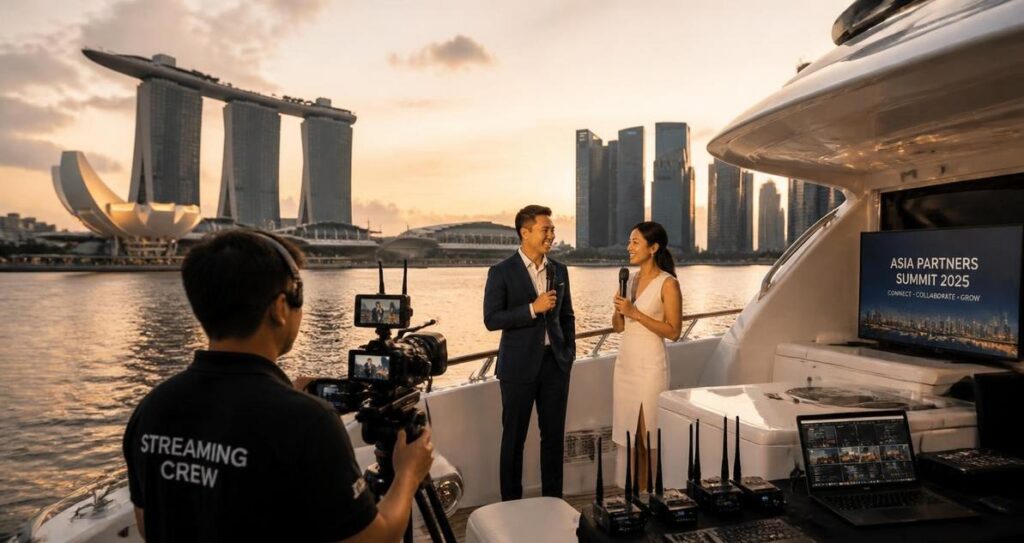
Streaming from a luxury yacht in Singapore sounds effortless when viewers see a polished live tour, a product launch at sea, or an executive event framed against the city skyline. In practice, the technical side is far more demanding. Marine movement, variable connectivity, metal hull interference, power management, weather exposure, and compliance considerations all shape whether a stream looks professional or repeatedly drops out. For businesses, brands, and event teams in Singapore, especially those planning premium hospitality or corporate activations on the water, understanding these challenges is essential before promising a reliable live broadcast.
Singapore is a particularly interesting environment for yacht streaming because the operating area is compact, heavily used, and influenced by maritime traffic, port activity, coastal infrastructure, and tropical weather. A yacht may be only a short distance from Marina Bay, Sentosa, or the Southern Islands, yet the technical conditions can change quickly. That means the same production approach used on land cannot simply be transferred to a yacht. A successful maritime stream requires careful planning, robust redundancy, and a realistic understanding of what can and cannot be controlled at sea.
Why yacht streaming is technically more complex than land-based production
A yacht is a moving platform, and that single fact affects every part of the workflow. Camera stability, audio clarity, internet reliability, electrical safety, and crew coordination all become harder than in a ballroom or studio. The vessel itself introduces vibration, sway, reflective surfaces, narrow spaces, and changing ambient noise, all of which can compromise image and sound quality. Even a beautifully designed luxury yacht does not function like a fixed production venue.
On land, event teams can usually rely on stable power, wired internet, predictable framing, and easy access to backup equipment. On a yacht, the production team often has to work with limited rigging points, compact cabins, salt exposure, and a deck layout that changes the sound and lighting conditions as the vessel turns. This means the technical director has to think not only about content, but also about marine safety, equipment placement, and operational resilience.
Motion, vibration, and image stability
One of the most visible problems in yacht streaming is motion. A handheld camera may appear to drift or wobble even on calm water, while sudden changes in speed or direction can produce noticeable shake. Mechanical movement is amplified by telephoto lenses, lightweight tripods, and unsecured accessories. For premium corporate broadcasts, this can make the stream feel amateur even when the content is strong.
Professional crews often respond by using stabilised cameras, gimbals, dampened tripod systems, and careful lens selection. A wider focal length is usually more forgiving than a long zoom when the vessel moves. Operators also need to anticipate the yacht’s pitch and roll, because a shot that looks level when framed may shift within seconds. For live event production, this is not a cosmetic issue, it directly affects viewer comfort and perceived quality.
Salt air, humidity, and equipment protection
Singapore’s maritime climate exposes gear to high humidity, salt spray, and condensation. These conditions can corrode connectors, fog lenses, damage exposed circuits, and shorten the life of delicate equipment if it is not protected properly. Even when the yacht remains near sheltered waters, the combination of warm air and air-conditioned interiors can create condensation when equipment is moved between spaces.
Best practice includes using weather-resistant cases, silica gel in storage containers, sealed cable terminations where appropriate, and regular inspection of connectors, microphones, and batteries. Equipment should be acclimatised before deployment when there is a major temperature difference between storage and deck areas. Cleaning and drying procedures matter too, because salt residue can remain after visible moisture has disappeared. In a marine environment, preventive maintenance is not optional, it is part of operational risk control.
Connectivity challenges in Singapore waters
Internet access is usually the most sensitive point in a yacht stream. Viewers expect consistent picture quality with minimal latency, but mobile data performance at sea can fluctuate because the vessel is moving between coverage zones, distances from shore vary, and signal quality is affected by antenna placement, line of sight, and network congestion. Singapore has strong telecommunications infrastructure, yet that does not eliminate marine connectivity issues. A yacht offshore or in busy channels may still experience unstable throughput, especially when multiple devices are competing for bandwidth.
Streaming failure is often caused not by complete signal loss, but by unstable upload speed. Live video platforms need a sustained uplink, and when that speed drops, the encoder has to lower video quality, increase compression, or disconnect entirely. For a luxury event, this can mean blur, buffering, or audio-video desynchronisation at the worst possible moment.
Why single-network reliance is risky
Relying on one SIM card or one hotspot is rarely adequate for yacht production. A better approach is bonded connectivity, where multiple links are combined to create a more resilient internet path. This may involve several mobile networks, router aggregation, and intelligent failover. If one link degrades, the system can shift traffic to another path with less disruption. However, bonded setups still require testing, because performance depends on the real-world conditions in the cruising area.
In Singapore, route planning should be aligned with the vessel’s intended path, whether near the Southern Islands, around Sentosa, or across more open water. The production team should test coverage before the event, ideally at the same time of day that the stream will take place. Network performance can vary with location and crowd density, especially during weekends, public holidays, or major waterfront events. A secure backup such as recorded content capture is also useful if the live uplink becomes unstable.
Latency, platform behaviour, and viewer experience
Latency is the delay between the action on deck and the moment viewers see it. Some delay is normal in live streaming, but excessive latency can make interactive features, such as live Q&A, audience shout-outs, or remote moderation, difficult to manage. On a yacht, the encoder may need to prioritise stability over low delay when network conditions are variable. That trade-off should be decided before the event, not during it.
Different platforms also process incoming streams differently. A production team must understand how the chosen platform handles adaptive bitrate streaming, reconnect logic, and resolution changes. If the stream is intended for a corporate audience in Singapore, the priority is usually reliability and presentation quality, rather than pushing the highest possible resolution at all costs. A stable 1080p stream can be more effective than an unstable higher-resolution feed that keeps dropping.
Audio, lighting, and spatial constraints on board
On a yacht, sound is often harder to control than video. Wind noise, engine hum, water movement, nearby vessels, and social conversation can all interfere with speech. Luxury yachts also have hard surfaces such as glass, polished wood, and metal, which can create reflections and echo. These acoustics are very different from a treated indoor studio, and the differences become obvious in a live broadcast.
Lighting presents another challenge. Deck lighting may be designed for ambiance, not for camera exposure. Sunset can look beautiful to guests, but it can also create severe contrast between bright skies and shaded interiors. As daylight changes, camera settings may need constant adjustment. If the stream includes presentations or branded content, the production crew must balance natural aesthetics with exposure control.
Managing audio for speech and ambient atmosphere
For speech-heavy streams, wireless lavalier microphones or discreet headset mics often outperform onboard camera microphones. Lavalier microphones are small clip-on microphones that sit near the speaker’s chest or collar, helping capture clearer voice pickup. However, wireless systems must be chosen carefully because radio performance can be affected by body placement, metal structures, and movement on deck. Wind protection, often through foam covers or furry windscreens, is essential outdoors.
Audio mixing on a yacht should also distinguish between two goals, intelligibility and atmosphere. If the event is a corporate briefing, voice clarity comes first. If the event is a luxury brand showcase, ambient sound may be part of the experience, but it should never overpower speech. Teams should monitor live audio with headphones and use a dedicated audio operator whenever possible. In a marine setting, one person trying to monitor camera, audio, and internet at the same time is a recipe for avoidable mistakes.
Exposure control and colour consistency
Lighting shifts quickly around water because the surface reflects sunlight and adds glare to the frame. This can create exposure swings when the camera pans from shaded seating to open sea or from indoor lounges to exterior decks. White balance can also drift if the scene mixes warm cabin lighting with daylight. Professional crews typically use manual camera settings, not automatic exposure, to avoid visible changes during the stream.
When a yacht has multiple zones, such as an interior salon and an outdoor deck, each area may need its own camera profile. Matching colour across those spaces is important for a polished look. If the event includes sponsor branding or product demonstration, inaccurate colour can affect presentation and perceived quality. Careful pre-lighting and test shots help reduce these issues before guests arrive.
Power, safety, and operational planning at sea
Reliable power is essential for encoders, routers, cameras, monitors, microphones, lights, and charging equipment. On a yacht, however, power distribution must be handled with more caution than on land. Marine electrical systems have their own load limits and safety considerations, and equipment must be configured so it does not overload circuits or create unnecessary hazards. A stream can fail because of something as simple as a tripped breaker or a depleted battery bank.
Operational safety matters as much as production quality. Cables should be secured to avoid trips, wet surfaces must be kept clear, and equipment should not obstruct movement around stairs, railings, or emergency access points. A luxury setting does not reduce the importance of safety. In fact, because the environment is compact and often crowded, poor cable management can become a serious operational issue very quickly.
Redundancy is not a luxury, it is a requirement
A robust yacht streaming setup should include backup power options, spare batteries, redundant recording, and a secondary streaming path if possible. Recording locally on camera or to an external recorder provides a safety net if the live feed is interrupted. If the stream is high-value, such as a product reveal or executive address, the production plan should also include a fallback communication protocol, clear team roles, and a decision tree for pausing or resuming the broadcast.
In Singapore, where many premium events are tightly scheduled, a delayed start can affect guest flow, marina permissions, and downstream content delivery. That makes pre-production discipline especially important. Equipment checklists, route confirmation, dry runs, and communication on board all reduce the likelihood of last-minute failure. The best live streams at sea are usually the result of quiet preparation long before the broadcast begins.
Practical steps for Singapore event teams and yacht owners
For organisers planning a yacht stream in Singapore, the most effective strategy is to design the event around the vessel’s technical limits rather than trying to force a land-based broadcast model onto a marine platform. That means conducting a site survey, testing internet performance on the intended route, checking power capacity, and deciding which parts of the event truly need live transmission. Not every moment has to be streamed. Sometimes a hybrid model works better, with selected live segments supported by high-quality recorded content.
Coordination with the yacht operator is also essential. The crew understands the vessel’s movement, safe areas, and onboard systems, while the production team understands camera, audio, and streaming workflow. When both sides plan together, the event is more likely to run smoothly. This collaboration is especially important in Singapore, where weather changes can be fast and marina schedules may be tight.
For brands and corporate teams, it is also wise to set realistic expectations. A yacht stream can be elegant, exclusive, and visually impressive, but it should be assessed by marine-production standards, not studio standards. The goal is consistency, clarity, and a credible viewer experience. If the production is well planned, the audience sees a seamless broadcast. If it is not, the environment will expose weak points immediately.
Anyone considering live streaming from a yacht should view the project as a technical production with maritime constraints, not just a content exercise. In Singapore, where premium events often carry strong brand visibility, that distinction matters. A careful combination of route planning, redundancy, weather awareness, audio management, and marine-safe operation gives the stream the best chance of success. When the technical foundation is strong, the yacht setting can support a polished and memorable live experience without compromising reliability or safety.
For events with significant commercial, reputational, or safety implications, work with professionals who understand both broadcast requirements and marine operations. That is the most dependable way to turn a luxury yacht into a functional live-streaming venue in Singapore’s coastal environment.
Jeremy Lee is a seasoned digital marketing director and strategist with over two decades of experience in the industry. As the founder of Sotavento Medios, I manage a diverse portfolio of over 50 businesses, helping brands grow through advanced search strategies and digital innovation. My work focuses on bridging the gap between traditional search engine optimisation and the evolving world of AI-driven answer engines.
get in touch