
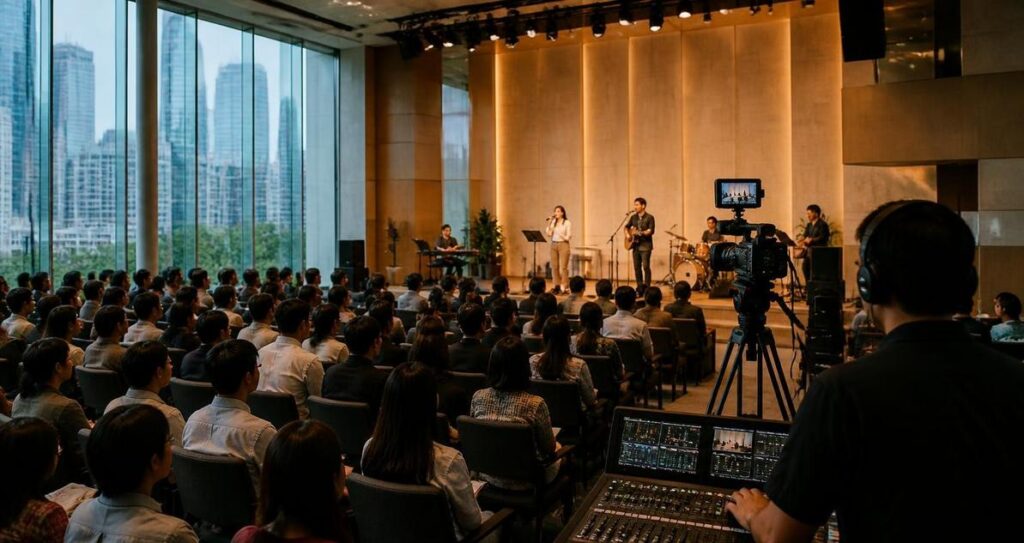
For many churches in Singapore’s Central Business District, outreach no longer happens only through Sunday services or weekday gatherings. Professional streaming has become an important way to stay connected with congregations, welcome newcomers, and reach people who may not be able to attend in person because of work, family commitments, mobility limitations, or travel. In a dense urban environment like the CBD, where time is limited and schedules are demanding, live and on-demand church content can extend ministry beyond the sanctuary and into homes, offices, and mobile devices.
Professional streaming is more than turning on a camera and pressing record. For churches, it involves clear audio, stable internet, thoughtful camera placement, reliable switching, good lighting, captioning where possible, and a content plan that respects both worship and the audience’s viewing experience. When done well, streaming can help a church serve weekday commuters, expatriates, shift workers, young adults, and older members who may find regular physical attendance difficult. It also supports continuity during public holidays, weather disruptions, and periods when members are overseas or unwell.
In Singapore, where digital adoption is high and mobile viewing is common, churches that invest in quality streaming often find that online worship becomes part of a broader outreach strategy. The aim is not to replace physical fellowship, but to widen access in a practical and consistent way. For a CBD church, this approach can be especially meaningful because its immediate community includes office workers, business travellers, and people whose routines are often fragmented.
Why CBD churches in Singapore increasingly rely on professional streaming
Singapore’s CBD is one of the most time-pressured parts of the city. Many people work long hours, commute across multiple transit lines, and juggle family or caregiving responsibilities. This makes it harder for some individuals to attend events outside work hours, even if they are interested in church life. Streaming bridges that gap by allowing people to join worship services, prayers, teaching sessions, and special events without needing to be physically present every time.
For churches located near Raffles Place, Marina Bay, Tanjong Pagar, Shenton Way, and surrounding areas, the audience is often more geographically diverse than the local neighborhood alone suggests. A single service may be viewed by members in different parts of Singapore, by overseas attendees, and by people exploring faith privately before visiting in person. Professional streaming helps maintain a sense of consistency and dignity, which matters when a church wants its online presence to reflect care and credibility.
Streaming also fits the expectations of a digitally fluent audience. Many Singaporeans are comfortable consuming information through video and are accustomed to smooth playback, clean audio, and mobile-friendly formats. If a church’s livestream has frequent dropouts, distorted sound, or poor framing, viewers may disengage quickly. By contrast, a well-produced broadcast communicates that the church values the viewer’s time and attention.
Outreach is not only about attendance
Church outreach in a CBD setting is often relational rather than purely numerical. Some viewers will never click “join” immediately, but they may watch several services quietly before making contact. Others may engage with short sermon excerpts, worship clips, or testimony videos on different platforms. Professional streaming supports this gradual journey by creating reusable content that can be shared and revisited. That is especially useful in Singapore, where people often evaluate information carefully before committing to a new community.
Streaming also allows churches to serve those who are temporarily unable to attend because of recovery from illness, childcare obligations, overseas deployment, or caregiving responsibilities. In such cases, the broadcast is not a substitute for personal pastoral care, but it can be an important connection point. This is why a thoughtful streaming strategy should be integrated with follow-up, pastoral messaging, and clear ways for viewers to ask questions or request prayer.
What professional streaming looks like in a church environment
A professional church livestream is built around the full worship experience, not just the camera feed. The goal is to make the online viewer feel included without distracting the congregation or compromising the integrity of the service. That requires technical planning, coordination with speakers and musicians, and a production workflow that can adapt to different service formats.
At a basic level, churches usually need multiple cameras or camera angles, a reliable video switcher, quality microphones, a stable network connection, and monitoring equipment. The technical team must balance what happens in the room with what appears on screen. For example, a close-up shot of a preacher may work well during a sermon, but a wider shot is better during congregational singing or responsive reading. Professional audio is equally important because viewers can tolerate modest video quality more easily than poor sound.
Audio quality matters more than many people expect
Speech intelligibility is central to worship streaming. In plain terms, that means viewers must be able to understand spoken words clearly. Echo, background noise, or low volume can make a sermon difficult to follow, especially for older viewers or people watching on phone speakers. Churches often benefit from using dedicated microphones for preachers, worship leaders, and panel discussions, rather than relying on ambient room sound alone.
In Singapore’s CBD venues, acoustics can be challenging because many spaces are multipurpose, compact, or designed with hard surfaces that reflect sound. Professional audio mixing helps reduce those problems. It also supports a more polished and less fatiguing listening experience, which matters for longer services and special events.
Lighting and framing influence viewer engagement
Good lighting does not mean making the service look theatrical. It means ensuring faces are visible, text on screens is readable, and the overall image is balanced. Churches that stream regularly often use lighting to reduce shadows and maintain consistency when natural light changes throughout the day. Framing is equally important. If the camera angle is too high, too low, or too wide, viewers may struggle to feel connected to the speaker.
Simple production choices can improve engagement significantly. For instance, switching to a different camera during prayer, worship, and announcements keeps the stream visually coherent. Capturing lyrics, scripture passages, or sermon slides can also help online viewers stay oriented, especially if they join midway through the service.
Captioning and accessibility should be part of the plan
Accessibility is an important part of trustworthy digital ministry. Captions, when available, can help viewers with hearing difficulties and can also support people watching in noisy environments, such as during a commute. In Singapore, where many people consume content on mobile devices in public spaces, captions can make a meaningful difference. If live captioning is not feasible, churches can consider post-production captions for recorded sermons or highlights.
Accessibility also includes clear service information, simple navigation, and easy-to-find contact details. A viewer should not have to search extensively to find service times, location details, or ways to get in touch. The more straightforward the experience, the more likely a first-time viewer will return.
How streaming supports church outreach across different audience groups in Singapore
One of the strongest advantages of professional streaming is flexibility. Different groups within Singapore’s CBD and surrounding districts respond to content in different ways, and streaming allows churches to reach them without changing the heart of the message. A single broadcast can serve current members, seekers, visitors, and those returning to faith after a long absence.
For working adults, streaming offers a realistic entry point. A person may not be able to attend every week in person, but they may be willing to watch a service after work, during lunch, or on a weekend morning at home. For families with young children, streaming can help parents stay connected when illness, travel, or caregiving makes attendance difficult. For older adults, a dependable online service can reduce the strain of commuting while preserving spiritual routine.
Seeker-friendly content builds trust
People who are exploring faith often prefer to observe before participating. A professionally streamed service can make that process less intimidating. Clear audio, respectful pacing, and well-structured segments help viewers understand what is happening. Churches can also use short explanatory segments, such as brief introductions to communion, baptisms, or liturgical practices, if relevant to the congregation’s tradition.
Trust grows when online content feels honest and well organized. That includes avoiding exaggerated claims, keeping announcements concise, and using language that is understandable to people who may not be familiar with church terminology. In Singapore’s multicultural context, clarity is especially important because audiences often include people from different backgrounds and levels of familiarity with Christian practice.
Hybrid participation can widen the circle of care
Hybrid ministry means combining in-person and online participation in a way that supports both. A church can hold the main service onsite while making selected elements available online for remote viewers. It can also use livestreams for special prayer meetings, leadership talks, holiday services, and community events. This approach allows churches to maintain face-to-face fellowship while extending pastoral presence to those who are not physically present.
In practical terms, hybrid participation can support outreach by lowering the threshold for engagement. A newcomer may first watch online, then attend a special event, and later visit a Sunday service. Churches that respond promptly to online enquiries and provide a clear pathway for next steps are more likely to turn passive viewing into meaningful connection.
Operational considerations for churches in the CBD
Running a reliable stream in a busy urban setting requires planning. Churches in the CBD often operate in rented venues, shared facilities, or spaces with time restrictions. That means setup and teardown need to be efficient, and the technical workflow must suit the venue rather than disrupt it. Professional production teams help churches manage these constraints while maintaining quality.
Network stability is a key concern. A livestream depends on upload speed, redundancy, and proper testing before the service begins. If the connection fails, even excellent camera work will not save the broadcast. Many churches therefore plan backup options, such as recording locally while streaming live, so that content is not lost if the internet becomes unstable. Power management, cable safety, and equipment security also matter, especially in multi-use or high-traffic spaces.
Another practical issue is volunteer capacity. Some churches rely on volunteers who serve faithfully but may not have advanced production training. Professional support can complement volunteer teams by providing training, system design, and troubleshooting frameworks. This helps reduce stress and improves consistency from week to week.
Content planning should match ministry goals
Not every church stream needs to be identical. A Sunday service may require full multi-camera coverage, while a midweek prayer meeting may only need a simpler setup. Churches can also segment content for different purposes. For example, a full service can be archived for later viewing, while shorter clips can be shared on social platforms to invite new viewers. This makes the overall outreach strategy more efficient and easier to measure through engagement rather than attendance alone.
Churches should also define how livestream comments, prayer requests, or direct messages will be handled. Without a clear workflow, online engagement can become inconsistent or delayed. A designated team can help moderate, respond appropriately, and route pastoral concerns to the right ministry leaders.
What churches should look for in a streaming partner
For a church in Singapore’s CBD, selecting the right production partner is not just a technical decision. It affects how well the church communicates, welcomes newcomers, and protects the integrity of its worship environment. A good partner should understand live event production, worship settings, and the practical realities of Singapore venues. They should also be able to adapt to both small services and larger seasonal events.
Churches should ask whether the provider can handle audio, video, lighting coordination, encoding, platform setup, and event-day troubleshooting. It is also important to confirm whether the team can work discreetly in a worship setting and collaborate respectfully with clergy, musicians, and volunteers. The best results usually come from a partnership that balances technical expertise with sensitivity to the church’s culture and theology.
It helps to choose a provider that can support both live and recorded content, because outreach rarely ends when the service finishes. Sermon archives, highlight clips, and event recaps can continue to serve the church throughout the week. In a fast-moving city like Singapore, where people consume media on their own schedules, on-demand access is often just as important as the live broadcast itself.
Churches should also think about data protection and platform governance. If the stream collects contact details or prayer requests, these should be handled responsibly and in line with Singapore’s personal data protection expectations. Clear consent, appropriate storage practices, and limited access to sensitive information are part of trustworthy digital ministry.
For churches in the CBD, professional streaming is no longer a niche option. It is a practical ministry tool that can help them remain visible, accessible, and relevant to the people they want to serve. When implemented well, it supports worship, extends pastoral care, and creates more entry points for people who might otherwise never step into a church building. The most effective approach is thoughtful rather than flashy: stable audio, clear visuals, respectful pacing, accessible content, and a plan for follow-up. Churches that treat streaming as part of their outreach, not just a technical add-on, are better positioned to connect with Singapore’s digitally engaged and time-conscious audience.
If a church is considering professional streaming, the best starting point is to identify its ministry goals, its audience, and the practical constraints of its venue. From there, it can build a production approach that is reliable, welcoming, and appropriate for Singapore’s CBD context. For viewers, that can mean a more meaningful online experience. For churches, it can mean outreach that reaches beyond the walls of the building and into everyday life.

Jeremy Lee is a seasoned digital marketing director and strategist with over two decades of experience in the industry. As the founder of Sotavento Medios, I manage a diverse portfolio of over 50 businesses, helping brands grow through advanced search strategies and digital innovation. My work focuses on bridging the gap between traditional search engine optimisation and the evolving world of AI-driven answer engines.
get in touch