
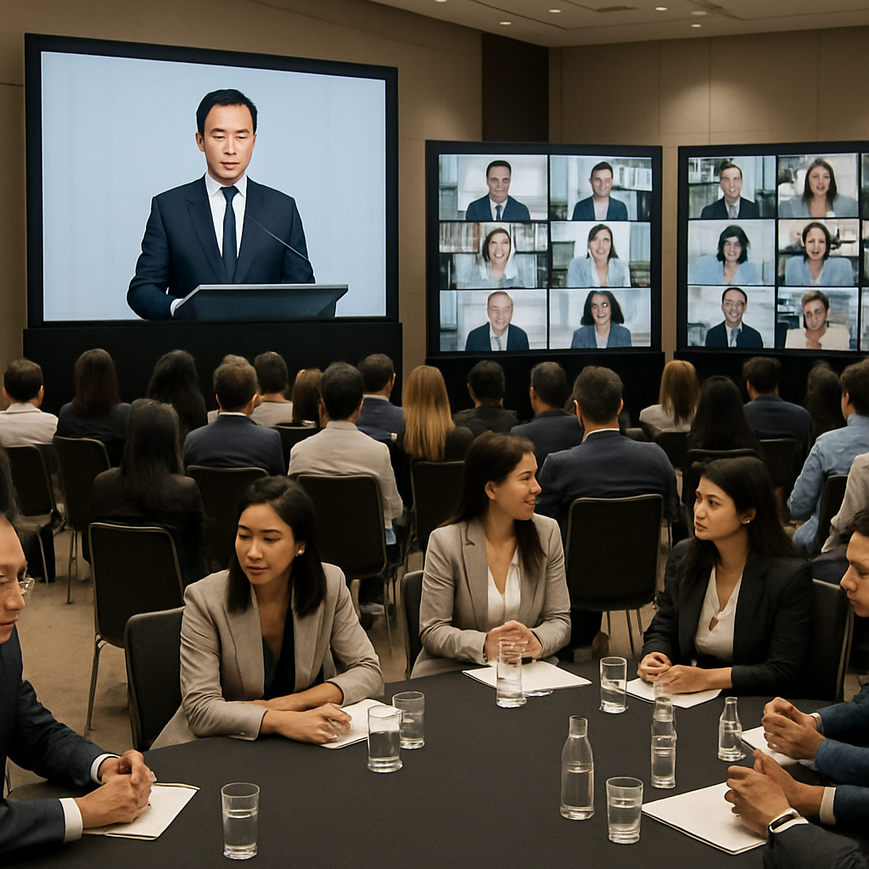
For Singapore businesses running virtual conferences, client briefings, product launches, training programmes, and investor meetings, breakout rooms are no longer a nice extra. They are a practical feature that can turn a one-way stream into a structured business conversation. In a market like Singapore, where many B2B events serve regional teams across different time zones and where audiences expect polished, efficient communication, breakout rooms help organisers create smaller spaces for discussion, networking, sales conversations, and technical deep dives without losing the reach of a larger broadcast.
The challenge is not simply adding breakout rooms to a streaming platform. The real strategic question is how to use them well. Poorly planned breakout sessions can create confusion, uneven engagement, weak moderation, and data gaps for the marketing or sales team. Well-designed breakout rooms, on the other hand, can support lead qualification, internal alignment, product education, and better attendee satisfaction. For Singapore-based organisations that often work with regional clients, multinational teams, and compliance-sensitive industries such as finance, healthcare, and professional services, the design of breakout rooms should be intentional, secure, and operationally disciplined.
This article explains how breakout rooms work in B2B streaming environments, why they matter, and how to use them strategically in Singapore’s business context. It also covers moderation, technology selection, data protection, accessibility, and practical planning considerations so teams can build more effective hybrid and virtual experiences.
What breakout rooms do in a B2B streaming environment
In streaming and hybrid event platforms, breakout rooms are smaller, separate meeting spaces created for focused interaction after, or alongside, a main broadcast. The main session usually carries keynote presentations, announcements, or panel discussions, while breakout rooms support smaller groups that need more interaction. In a B2B setting, these rooms can be used for account-based conversations, product demonstrations, expert clinics, workshops, or departmental discussions.
Unlike a one-way webcast, breakout rooms allow participants to talk, ask questions, share screens, and collaborate in a more intimate setting. This is especially useful when the audience has different needs. For example, a regional sales kick-off may include a general plenary session for all staff, followed by separate breakout rooms for market-specific planning, product line training, and leadership Q&A. A virtual trade event may use breakout rooms for buyers interested in different solution categories, allowing vendors to speak directly with qualified prospects.
Why breakout rooms change the event experience
The main value of breakout rooms is relevance. Large streams are efficient for reach, but they often flatten the experience because every attendee receives the same message. Breakout rooms restore specificity by grouping people according to role, interest, geography, seniority, or business objective. This can improve engagement because people are more likely to participate when the discussion matches their immediate needs.
They also support better pacing. A long stream with no interaction can cause attention to drop, especially when participants are joining from office desks, co-working spaces, or home setups across Singapore and the region. Breakout rooms break the session into manageable segments and give attendees a clear reason to stay involved. When used properly, they make the overall event feel more responsive and less passive.
Common B2B use cases
- Product training for different user groups, such as administrators, end users, and technical teams.
- Account-based marketing sessions with tailored discussions for high-value prospects.
- Internal leadership briefings split by business unit or market.
- Partner enablement sessions for distributors, resellers, or implementation partners.
- Investor or stakeholder meetings with separate rooms for specialist questions.
How breakout rooms support business goals
Breakout rooms are not only a convenience feature. They can serve measurable business objectives when aligned with event design. In B2B marketing, every touchpoint should move the attendee toward understanding, trust, and action. Breakout sessions help by creating more space for conversation, which is often where intent becomes visible. That matters in Singapore, where many B2B decisions involve careful evaluation, multiple stakeholders, and a preference for credible, well-structured communication.
For sales teams, breakout rooms can help qualify interest more effectively than a main-stage Q&A. A smaller room gives prospects the opportunity to ask detailed questions about implementation, pricing logic, integration requirements, or service support. For customer success and training teams, breakout rooms allow the facilitator to respond to different levels of knowledge. A beginner group may need plain-language orientation, while an advanced group may want configuration details or case examples.
For management teams, breakout rooms can improve decision-making during large virtual meetings. Rather than asking hundreds of participants to react in a single chat or Q&A thread, organisers can place them into groups by function or geography. This helps surface issues earlier and can make follow-up more targeted. It also reduces the risk that important feedback is lost in a crowded main session.
Event objectives that breakout rooms can support
Lead qualification: Smaller conversations reveal intent, urgency, and fit more clearly than broad presentations.
Education: Trainers can adjust pace and depth to suit the room, making learning more effective.
Relationship building: Participants often speak more openly in a small room than in a large audience.
Operational clarity: Internal teams can use breakouts to work through regional differences, process questions, or implementation issues.
Conversion support: When used as part of a larger journey, breakout rooms can encourage next-step actions such as demos, consultations, or pilot discussions.
Designing breakout rooms for Singapore-based audiences
Singapore audiences are generally familiar with digital tools and expect efficient, well-run sessions. That does not mean every group behaves the same way. B2B audiences in Singapore often include local decision-makers, regional teams in Southeast Asia, and global stakeholders connecting across time zones. A strong breakout room strategy should account for that mix. It should also reflect local expectations for punctuality, clarity, and professionalism.
One important planning step is segmenting attendees by role or objective rather than by arbitrary count. A room filled with people who all work in procurement may produce a far more useful discussion than a room filled randomly. Similarly, if an event includes attendees from Singapore, Malaysia, Indonesia, and Hong Kong, the organiser may want to separate discussions based on market relevance, regulatory context, or business maturity. This creates more meaningful exchanges and reduces wasted time.
Language planning also matters. English is widely used in Singapore’s business environment, but not every attendee will be equally comfortable speaking spontaneously in a public online setting. Moderators should keep instructions simple, use clear signposting, and avoid jargon unless the room is clearly technical. If the session includes regional participants, organisers should also consider whether written instructions, slides, or follow-up materials need to be adapted for different audiences.
Practical planning considerations
- Assign room goals before the event begins, such as Q&A, workshop, or sales conversation.
- Limit room size to support real discussion rather than passive listening.
- Prepare a moderator script, including opening instructions and closing prompts.
- Use clear naming conventions so attendees know where they are going and why.
- Schedule transitions carefully so the main session and breakouts do not overlap in a confusing way.
Moderation and facilitation
A breakout room is only as effective as the person running it. Moderators need more than technical competence. They need the ability to keep discussion on track, invite quieter participants, manage dominant voices, and summarise key points. In a Singapore business setting, where participants may come from different corporate cultures and seniority levels, the moderator’s role is especially important. A good facilitator creates psychological ease without becoming overly casual.
The best moderators use short instructions, set expectations early, and confirm the purpose of the room. For example, a facilitator might open with a brief agenda, then ask each participant to introduce their role and what they want to get out of the session. In a product or technical room, the moderator can collect questions in order of priority and then group them into themes. This saves time and creates a more coherent discussion.
Technology, privacy, and operational risk
From a technology perspective, breakout rooms need to be stable, secure, and easy to navigate. Organisers should test whether the platform supports smooth room assignment, host controls, screen sharing, chat moderation, recording permissions, and back-to-main-session transitions. In a B2B environment, these features are not cosmetic. They directly affect whether the event feels controlled and professional.
Security is particularly important when discussions involve commercial strategy, client data, internal planning, or technical information. Singapore organisations often operate under strict confidentiality expectations, and some sectors face regulatory obligations as well. If a platform allows participants to move between rooms, share screens, or record content, access controls should be reviewed carefully. Organisers should know who can enter each room, who can move people, and whether breakout content is stored.
Data protection should also be handled with care. Under Singapore’s Personal Data Protection Act, organisations should collect, use, and disclose personal data for reasonable purposes and make appropriate security arrangements. For event teams, that means being deliberate about attendee registration data, session participation records, chat logs, and any recordings. If a platform captures engagement data, the organiser should ensure that privacy notices, consent flows, and retention practices are aligned with internal policy and legal requirements.
Risk areas to manage
- Unclear room assignment that leaves participants waiting or joining the wrong discussion.
- Insufficient moderation, which can lead to off-topic conversation or disengagement.
- Recording without proper notice or consent handling.
- Weak authentication controls for confidential sessions.
- Poor transition design between the main stream and breakout sessions.
Accessibility and user experience
Good breakout design also includes accessibility. Participants may join from different devices, network conditions, and physical environments. Some may be on a laptop in the office, while others join from mobile devices during travel. The interface should be simple enough that people can move between the main room and breakouts without confusion. Clear labels, countdown timers, and written instructions improve usability.
Accessibility should extend to communication style. Moderators should speak clearly, avoid talking over participants, and allow time for people to respond. If captions, transcripts, or interpreters are available, they should be planned in advance rather than added as an afterthought. These measures help ensure that breakout rooms are inclusive and usable for a wider range of attendees.
How to measure whether breakout rooms are working
It is tempting to measure breakout success only by attendance, but that is too narrow. A room can be full and still be ineffective if the discussion is unfocused. More useful indicators include participation quality, question depth, follow-up actions, and attendee feedback. In a B2B setting, organisers should ask whether the breakout moved the attendee closer to a business outcome.
For example, if a breakout room is designed for product education, useful measures may include whether participants completed the session, whether they asked informed questions, and whether they requested follow-up materials or demos. If the room is for partner development, the organiser might look at whether the discussion identified implementation blockers or next-step opportunities. For internal events, the key outcome may be clearer alignment and stronger cross-functional understanding.
It is also useful to review operational metrics such as room drop-off points, average time spent in rooms, number of questions raised, and moderator notes. These data points should be interpreted carefully and in context, not treated as proof of success on their own. A short breakout session that produces one important buyer conversation may be more valuable than a long session with many passive attendees.
Questions to ask after the event
- Did the breakout room match the attendee’s reason for joining?
- Was the moderator able to manage the conversation smoothly?
- Were transitions between sessions clear and timely?
- Did the session produce actionable follow-up items?
- Were there any privacy, access, or technical issues that affected trust?
For Singapore organisations, breakout rooms are most effective when they are treated as part of a wider engagement strategy, not as an isolated feature. They should connect to registration flows, content planning, sales handoff, customer education, and post-event follow-up. If the main stream builds awareness, breakout rooms should deepen relevance. If the main stream creates interest, breakout rooms should help convert that interest into a business conversation.
That strategic approach is particularly useful in Singapore, where business audiences value professionalism, efficiency, and evidence of preparation. A well-run breakout room reflects positively on the organiser because it shows that the event was designed for the audience, not merely broadcast at them. When the structure is clear, the moderation is disciplined, and the technology is reliable, breakout rooms can raise the quality of B2B streaming from informational to genuinely interactive.
For teams planning their next virtual or hybrid event, the most practical takeaway is simple. Start with the business objective, then design the breakout structure around the audience’s needs, the sensitivity of the content, and the level of interaction required. If your goal is to educate, qualify, align, or collaborate, breakout rooms can be one of the most effective tools in a B2B streaming platform. If you treat them as an afterthought, they can create noise. If you use them with intent, they can create real business value.
General information only: This article provides educational guidance for B2B event planning and does not replace legal, compliance, or privacy advice. Organisations handling personal data, confidential commercial information, or regulated content should review internal policies and seek appropriate professional advice where needed.

Jeremy Lee is a seasoned digital marketing director and strategist with over two decades of experience in the industry. As the founder of Sotavento Medios, I manage a diverse portfolio of over 50 businesses, helping brands grow through advanced search strategies and digital innovation. My work focuses on bridging the gap between traditional search engine optimisation and the evolving world of AI-driven answer engines.
get in touch