
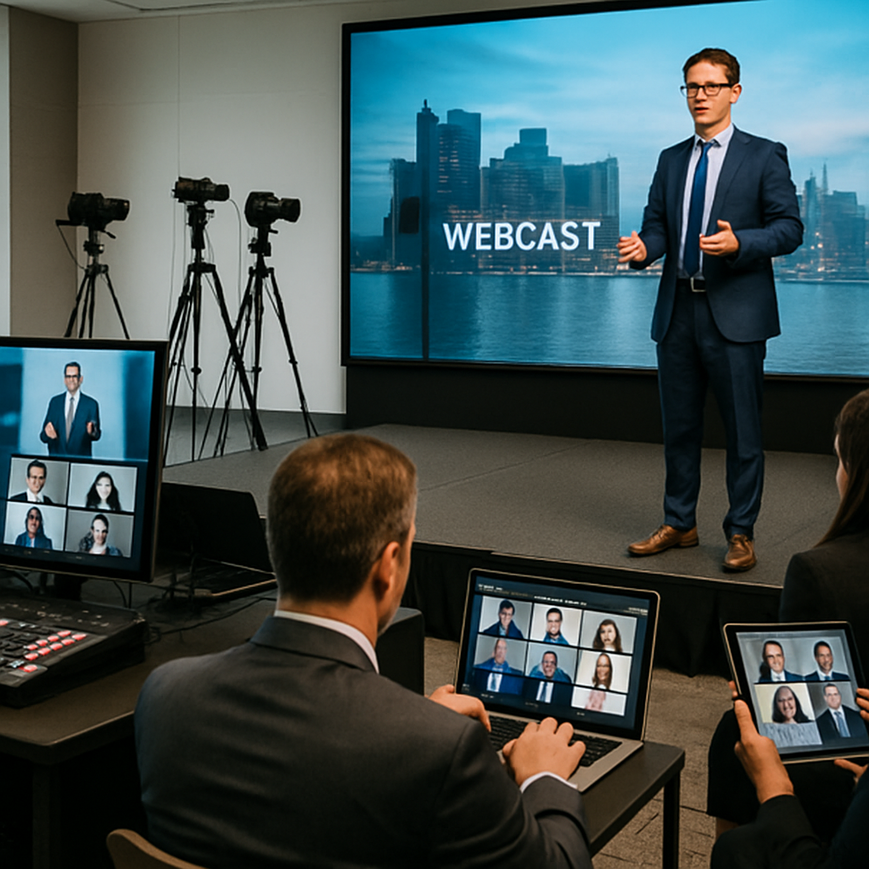
For Singapore businesses, events are no longer limited to a physical room, a hotel ballroom, or an in-house auditorium. Executive town halls, product launches, medical conferences, investor briefings, training programmes, and hybrid events now need to reach audiences who may be on-site, at home, or joining from another country. That shift has made streaming more than a technical add-on. It has become a business capability that affects brand perception, audience reach, operational reliability, and the quality of communication itself.
Many organisations begin with a generic streaming setup because it appears faster and simpler. A ready-made platform can be useful for basic broadcasts, especially when the audience size is modest and the production requirements are straightforward. However, once the event becomes more complex, a standard setup may create friction. Audio may not suit the venue, the workflow may not match the event format, branding may feel inconsistent, and the technical team may struggle to coordinate camera feeds, slides, captions, and interactivity in real time. For Singapore companies that care about precision, professionalism, and efficiency, custom-built streaming solutions often provide a meaningful strategic advantage.
A custom-built streaming solution is designed around the event objective, the venue layout, the audience profile, and the operational needs of the organiser. Instead of forcing the event into a fixed template, the system is configured to support the actual communication goal. That might mean integrating multiple cameras for keynote coverage, connecting presentation slides with live switching, setting up secure access for internal corporate meetings, or ensuring stable delivery across both in-room and remote audiences. The result is not simply a better-looking stream. It is a more dependable communication channel that supports the organisation’s broader goals.
Why Custom-Built Streaming Creates Better Outcomes Than Generic Setups
The main advantage of a custom-built solution is alignment. A streaming system should support the way the event is run, not the other way around. Generic platforms tend to standardise the user experience for convenience, but event production often requires the opposite. A company launching a regulated product, for example, may need controlled speaker transitions, specific visual layouts, moderated Q and A, and recording workflows that support internal review. A healthcare association may need clear slides, reliable audio for specialised terminology, and a broadcast structure that keeps the content accessible to professionals across different locations.
In Singapore, where event venues vary from hotel ballrooms and convention centres to office boardrooms and studio-style production spaces, flexibility matters. A custom system can be adapted to the acoustics of the room, the internet conditions available at the site, the number of speakers on stage, and the level of interactivity required. This reduces the risk of a one-size-fits-all approach failing at a critical moment.
Better control over quality and reliability
Quality is not only about high resolution video. It also includes stable audio, appropriate lighting, smooth transitions, latency management, and backup planning. Latency is the delay between what happens on stage and what viewers receive online. For some events, low latency is important because viewers need to react quickly during live polling, moderated questions, or real-time discussions. A custom-built workflow can be designed to reduce delay where needed and to balance that need against stability and delivery quality.
Reliability also depends on redundancy. Professional streaming teams often use backup encoders, alternative internet paths, reserve cameras, and contingency audio routes. These measures are especially important for corporate events that cannot afford an interrupted broadcast. A custom solution makes it easier to build these safeguards into the design rather than adding them later as an afterthought.
More precise audience targeting and access management
Not every stream should be open to everyone. Internal town halls may require staff-only access, while paid conferences may require registration, authentication, or session-specific permissions. Custom-built systems can support audience segmentation, controlled entry, and secure playback links. This is particularly useful for organisations that handle sensitive information, confidential announcements, or proprietary training content.
For Singapore-based businesses operating across multiple locations, access control can also support regional teams, board members, partners, or invited guests with different viewing privileges. This structure improves governance and helps the organisation maintain a clear record of who received what information.
How Custom Streaming Supports Corporate Communication in Singapore
Singapore’s business environment places a high value on clarity, professionalism, and operational discipline. The same expectations apply to streamed events. A webcast that looks improvised can weaken trust, even if the message itself is strong. Custom-built streaming helps organisations present information in a way that feels deliberate and credible.
This is particularly important for sectors where communication quality influences decision-making, including finance, healthcare, education, government-linked organisations, technology, and professional services. A well-produced stream can support stakeholder confidence, reinforce brand standards, and improve the audience’s ability to absorb information.
Supporting multilingual and diverse audiences
Singapore audiences are diverse, and some events need to accommodate multiple languages or at least make content more accessible to a wider range of participants. A custom workflow can support live captions, subtitle integration, simultaneous slide display, or translated support materials when appropriate. While captions do not replace a full interpretation service, they can improve accessibility for viewers who are hard of hearing, in noisy environments, or joining from mobile devices.
Accessible design is not only a best practice. It also improves the usefulness of the stream for a broader audience. Simple measures such as clear visual contrast, readable graphics, and well-paced speaker transitions make a noticeable difference. These details are easier to implement when the streaming architecture is built around the event, rather than adjusted after the fact.
Enhancing internal and external communication
Hybrid events often serve more than one purpose. An internal briefing may also be watched by regional stakeholders. A customer event may need to support in-person attendees while also reaching remote participants in other time zones. A custom-built streaming solution allows the organiser to shape each component of the broadcast around these different needs. The opening segment may be live and interactive, while a product demonstration may use pre-produced elements for consistency. A Q and A session may be moderated differently for the room audience and the online audience.
This kind of planning helps organisations communicate with more precision. It also reduces the risk that remote viewers feel like second-class participants, which is a common weakness in poorly designed hybrid events. When the stream is thoughtfully structured, both audiences can feel included.
The Technical Elements That Make a Custom Solution Worth Investing In
Custom streaming is valuable because it brings together several technical components into a coherent system. A strong result depends on how these components work together, not on any single piece of hardware or software. The exact configuration will vary by event, but the principles remain the same: the system should be stable, fit-for-purpose, and scalable.
Camera workflow and production design
Multi-camera production is often essential for corporate events that require more than a static shot. Different angles can help viewers follow the speaker, observe demonstrations, and stay engaged over a longer programme. A custom setup can assign cameras to keynote coverage, audience reactions, panel discussions, or product close-ups. The director can then switch between sources in a way that supports the event narrative.
Production design also includes framing, lighting, and scene composition. Good lighting improves clarity, but it must also suit the venue and the speakers. A studio-style setup may be appropriate for a controlled broadcast, while a conference venue may require portable lighting and discreet cabling. These considerations are part of the strategic value of custom production, because they reduce visual inconsistency and improve viewer comfort.
Audio engineering and speech intelligibility
Many streaming issues are actually audio issues. Viewers will tolerate modest video imperfections more readily than poor sound. Speech intelligibility, which means how clearly the audience can understand spoken words, is critical for business communication. Microphone choice, gain staging, room acoustics, speaker movement, and interference management all affect the final result.
Custom-built streaming allows audio to be planned around the actual venue and speaker behaviour. For example, a panel discussion may require lapel microphones, handheld microphones for audience questions, and a separate feed for computer audio. A product demonstration may need close-miked sound and careful balancing to avoid background noise. In Singapore’s mixed-use venues, where air-conditioning hum and reflective surfaces can affect audio quality, this level of planning is often essential.
Integration with event platforms and business systems
Streaming rarely exists in isolation. It is often linked with registration systems, event apps, polling tools, CRM platforms, or internal communications channels. A custom solution can be built to integrate with these systems, making it easier to manage attendee flow, collect engagement data, and organise post-event follow-up. For example, a webinar may require registration confirmation, reminder emails, secure access, and attendance tracking. A product launch may need branded landing pages, live chat moderation, and recording archives for later use.
In practice, integration reduces manual work and helps the event team keep a clear operational picture. That matters in fast-paced Singapore work environments, where teams often manage multiple deliverables across short timelines.
Risk Management, Compliance, and Long-Term Value
Streaming is not only a creative or marketing function. It also involves risk management. Once an event is broadcast live, any technical failure becomes immediately visible. Any confidential detail that appears on screen can be exposed. Any poorly managed transition can affect the credibility of the entire programme. A custom-built solution helps organisations control these risks more effectively.
Data protection and privacy considerations
Singapore organisations should think carefully about privacy, recording permissions, and the handling of personal data when they stream or archive events. This is especially relevant when participants register online, ask questions on camera, appear in recordings, or are captured in chat logs. Good practice includes clear notice about recording, careful access control for recordings, and limiting the collection of unnecessary personal information.
For sensitive events, the production team should also consider what appears on screen, who has access to the control room, and how recordings are stored after the event. These are practical governance questions, not just technical ones. Custom-built systems make it easier to design access controls and workflows that match the organisation’s internal policies.
Scalability for future events
A custom streaming system can be designed with future growth in mind. An organisation may start with a single keynote broadcast, then expand into a recurring webinar series, a hybrid annual meeting, or regional training sessions. A scalable design can accommodate new camera inputs, additional audio channels, better graphics support, or more sophisticated interactivity as needs evolve.
This long-term flexibility can be more cost-effective than repeatedly patching a generic setup. While the initial planning effort may be greater, the organisation gains a production framework that can be reused and refined. Over time, that consistency helps internal teams work more efficiently and deliver a more polished audience experience.
What Singapore Organisations Should Look For When Planning a Custom Streaming Project
Choosing the right production partner is just as important as choosing the right technology. A capable team should understand both the technical side of broadcast production and the communication goals of a business event. They should be able to explain how the setup supports the objective, not just list equipment specifications.
Before commissioning a project, organisations should ask whether the provider can handle venue constraints, audio complexity, backup planning, show-calling, live moderation, and recording handoff. They should also assess whether the team has experience with hybrid formats, corporate protocols, and the pace of live event operations. In Singapore, where events often involve multiple stakeholders, bilingual requirements, and tight scheduling, these capabilities matter.
Practical questions to ask before the event
- How will the stream be adapted to the venue layout and audience size?
- What backup measures are in place for internet, audio, and power issues?
- How will slides, speaker video, and other visual elements be coordinated?
- What access controls will be used for private or invitation-only events?
- How will the recording be stored, shared, and archived after the event?
- Can the setup support captions, chat moderation, or interactive features if needed?
These questions help the organiser move beyond surface-level comparisons and evaluate whether the solution is truly built for purpose. A custom system should feel intentional at every stage, from pre-production to post-event delivery.
For Singapore businesses, the strategic advantage of custom-built streaming solutions lies in their ability to combine technical reliability, audience engagement, and operational control. They support clearer communication, stronger branding, better access management, and more resilient event delivery. Just as importantly, they give organisers a framework that can adapt to the changing demands of hybrid work, regional collaboration, and digital-first communication.
Organisations that treat streaming as a core communication tool, rather than a last-minute add-on, are better positioned to protect quality and deliver a consistent experience. If your event must reflect professionalism, safeguard sensitive information, and serve both in-person and remote participants effectively, a custom-built solution is often the more strategic choice. The most effective approach is to plan early, define the communication goal clearly, and design the streaming workflow around the event itself. That is how production becomes a business advantage rather than just a technical requirement.
General information only: This article provides broad guidance on streaming and event production for business and educational purposes. For event-specific planning, privacy obligations, or technical implementation, organisations should consult qualified professionals familiar with their venue, audience, and internal requirements.
Jeremy Lee is a seasoned digital marketing director and strategist with over two decades of experience in the industry. As the founder of Sotavento Medios, I manage a diverse portfolio of over 50 businesses, helping brands grow through advanced search strategies and digital innovation. My work focuses on bridging the gap between traditional search engine optimisation and the evolving world of AI-driven answer engines.
get in touch