
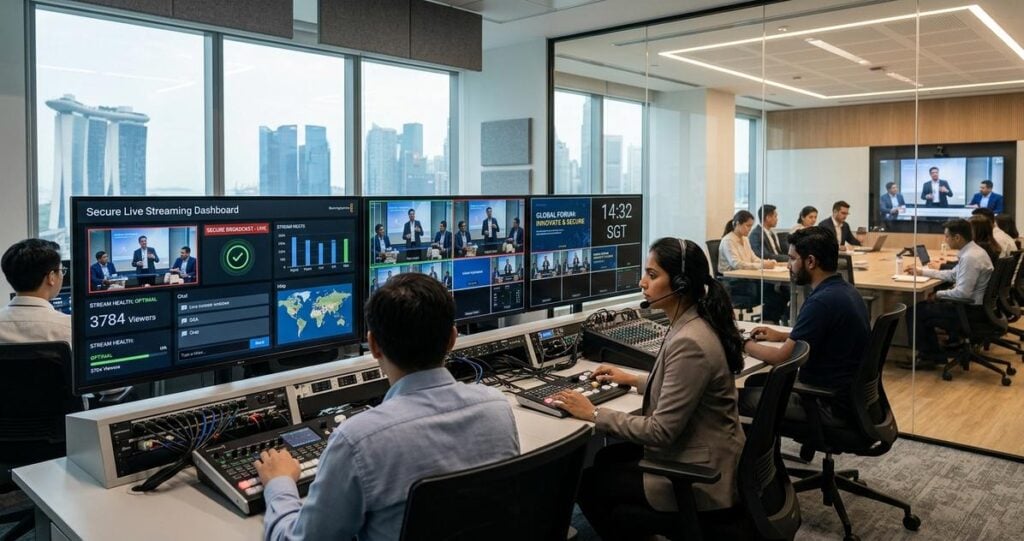
For businesses in Singapore, streaming is no longer limited to media companies or gaming communities. It now powers town halls, product launches, investor updates, training sessions, hybrid conferences, government outreach, and internal communications across sectors such as finance, healthcare, education, logistics, and professional services. As more organisations rely on live and on-demand video to reach employees, customers, and stakeholders, security becomes part of the core business discussion rather than a technical afterthought. A single weak link in a streaming workflow can expose confidential information, disrupt a live event, damage trust, and create compliance concerns that are difficult and costly to resolve.
Enterprise-grade streaming platforms are designed to reduce those risks. They bring together access controls, encryption, monitoring, auditability, content protections, and operational safeguards that consumer-grade tools often do not provide at the same level. For Singapore organisations, where data protection, reputation, and business continuity are closely tied to day-to-day operations, this matters. Whether the event is a shareholder briefing at Marina Bay, a regional leadership meeting involving teams across APAC, or a closed-door training session for a regulated industry, security should be built into the platform from the start.
Security in streaming is not only about keeping outsiders out. It also covers who can join, what they can see, how content is stored, whether recordings can be redistributed, how incidents are detected, and how the system behaves under pressure. When handled properly, an enterprise-grade platform supports both privacy and reliability, allowing organisations to communicate confidently without exposing sensitive information or weakening internal controls.
Why Streaming Security Matters More for Singapore Organisations
Singapore businesses operate in a highly connected environment. Teams are often distributed across offices, work-from-home arrangements, client sites, and regional hubs. Many organisations also handle personal data, commercial information, financial records, health-related content, intellectual property, or board-level discussions. When these are delivered through live or recorded video, the attack surface expands. A streaming link shared too widely, a recording stored without access restrictions, or a session hosted on a platform without strong controls can create avoidable exposure.
Security concerns are not theoretical. Common risks include unauthorised access, credential sharing, session hijacking, phishing around event invitations, accidental public posting of private links, and unapproved downloads of recordings. In a hybrid environment, these risks can be amplified by the speed at which information moves. A meeting invite forwarded to the wrong person, or a screen share that exposes a confidential dashboard, can spread faster than the organiser can react.
Data protection and governance expectations
Singapore organisations must also consider governance and regulatory expectations. The Personal Data Protection Act, or PDPA, sets requirements around the collection, use, disclosure, and protection of personal data. Even when a livestream is not itself “personal data,” it may include names, faces, voices, email addresses, employee IDs, customer discussions, or other identifiable information. If recordings are stored, reviewed, or reused, the organisation needs clear controls over access, retention, and purpose limitation.
Enterprise-grade platforms support these expectations by making it easier to apply role-based access, limit sharing, restrict downloads, and maintain logs of who accessed content and when. These features do not replace internal policy or legal review, but they make compliance more practical and auditable. That is especially important for companies in regulated sectors such as banking, insurance, healthcare, and education, where video can contain sensitive operational details or personal information.
Access Control Features That Reduce Unauthorised Viewing
One of the strongest security benefits of enterprise-grade streaming platforms is precise access control. Rather than relying on a simple public link, organisations can use authentication, invitation-based entry, domain restrictions, single sign-on, or multi-factor authentication. These controls help ensure that only the intended audience can enter a live session or view a recording later.
In practical terms, this means a private all-hands meeting for a Singapore company can be limited to employees who sign in with approved credentials. A regional partner briefing can be separated by user group, and a sensitive training module can be available only for a defined period. This reduces the chance of leaks and helps organisers manage audiences more precisely.
Authentication and identity verification
Authentication means confirming that a user is who they claim to be. In streaming, that can involve password access, company login, SSO, or stronger identity checks. Multi-factor authentication, often called MFA, adds another layer by requiring a second verification step, such as a code from a phone app. This is especially useful when a stream covers confidential material or when attendees may be joining from unmanaged devices.
For Singapore organisations with frequent cross-border collaboration, identity verification can be particularly important because event participants may come from multiple offices and time zones. Without strong authentication, it becomes easy for a forwarded link or leaked password to compromise a session. An enterprise platform helps reduce that risk by linking access to verified identities rather than to a shareable URL alone.
Role-based permissions
Role-based permissions let organisers decide who can watch, speak, moderate chat, present content, or manage the broadcast. This matters because security failures are not always caused by outsiders. Sometimes they happen when a well-meaning employee has more access than they need. By limiting permissions, businesses reduce accidental exposure and improve control during high-stakes events such as leadership announcements, earnings calls, or internal briefings.
For example, a production team may be able to run the stream, while only selected executives are allowed to share audio or video. Moderators can approve questions before they appear publicly. Recordings can be made available only to the HR department, compliance team, or selected teams in Singapore and overseas. These controls support operational discipline and reduce the chance of unintentional disclosure.
Encryption, Content Protection, and Safer Data Handling
Enterprise-grade streaming platforms typically include encryption, which is the process of converting data into a coded format so that unauthorised parties cannot easily read it. In simple terms, it acts like a lock on the video data while it travels across networks and while it is stored. Without it, confidential information can be intercepted or exposed more easily, especially when users are connecting through public networks or mobile devices.
Security is not only about what happens during the live broadcast. It also includes what happens before and after the event. Content protection controls can help ensure that recordings are not freely downloadable, restreamed, or embedded without permission. This is important for companies that use training videos, executive communications, or customer education content that should remain within a controlled audience.
Encryption in transit and at rest
Encryption in transit protects data as it moves between the source, the platform, and the viewer. Encryption at rest protects stored files, such as recordings or event assets, while they sit on servers or cloud storage. Both are important. If only one layer is secured, the other can remain vulnerable. Enterprise-grade platforms often implement these protections as part of a broader security architecture rather than as optional extras.
This is especially relevant where recordings may contain personal details, operational plans, or sensitive discussions. In Singapore, where businesses often store and access data across cloud environments, clear control over storage and transfer helps support better information security practices. It also helps the organisation align streaming workflows with internal IT policies.
Watermarking and controlled playback
Some enterprise platforms support visible or forensic watermarking, which can identify the source of a leak if content is copied or captured improperly. Controlled playback settings can also limit when a recording can be viewed, whether it can be paused or fast-forwarded, and whether it can be accessed after a specific date. These tools are useful for confidential training content, internal announcements, and partner-facing materials.
Although no system can eliminate every risk, these controls increase deterrence and help organisations trace misuse. They are especially valuable where information has commercial sensitivity or where the event involves multiple stakeholders and external vendors.
Monitoring, Audit Trails, and Incident Response Capabilities
Security is strongest when the organisation can see what is happening in real time and review what happened later. Enterprise-grade streaming platforms often include monitoring dashboards, access logs, moderation tools, and alerting functions. These features help security, IT, and event teams detect unusual activity quickly, such as repeated failed login attempts, unexpected geographic access, or abnormal download behaviour.
In a live event, the ability to act fast matters. A moderator can remove an unauthorised participant, mute disruptive audio, lock the session, or disable chat if needed. After the event, logs can support investigations and policy reviews. This level of visibility is hard to achieve with basic consumer tools, especially when multiple teams are involved.
Auditability for compliance and internal review
Audit trails record who accessed the platform, when they joined, what actions they took, and how content was managed. For Singapore organisations that need to demonstrate internal control, this is highly valuable. It supports governance reviews, compliance checks, and incident investigations. If a recording is accessed inappropriately, logs can help establish the timeline and scope of the issue.
Auditability also helps with vendor oversight. If a company works with a live production partner, a streaming agency, or a platform operator, clear logs make it easier to understand how content moved through the system and where responsibilities sat. That clarity is important for risk management and for documenting operational processes.
Incident containment during live broadcasts
Live streaming can be vulnerable to disruption because events unfold in real time. Enterprise-grade systems usually offer controls that can contain incidents without ending the entire broadcast. Organisers may be able to remove individual viewers, switch off public chat, replace exposed content quickly, or transition to a standby screen. These features help protect both the audience experience and the confidentiality of the session.
For example, if a confidential slide is accidentally shared during a client webinar, a production team with the right tools may be able to stop the segment immediately, remove the slide, and continue the event in a controlled manner. That kind of operational resilience is one of the key security advantages of professional platforms.
Business Continuity, Vendor Trust, and Safer Hybrid Operations
Security and continuity are closely linked. A platform that lacks strong controls can fail not only from a cyber perspective but also from an operational one. If a stream crashes, a recording disappears, or access controls malfunction, the business may lose trust with staff, customers, or external stakeholders. Enterprise-grade platforms are generally built with redundancy, support processes, and structured administration to reduce such disruptions.
For Singapore companies that host frequent hybrid events, continuity matters because teams often depend on these broadcasts to keep operations moving. Internal briefings, client updates, training sessions, and product launches may all be scheduled tightly and tied to regional deadlines. A secure, stable platform reduces the need for last-minute workarounds that can weaken protection.
Working with production teams and vendors
Many organisations rely on event partners for hybrid production, video engineering, and technical support. In that setting, vendor trust becomes part of the security framework. Enterprise-grade platforms help by supporting granular permissions, separating production roles, and limiting access to only what each vendor needs. This reduces the risk of overexposure when several third parties are involved.
Singapore businesses should ask practical questions when selecting a platform or production partner. Where is content stored? Who can access the recordings? Can the platform enforce MFA? Are logs available? Is the system compatible with internal IT policies? Does it support private events and controlled distribution? These questions are more useful than broad marketing claims because they relate directly to real-world risk.
Fit for regulated and sensitive use cases
Enterprise streaming is especially valuable for use cases that involve sensitive or high-value information. Examples include board meetings, HR briefings, investor relations updates, medical training, compliance seminars, and confidential customer education. In these settings, a strong platform helps protect both the content and the confidence of the people involved.
It also supports professionalism. When attendees see clear login controls, branded but secure access pages, and well-managed moderation, they are more likely to trust the organisation with future communications. In Singapore’s business environment, trust is a major asset. Security is one of the ways it is earned and preserved.
Choosing an enterprise-grade streaming platform is ultimately a decision about risk management. It helps reduce unauthorised access, strengthens data protection, supports compliance, improves visibility, and gives organisations more control over live and recorded content. For Singapore businesses that depend on hybrid communication, that combination can make the difference between a routine broadcast and a serious security incident. The safest approach is to treat streaming as part of the wider information governance strategy, not as a standalone event tool. Review the access model, encryption settings, content retention rules, and vendor responsibilities before the next broadcast, and align them with your organisation’s internal policies and legal requirements. If the stream may include personal data, confidential business information, or regulated content, consult your internal compliance, IT security, or legal team before going live.

Jeremy Lee is a seasoned digital marketing director and strategist with over two decades of experience in the industry. As the founder of Sotavento Medios, I manage a diverse portfolio of over 50 businesses, helping brands grow through advanced search strategies and digital innovation. My work focuses on bridging the gap between traditional search engine optimisation and the evolving world of AI-driven answer engines.
get in touch