
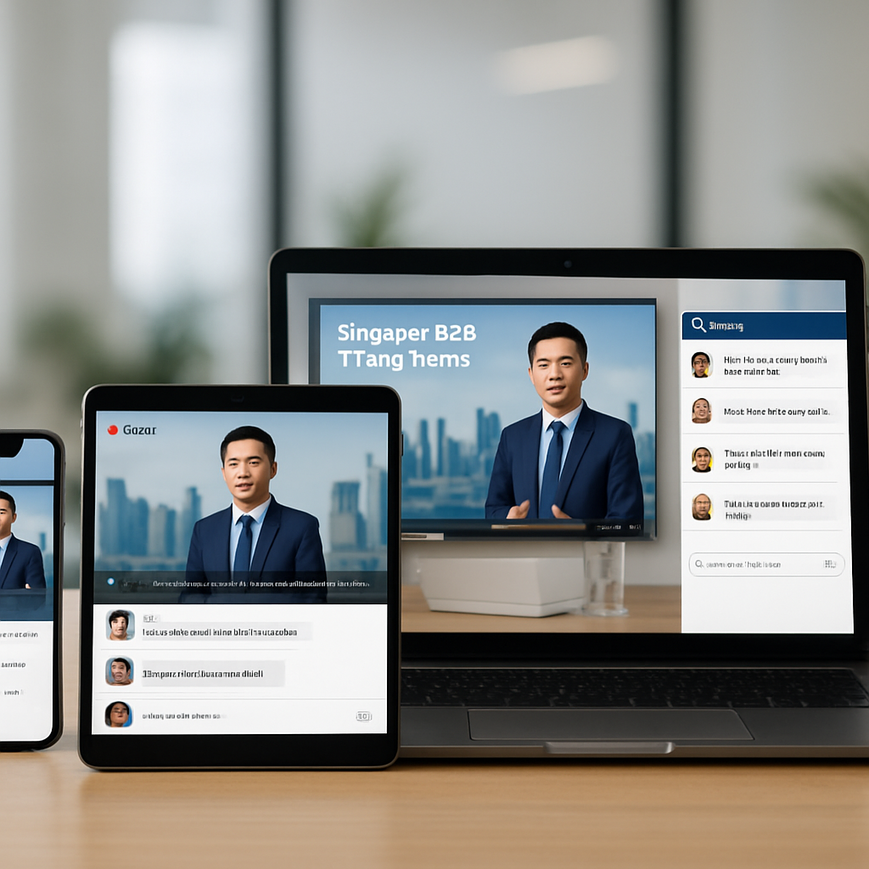
For Singapore businesses that rely on webinars, virtual town halls, product launches, training sessions, and hybrid events, mobile responsiveness is no longer a design preference. It is a practical requirement that affects attendance, engagement, accessibility, and the credibility of the brand hosting the stream. Many decision-makers now join sessions from a phone during a commute, between client meetings, or while moving between office and home, and they expect the stream, registration flow, chat functions, and supporting content to work smoothly on a small screen. If a platform looks polished on a desktop but becomes awkward, cramped, or unstable on mobile, the user experience can quickly feel unprofessional.
In Singapore, this expectation is especially relevant because business communication often happens across flexible schedules and multiple devices. A procurement lead may review a demo on a laptop in the office, then rejoin the same event on a smartphone while travelling. A regional team member may attend from home after hours, using a tablet or mobile hotspot. When a B2B streaming platform is mobile responsive, it adapts its layout, controls, text, and media playback to the device in use. That means viewers can read clearly, tap accurately, and keep up with the session without unnecessary friction. For organisations investing in event streaming, mobile responsiveness is not just about visual polish, it is part of reliable service delivery.
Why mobile responsiveness matters for B2B streaming platforms
Mobile responsiveness refers to a platform’s ability to adjust its interface automatically to different screen sizes and orientations. In practical terms, the same streaming experience should remain usable on a smartphone, tablet, laptop, or large conference display. This includes readable text, accessible buttons, stable video scaling, and navigation that does not require constant zooming or horizontal scrolling. For B2B events, where the audience may include C-suite leaders, sales teams, partners, and overseas stakeholders, the interface must support fast comprehension and low-friction interaction.
From a business perspective, responsiveness affects the core metrics that event teams care about. If viewers struggle to enter a session, find the agenda, post a question, or access the next step after a presentation, engagement drops. When mobile viewers abandon a stream early because the controls are difficult to use, the organisation loses not only watch time, but also lead quality and post-event conversion opportunities. A responsive platform reduces these points of failure by making the entire journey easier from the start. It helps the audience stay focused on the content instead of on the device.
Responsiveness also matters because B2B decision-makers often consume content in short, fragmented windows. Unlike entertainment viewing, a business audience may join late, switch devices, or multitask. A mobile-friendly platform supports this pattern without forcing people to restart, reorient, or search for basic functions. In Singapore’s fast-moving work culture, that convenience is not a luxury. It is part of meeting professional expectations.
What mobile responsiveness should include
A responsive streaming platform should do more than shrink the desktop page. It should preserve readability and usability across different device classes. Key features include:
- Flexible layouts that reflow content instead of compressing it into unreadable blocks.
- Touch-friendly controls with adequate spacing for tapping play, pause, volume, chat, and call-to-action elements.
- Readable typography that scales properly without forcing zoom.
- Adaptive video players that maintain aspect ratio and support smooth resizing.
- Navigation that remains intuitive on smaller screens, including agenda, speaker bios, downloadable resources, and support links.
- Forms for registration or post-event follow-up that are easy to complete on mobile keyboards.
These features sound simple, but they shape whether a platform feels reliable. In B2B streaming, reliability is part of the brand message.
The user experience impact in Singapore’s business environment
Singapore’s business audience is highly mobile and digitally literate. Many professionals split their time between the office, client sites, co-working spaces, and home offices. Hybrid work remains common across many sectors, which makes device flexibility an everyday reality. Because of this, a B2B streaming platform must support use cases that are not confined to a single room or a single screen. A sales director may join from an iPhone while commuting on MRT, then switch to a desktop later for replay and resource review. A regional customer may attend from abroad on an Android device, while a local team member joins from a tablet during lunch.
When the mobile experience is poor, the organisation can appear less competent than it actually is. If the registration page is hard to complete on a phone, people may abandon the process before they even enter the event. If the video player buffers awkwardly or overlays cover the speaker feed on a small screen, viewers may interpret that as a technical failure in the event itself. In reality, the issue may be poor responsive design rather than stream quality, but the audience usually does not separate those factors. Their experience of the event is the brand experience.
There is also an accessibility dimension. While mobile responsiveness is not the same as accessibility, the two overlap. Clear contrast, larger tappable areas, and predictable layouts help more users follow the content, including older professionals who may prefer a phone or tablet with larger fonts enabled. In Singapore, where B2B audiences can span multiple age groups and technical comfort levels, making the interface easier to use benefits the entire audience.
Mobile use affects attention and interaction
On a mobile device, attention is more fragile because the screen is smaller and the user may be distracted by notifications, transport movement, or environmental noise. That means the platform must reduce cognitive load. If users have to hunt for a chat icon, hunt for a transcript, or guess where to find slides, they are less likely to participate meaningfully. Responsive design helps by placing the most important actions where the thumb can reach them easily and by presenting information in a clear hierarchy.
For event organisers, that improves the quality of interaction. Questions are submitted more easily. Polls receive more responses. Post-event resources are accessed more often. These are not minor details, they are the mechanisms through which B2B streaming creates business value.
Technical considerations that influence mobile performance
Mobile responsiveness is partly a front-end design issue, but in streaming platforms it is also linked to technical delivery. Video bitrate, player configuration, page loading speed, and device compatibility all affect whether the mobile viewer gets a smooth experience. A responsive interface cannot fully compensate for a poorly optimised stream. Likewise, strong video infrastructure can still feel inadequate if the user interface breaks on smaller screens. For best results, both design and delivery must work together.
One important factor is adaptive bitrate streaming, which adjusts video quality according to the viewer’s network conditions. This is especially useful for mobile users, whose connections may change as they move between office Wi-Fi, public networks, and cellular data. If the stream adapts intelligently, it can reduce buffering and interruptions. Another factor is the size and structure of page assets. Heavy scripts, oversized images, and unnecessary third-party elements can slow down load times on mobile devices. In B2B contexts, even a few seconds of delay can affect whether a participant stays or leaves.
Video controls also need careful thought. On desktop, users can rely on a mouse and large screen. On mobile, control elements must remain visible and usable without covering critical content. Live captions, speaker labels, and presentation slides should not become unreadable because of poorly placed interface overlays. If the platform offers simultaneous chat, Q&A, or translation features, those tools must be designed for touch interaction, not merely scaled down from a desktop interface.
Testing across devices is not optional
Every B2B streaming platform should be tested on a range of actual devices and browsers before an event goes live. Emulators are useful, but they do not fully reproduce real-world behaviour. Testing should include iOS and Android phones, tablets of different sizes, and common browsers used by the target audience. It should also include portrait and landscape orientations, because many users change orientation depending on the type of content they are viewing.
For Singapore-based teams, testing should reflect local usage patterns. That means checking performance on mobile networks, office Wi-Fi, and mixed-connection environments. It also means confirming that registration pages, reminder links, event notifications, and replay access work well across email clients and mobile browsers. A smooth live stream is only one part of the journey. The surrounding workflow matters just as much.
Why responsiveness supports lead generation and stakeholder trust
B2B streaming is not only about delivering information. It often supports lead generation, relationship building, sales enablement, training, and thought leadership. A mobile-responsive platform strengthens these goals because it lowers the barrier to participation. When a business audience can register easily, join quickly, and move between content and action points without friction, the organisation increases the chance that the session will translate into measurable business outcomes.
Trust is also central. In B2B settings, stakeholders often infer operational quality from digital experience. A well-designed responsive platform signals preparation, attention to detail, and respect for the audience’s time. A poorly adapted mobile experience can suggest the opposite, even if the speaker content is strong. This is particularly important for industries where professionalism and reliability influence purchasing decisions, such as professional services, technology, finance, healthcare, education, logistics, and public sector communications.
For hybrid events in Singapore, where local and regional stakeholders may participate at different times and from different locations, mobile responsiveness also helps maintain continuity after the live session ends. Recordings, gated resources, follow-up forms, and contact options should remain usable on phone screens so that interest does not fade during the post-event phase. Many business conversations continue after the stream, and mobile usability helps those conversations progress.
Content design should match device behaviour
Responsive platforms work best when the content itself is designed for mobile consumption. Long unbroken paragraphs, tiny slide text, and overly complex dashboards make little sense on small screens. Organisers should structure content so that key messages are visible quickly and supporting materials are easy to open when needed. Speakers should also be briefed to keep on-screen visuals legible, because viewers may be watching on a device that is far smaller than the presenter’s laptop or conference monitor.
Simple design choices can make a real difference. Use high-contrast visuals. Keep headlines short and clear. Avoid overcrowding the screen with too much information at once. If the platform includes downloadable files, make sure they are mobile-friendly or offer an alternative summary page. These decisions improve the viewing experience without changing the substance of the event.
Practical steps for Singapore organisations choosing a streaming platform
When evaluating B2B streaming platforms, Singapore organisations should ask practical questions rather than relying on marketing claims. Can the platform handle live, on-demand, and hybrid use cases with the same responsive interface? Does the registration flow work well on mobile browsers? Are captions, chat, Q&A, and resource links easy to access on a phone? Does the player adapt to different bandwidth conditions without constant disruption? Can the platform support branded pages without sacrificing load speed on mobile devices?
It is also wise to involve the people who will actually use the platform. Event managers, marketing teams, sales representatives, and internal communications staff should test the experience on their own phones before committing to a rollout. This creates a more realistic understanding of what attendees will face. If the internal team finds a step confusing, external viewers probably will too. In a country where many users are accustomed to polished digital services, small usability issues can become meaningful obstacles.
For organisations working with a production partner, mobile responsiveness should be part of the planning conversation from the start. It is easier to build a good experience early than to patch one later. Discuss layout priorities, audience devices, caption placement, interaction tools, bandwidth assumptions, and post-event access before the event is launched. That proactive approach reduces risk and improves consistency.
What good mobile responsiveness looks like in practice
A strong mobile-responsive streaming platform feels simple, even though it may be technically sophisticated behind the scenes. The viewer lands on the page quickly, understands where to click, sees the video clearly, and can interact without confusion. The content remains legible, the controls remain usable, and the platform behaves predictably as the device orientation changes. Nothing feels squeezed, hidden, or unstable.
For B2B teams in Singapore, that experience supports more than convenience. It supports participation, professionalism, and business continuity. Whether the goal is educating clients, onboarding staff, launching a service, or hosting a regional panel discussion, the audience should be able to join from the device that is most convenient for them. A responsive platform respects that reality and turns it into an advantage.
General information notice: This article provides general information about mobile responsiveness in B2B streaming platforms. It is not medical advice. For technology procurement, accessibility compliance, or specific platform architecture decisions, organisations should consult qualified technical and legal professionals as needed.
For Singapore businesses, the takeaway is straightforward. If your streaming platform performs well only on desktop, it is not fully meeting the way modern professionals work. Mobile responsiveness should be treated as a core requirement, not an optional enhancement. When you build for phones and tablets first as well as desktops, you create a more dependable event experience, support better engagement, and present your organisation in the way professional audiences expect.

Jeremy Lee is a seasoned digital marketing director and strategist with over two decades of experience in the industry. As the founder of Sotavento Medios, I manage a diverse portfolio of over 50 businesses, helping brands grow through advanced search strategies and digital innovation. My work focuses on bridging the gap between traditional search engine optimisation and the evolving world of AI-driven answer engines.
get in touch