
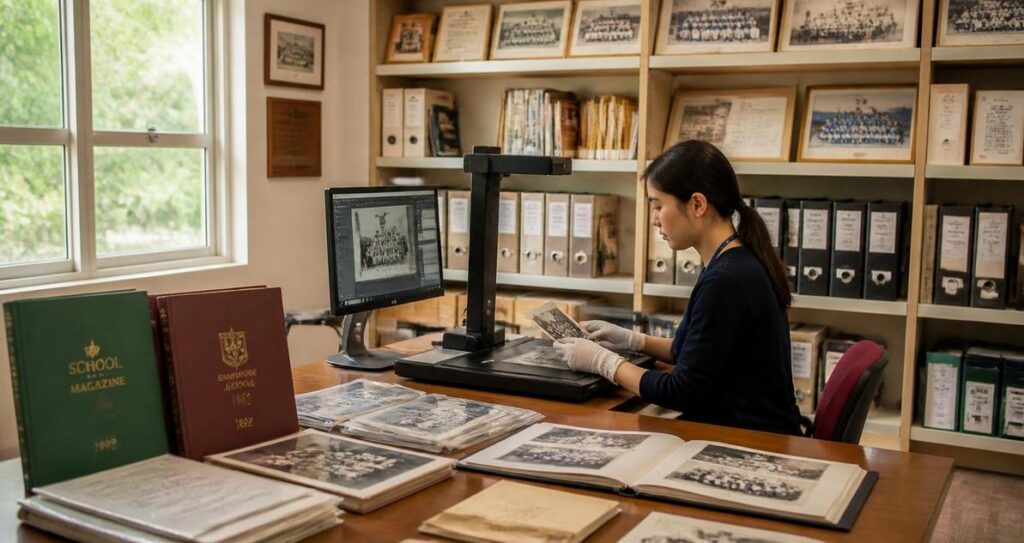
School history is more than a collection of old photographs, yearbooks, and event posters. For many Singapore schools, it is a record of how the institution has grown alongside the nation, how values were shaped over time, and how generations of students, teachers, and alumni contributed to the school’s identity. When archival materials are preserved properly, they become reliable sources for commemorations, publications, research, alumni engagement, and future planning. When they are poorly stored, misplaced, or digitised without care, the record becomes fragmented, and important details can be lost permanently.
For schools in Singapore, archiving has practical significance. Schools often celebrate milestone anniversaries, produce heritage books, create exhibitions for open houses, and respond to requests from alumni, media, and community partners. In each of these situations, the accuracy and quality of archived materials matter. A well-managed archive helps a school present its history with confidence, while also protecting records that may be culturally and institutionally valuable. High-quality archiving is not simply about keeping old items, it is about preserving context, authenticity, and access in a way that supports long-term continuity.
Good archiving also reflects responsible stewardship. Schools hold materials that document student life, leadership transitions, academic achievements, co-curricular activities, and major national events that affected the school community. These records can have educational, historical, and administrative value. In Singapore, where schools often maintain strong alumni networks and a deep sense of institutional pride, a thoughtful archive supports intergenerational connection and helps preserve the story of the school for future students.
Why school archives matter for institutional memory and identity
A school archive is a structured body of records that documents the history and operations of the school. This may include photographs, annual reports, speech transcripts, newsletters, certificates, audio recordings, videos, newspaper clippings, digital files, and artefacts such as banners or commemorative items. Institutional memory refers to the knowledge and experience a school retains over time, especially when leadership, staff, and student cohorts change. Without archival systems, that memory can become dependent on individual recollection, which is often incomplete and difficult to verify.
School identity is built over time through traditions, achievements, and shared experiences. Archives provide evidence of that identity. They show how a school’s mission evolved, how programmes developed, and how the school responded to broader social changes. For example, a heritage display for a founding anniversary may rely on original programme booklets, photographs, and testimonials to tell a credible story. If the sources are incomplete or poorly labelled, the school may struggle to present an accurate narrative.
In Singapore, school history often intersects with national development. Many schools have records that reflect changes in bilingual education, the growth of co-curricular programmes, shifting student demographics, and community involvement. These materials help document not only school-specific milestones, but also the broader educational and social context of the country. For this reason, archiving is not a decorative task. It is a core part of heritage preservation and institutional continuity.
Archival value goes beyond nostalgia
It is common to view old school materials as sentimental items, but archival value is broader than nostalgia. Records have evidential value when they prove when an event happened, who was involved, and what decisions were made. They have informational value when they contain details that are useful for research or publication. They also have legal and administrative value when they support verification of names, dates, awards, or institutional claims.
These values matter when schools prepare anniversary books, reunions, or exhibitions. A yearbook photo without labels is much less useful than one that includes the year, event, location, and names of the people featured. A digitised newsletter without metadata, such as date and issue number, may be difficult to retrieve later. Archiving quality directly affects whether materials remain meaningful.
What high-quality archiving means in practice
High-quality archiving requires more than a storage room or a folder of scanned files. It involves selection, organisation, preservation, description, access control, and ongoing maintenance. In practice, this means using consistent methods so that materials remain usable over decades, not just until the next celebration.
One of the most important principles is provenance, which means preserving the origin and context of records. A photograph should not be separated from its caption, and a video should not be detached from its event description if those details help explain its meaning. Another key principle is original order, where records are maintained in a system that reflects how they were created and used. These principles help maintain authenticity and reduce confusion.
High-quality archiving also depends on accurate metadata. Metadata is descriptive information about a record, such as title, date, creator, file format, subject, and rights information. In a school setting, metadata can also include cohort year, event name, venue, department, or the names of staff and alumni where appropriate. Clear metadata makes retrieval easier and reduces the risk of misidentifying important historical materials.
Physical preservation of school records
Many schools still hold important printed and physical materials, including registers, photographs, certificates, medals, banners, trophies, and printed publications. These items require suitable storage conditions. Paper records should be kept away from moisture, direct sunlight, excessive heat, and pests. Photographs should be stored in archival-quality enclosures when possible, because poor-quality plastic or adhesive materials can damage surfaces over time.
In Singapore’s humid climate, physical preservation requires particular attention. High humidity can encourage mould growth and accelerate deterioration of paper, photographs, and textiles. Storage areas should be monitored for cleanliness, ventilation, and temperature stability. Items should not be stored directly on floors, near leaking pipes, or in spaces with repeated exposure to condensation. Schools planning long-term preservation should assess whether certain records need specialist conservation treatment.
Digital preservation and digitisation
Digitisation means converting physical materials into digital form, usually through scanning or video capture. Digital preservation goes a step further. It refers to maintaining digital files so they remain accessible and readable over time. This includes selecting suitable file formats, backing up files, checking file integrity, and managing migration when technology changes.
Digitisation is useful for access, but it does not replace the original item. A scan captures content, but not always the texture, scale, or physical characteristics of the original document. For this reason, schools should preserve originals where they have long-term historical value, while using digital copies to improve access and reduce handling. It is also important to name files consistently and store them in a structured system, so records can be retrieved easily by staff, alumni, or approved researchers.
Digital files need governance. If photographs are scattered across personal phones, email inboxes, and unlabelled folders, they become difficult to trust and use. A managed archive should define where files are stored, who can update them, and how versions are controlled. This is especially relevant for schools that regularly document events, performances, graduation ceremonies, and community outreach activities.
The role of archives in storytelling, education, and community engagement
Well-maintained archives support better storytelling. A school that has organised historical records can create exhibitions, online timelines, commemorative videos, and anniversary publications with confidence. These projects are more credible when based on verified sources rather than memory alone. For alumni, accurate archives help reconnect them with the school experience they remember. For current students, they provide a sense of belonging and continuity.
Archives also support teaching and learning. Historical photographs, speeches, and publications can be used in humanities, social studies, literature, and CCA-related activities. They help students understand how institutions evolve over time, how communities respond to change, and how personal stories fit within larger historical patterns. When used carefully, archival materials become powerful educational tools.
For community engagement, archives can strengthen intergenerational ties. Alumni often value seeing their contributions recognised in school heritage displays or digital collections. Parents and donors may also be more engaged when they can see a school’s long-standing commitment to excellence, service, or character development. A credible archive helps the school speak with authority about its journey and values.
Archives and public trust
Trust matters when a school publishes its history. If records are incomplete, inconsistent, or poorly verified, public-facing materials may contain inaccuracies. This can create confusion during major events such as anniversary celebrations or leadership transitions. Reliable archives reduce this risk because they provide documented evidence that can be checked and cross-referenced.
Public trust is also strengthened when schools handle historical records responsibly. Proper archiving shows respect for the people represented in those records, including students, teachers, and alumni. It signals that the school values its heritage and is careful with information. In a city like Singapore, where educational institutions are often seen as key community anchors, that level of care carries real reputational value.
Common risks when school archives are neglected
Neglected archives tend to suffer from a few predictable problems. Materials may be stored without labels, making them difficult to identify later. Files may be kept in outdated formats that are hard to open. Physical items may deteriorate because of heat, humidity, pests, or poor handling. Sometimes records are separated from their context, which makes them much less useful even if they survive physically.
Another common problem is overreliance on informal storage. Important documents may sit in personal drives, old email accounts, or boxes kept by individual staff members. When staff move on, records can be lost. This is especially risky for schools, because institutional knowledge can disappear when there is no central archiving framework.
There is also the issue of privacy and consent. School archives often contain identifiable images and personal information. A responsible archiving process should respect data protection obligations and internal policies on access. Not every record should be freely circulated, even if it is historically interesting. Schools should balance heritage access with the need to protect personal information, especially where students are concerned.
Governance, access, and compliance considerations
Archiving should be guided by clear governance. Schools need to decide what should be kept, how long it should be retained, who is responsible for it, and who may access it. Some records are administrative and may only need to be kept for a defined period, while others have long-term historical value. A retention approach helps avoid both unnecessary clutter and accidental destruction of important materials.
In Singapore, schools should also align archiving practices with relevant data governance and record management expectations. This includes protecting personal data, applying access controls where needed, and ensuring that records used for public display are checked carefully. If a school works with external vendors for digitisation, scanning, or event production, it should also ensure that handling procedures are clear and confidentiality is maintained.
Practical steps Singapore schools can take to improve archiving
Improving school archives does not always require a large budget. It starts with clear priorities and consistent processes. A school can begin by identifying its most valuable materials, such as founding records, annual reports, photographs of major events, significant publications, and materials linked to milestone anniversaries. These items should be stabilised first, because they are often the hardest to replace if lost.
Next, schools should create a simple classification system. For example, records can be grouped by year, department, event type, or format. Labels should be consistent and descriptive. A shared naming convention for digital files is especially useful, because it helps staff find records without relying on memory. Basic documentation should explain where files are stored, how they are backed up, and who approves additions or edits.
Schools should also train staff and student leaders involved in documentation. Event organisers, yearbook teams, and CCA leaders often create valuable records, but they may not know how to label or save them properly. A short internal guide can improve quality significantly. This is particularly helpful in busy Singapore school environments, where documentation may be spread across different teams and event cycles.
Digitisation strategy with long-term value
A sensible digitisation strategy focuses on quality rather than speed alone. Scans should be clear, complete, and saved in formats suited to long-term use. Colour accuracy matters for photographs and posters. Descriptive file names and metadata should be added at the point of capture, not months later when the context is already fading.
Schools should also keep backup copies in separate locations and review them periodically. Files can become corrupted, storage services can change, and links can break. A digital archive is only useful if it remains accessible. Regular review helps confirm that files still open correctly and that folder structures remain understandable.
For schools planning heritage projects, it can be useful to involve alumni, retired teachers, and long-serving staff in identifying and describing records. Their input can help clarify dates, names, and the significance of certain events. This strengthens the archive while also building a sense of shared ownership.
Why high-quality archiving supports Singapore’s educational heritage
Singapore places strong emphasis on education, social cohesion, and national memory. Schools are part of that story. Their archives document how communities learn, adapt, and contribute across generations. A well-preserved school archive supports more than a celebratory booklet. It supports research, remembrance, communication, and identity-building.
In practical terms, high-quality archiving helps schools respond to anniversaries, heritage projects, alumni requests, and future documentation needs without scrambling for missing records. It also helps ensure that the school’s story is told accurately, with evidence rather than assumption. For Singapore readers, this matters because schools are often closely tied to family history and community pride.
High-quality archiving also has a future-facing value. As schools increasingly create content in digital formats, the challenge is no longer only about storing paper records. It is about preserving born-digital materials, such as videos, websites, digital newsletters, and social media content, in a way that remains usable over time. The schools that do this well will be better placed to protect their heritage and share it meaningfully with future generations.
For any school looking to strengthen its heritage work, the message is clear: start with structure, preserve context, and treat every important record as part of the school’s living history. A strong archive does not just look back, it helps the school move forward with clarity, credibility, and pride.

Jeremy Lee is a seasoned digital marketing director and strategist with over two decades of experience in the industry. As the founder of Sotavento Medios, I manage a diverse portfolio of over 50 businesses, helping brands grow through advanced search strategies and digital innovation. My work focuses on bridging the gap between traditional search engine optimisation and the evolving world of AI-driven answer engines.
get in touch