
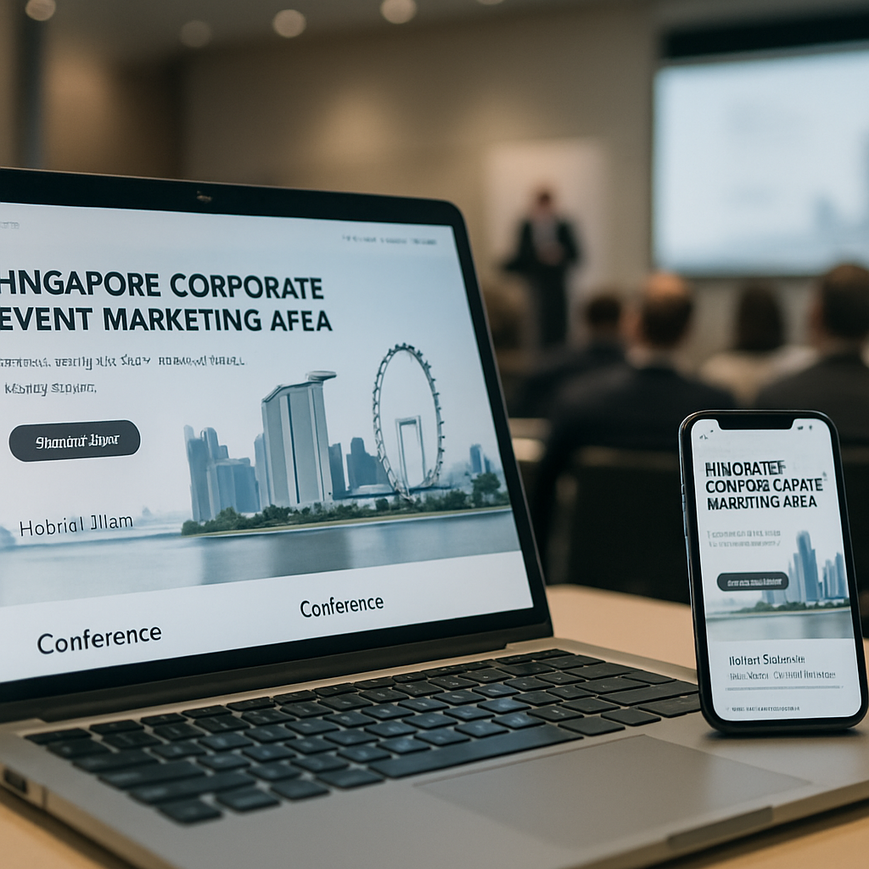
Corporate events in Singapore have become more sophisticated, whether they are product launches, leadership town halls, industry conferences, training sessions, or hybrid gatherings that connect people in a ballroom and online at the same time. For organisers, one of the biggest challenges is not only getting people to register, but also making sure they arrive with the right information, the right expectations, and a smooth path from interest to attendance. A custom landing page helps solve this by giving every event a dedicated online space that is designed for one purpose, which is to guide the audience toward a clear action.
For Singapore businesses, this matters because audiences are time-conscious, mobile-first, and often comparing multiple events, webinars, and professional commitments at once. A landing page that is tailored to a specific corporate event can improve clarity, support trust, and reduce friction across the registration journey. It also gives organisers a practical way to align messaging, branding, and data collection without forcing people to navigate a general company website that may not be built for event conversion. When used well, custom landing pages support both marketing performance and operational efficiency.
In event production, especially for corporate and hybrid formats, the landing page is not just a registration form. It becomes the central communication point for agenda details, speaker profiles, technical instructions, venue information, livestream access, and post-registration updates. That makes it an important part of the event experience itself, not an afterthought.
Why custom landing pages matter for corporate events
A custom landing page is a standalone web page created for a specific campaign or event. Unlike a generic homepage, which serves many audiences and many purposes, a landing page focuses on one objective. For a corporate event, that objective is usually registration, attendance confirmation, lead capture, or content download after the event.
This narrow focus is valuable because people tend to respond better when the next step is obvious. If an executive, client, or partner lands on a page that immediately explains what the event is, who it is for, and why it matters, they are more likely to continue. The page removes unnecessary distractions and keeps attention on the event itself.
In Singapore, where professionals often move quickly between meetings, deadlines, and commuting across dense urban routes, clarity matters. A landing page can present the essential information at a glance, including date, time, venue, parking or MRT access, dress code, and whether the event is physical, virtual, or hybrid. This reduces confusion and helps audiences make a faster decision.
Clear positioning builds confidence
Corporate events often involve a mix of internal staff, clients, prospects, media, and partners. Each group may need different information, but all of them want assurance that the event is credible and relevant. A custom landing page allows organisers to frame the event for a specific audience segment, using language, visuals, and calls to action that match the purpose of the event.
For example, a leadership forum for senior managers may benefit from concise, authoritative messaging and a refined design. A product demonstration for buyers may need stronger proof points, clearer benefits, and a faster registration route. By shaping the page to the audience, organisers create better alignment between event goals and attendee expectations.
Better first impressions for brands
Brand consistency matters in corporate communications. A landing page can extend the same visual identity used in the event presentation deck, email invites, and social posts. This gives attendees a coherent experience before they even reach the venue or join the stream. When the brand story is visually and verbally consistent, the event feels more organised and credible.
This is especially important in Singapore’s competitive B2B environment, where many industries operate with high expectations for professionalism. A polished landing page can signal that the event is carefully planned, well supported, and worth the attendee’s time.
How custom landing pages improve registration and attendance
The most immediate benefit of a custom landing page is often seen in the registration process. A well-structured page can reduce drop-offs, capture the right attendee details, and set expectations accurately from the start. That matters because event success is not only about generating interest, but also about converting that interest into actual attendance.
Registration forms embedded in landing pages can be configured to gather the information most useful for event operations. This may include name, email, company, designation, dietary preferences, or access requirements. For hybrid events, it may also include whether the participant intends to attend physically or online, which helps with capacity planning and streaming coordination.
Fewer distractions, smoother decision-making
General websites often contain navigation menus, unrelated service pages, and multiple calls to action. That can dilute attention and make it harder for users to complete registration. A custom landing page removes much of that clutter and keeps the journey simple. This is a standard conversion principle used in digital marketing and applies well to event promotion.
For Singapore audiences, simplicity is especially useful because many users will register from mobile devices during short breaks or while commuting. The page should load clearly on a phone, present essential details above the fold, and keep the form easy to complete. If the process takes too long or feels uncertain, users may postpone it and never return.
Better data quality for event operations
A landing page can be designed to collect accurate and usable information from the beginning. This helps organisers manage seating, badge printing, catering, security access, and livestream links. For corporate events with multiple attendee categories, the form can include logic that shows different questions depending on the audience type.
In practice, this means fewer manual follow-ups and fewer errors on event day. It also improves reporting after the event, because the organiser has a cleaner database of registrants and attendees. Better data supports more efficient post-event communication, including thank-you emails, feedback surveys, and follow-up sales or partnership conversations.
Stronger reminder workflows
Custom landing pages work well alongside automated email reminders and calendar invites. Once a person registers, they can be directed to a confirmation page with added instructions. Later, the same page can support updated information such as speaker changes, transport guidance, or login details for online participation.
This matters for corporate events in Singapore, where schedules can be affected by work commitments, travel time, and public transport planning. A clear confirmation page and reminder sequence help reduce no-shows by making the attendee feel informed and prepared.
The role of custom landing pages in hybrid and streamed events
Hybrid events combine a physical venue with a remote audience. In Singapore, this format is increasingly common for corporate communications because it allows broader reach without sacrificing in-person networking. A custom landing page is particularly useful in this setting because it can explain the event format clearly and direct different audiences to the correct participation path.
For a streamed event, the landing page can outline technical requirements such as browser compatibility, login steps, recommended internet access, and where to get support if a participant encounters issues. For an in-person audience, it can present venue directions, arrival timing, and check-in instructions. This reduces confusion and helps the event run more smoothly.
Supporting technical readiness
When an event includes livestreaming, technical readiness becomes a major part of the attendee experience. A landing page can prepare participants by letting them know whether they need to test their device, log in in advance, or use a specific platform. While the exact technical setup depends on the production provider and event platform, the principle remains the same, attendees should not be left guessing.
This is particularly important for corporate webinars, product announcements, and internal meetings where participation from multiple locations is expected. The landing page becomes a communication tool that reduces avoidable support issues and improves confidence before the event begins.
Making the physical and digital experience feel connected
Hybrid events can feel fragmented if the online audience and the venue audience receive different levels of attention. A custom landing page helps unify the experience by presenting a single, cohesive event identity. The same page can highlight keynote speakers, session timings, and engagement opportunities for both audiences, while still distinguishing between in-person and virtual access details.
That unity matters because corporate events are often judged by how seamless they feel. If attendees can move from invite to registration to participation without unnecessary confusion, the event is more likely to be remembered positively.
SEO, audience targeting, and long-term marketing value
A custom landing page also supports search visibility and campaign targeting. While the main purpose of an event landing page is usually conversion, it can also be structured so that people searching for relevant topics can find it more easily. This is useful for public-facing conferences, seminars, and industry events where organic discoverability matters.
Search engines reward pages that are relevant, clear, and useful to the user. A landing page focused on one event can include targeted wording around the topic, location, audience type, and event format. That helps the page match what potential attendees are searching for, especially if they are looking for a specific industry event in Singapore.
Targeted messaging improves campaign efficiency
Event organisers often promote to different groups through email, paid media, partner networks, and social channels. A custom landing page allows each audience to arrive at a page that matches the message they clicked on. A partner invite can lead to one version of the page, while a general public campaign can lead to another version tailored to broader awareness.
This alignment between ad copy, email messaging, and landing page content improves the relevance of the user journey. It also helps organisers identify which channel is driving the best response. That is useful when budgets need to be justified and future event planning depends on evidence rather than guesswork.
Reusable content for future campaigns
A strong landing page can also become a template for future events. Organisers can reuse the structure, refine the messaging, and adapt the visuals for the next conference, seminar, or hybrid production. Over time, this creates a more efficient event marketing workflow and helps internal teams work from a proven structure.
For Singapore businesses that run frequent corporate events, this is practical. It saves time, supports consistency, and builds internal capability across marketing, operations, and production teams.
What makes a custom landing page effective in Singapore
To be effective, a landing page needs more than attractive design. It must be clear, responsive, and built around the real needs of the audience. In Singapore, that usually means fast scanning, mobile-friendly layout, and concise but complete information. Users often want to know what the event is, why it matters, how long it will take, where it is, and what they need to do next.
It also means paying attention to cultural and practical context. Singapore audiences expect professionalism, accuracy, and punctuality. Event pages should reflect that by avoiding vague language, outdated details, and unnecessary clutter. Contact details, organiser identity, and privacy notices should be easy to find.
Essential elements to include
-
Event title and purpose, stated clearly and in plain language.
-
Date, time, and format, including whether the event is physical, virtual, or hybrid.
-
Key speakers or hosts, with brief, relevant credentials.
-
Agenda highlights, so attendees understand the value of attending.
-
Registration form, kept as short as possible while still collecting necessary details.
-
Location or access instructions, including venue directions or streaming guidance.
-
Privacy and consent information, especially where personal data is collected.
Because Singapore has a data protection framework under the Personal Data Protection Act, organisers should handle attendee information responsibly and explain how data will be used. This is not just a compliance consideration, it also affects trust. When users understand why their information is requested and how it will be managed, they are more likely to complete the form.
For event teams working with partners, venues, or production vendors, the landing page also helps align everyone around a single source of truth. That reduces miscommunication and makes event delivery more consistent.
Custom landing pages are most valuable when they are treated as part of the event strategy, not a final design task. They help organisers present the event clearly, collect better data, support hybrid delivery, and strengthen the attendee experience from the first interaction onward. For Singapore businesses that want corporate events to feel organised, credible, and efficient, the landing page is a small asset with significant impact.
Whether the goal is to increase registrations, improve attendance, support livestream participation, or create a more polished brand experience, a dedicated page gives the event a focused digital home. If your organisation is planning a conference, leadership forum, product launch, or hybrid session, investing in a custom landing page is one of the most practical ways to improve both communication and conversion. It helps people understand the event quickly, and that often makes the difference between interest and action.
General information only. For events involving personal data collection, contractual obligations, or regulated activities, organisations should review their own compliance requirements and seek appropriate professional advice where needed.

Jeremy Lee is a seasoned digital marketing director and strategist with over two decades of experience in the industry. As the founder of Sotavento Medios, I manage a diverse portfolio of over 50 businesses, helping brands grow through advanced search strategies and digital innovation. My work focuses on bridging the gap between traditional search engine optimisation and the evolving world of AI-driven answer engines.
get in touch