
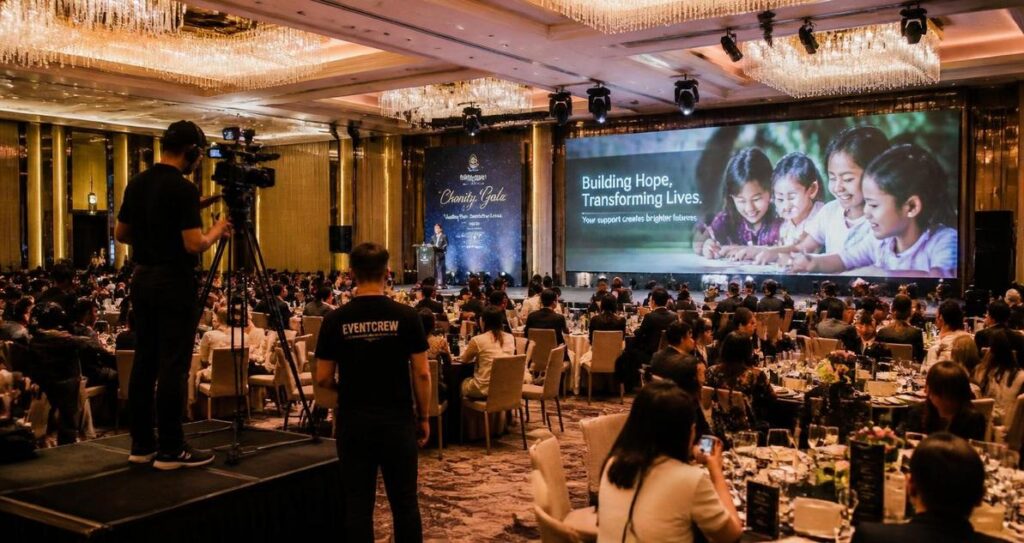
Non-profit galas in Singapore are more than formal evenings with speeches and fundraising appeals. They are carefully planned occasions where donor confidence, sponsor visibility, beneficiary stories, and organisational credibility all come together in one room. For many charities, social service organisations, and community foundations, the event is also a public-facing moment that can influence future support long after the lights go down. That is why professional video production matters. Good production does not simply make a gala look polished, it helps an organisation communicate purpose clearly, document impact accurately, and create a lasting asset that can be reused across fundraising campaigns, annual reports, and digital channels.
In Singapore, where audiences are accustomed to high production standards across corporate events, government communications, and branded content, a non-profit gala needs to feel intentional from the first announcement to the final thank-you message. The question is not whether a charity should use video, but how to use it well. The right production approach should support the event’s fundraising goals, reflect the organisation’s values, and fit the realities of local venues, audiences, and regulatory expectations. When done properly, professional video production becomes part of the donor experience, not just a technical add-on.
Why video production carries unusual importance at a non-profit gala
A gala is often the most visible event in a non-profit’s calendar. Guests may include major donors, corporate partners, volunteers, board members, government stakeholders, and members of the public who are learning about the organisation for the first time. Video content helps unify these different audiences by presenting the mission in a consistent and emotionally resonant way. A live speaker may explain the cause, but a well-produced video can show the work in action, letting people see the communities served, the challenges addressed, and the outcomes achieved.
Professional production also helps with pacing. Event evenings can become fragmented if presenters run long, AV cues are unclear, or transition time is poorly managed. A strong video package can improve flow by opening the evening with a mission film, supporting a fundraising appeal with a beneficiary story, or giving the stage crew a clean transition while guests are being seated or dinner is served. In a formal setting, these details matter because they keep attention focused and reduce the risk of a disjointed programme.
For Singaporean organisations, trust is especially important. Donors and sponsors expect transparency, clear messaging, and evidence of impact. A gala video should therefore avoid exaggerated claims and instead present verified information in a respectful, accurate manner. If the content refers to beneficiaries, programmes, or outcomes, the organisation should ensure that names, permissions, and depictions are handled appropriately. This is not just good practice, it is part of maintaining public trust.
Building a gala video strategy that fits Singapore’s event environment
Before filming begins, the organisation should decide what role video will play in the event. Some galas need a short brand film to set the tone. Others need a fundraising video featuring beneficiaries or frontline staff. Larger events may require multiple video elements, such as sponsor reels, motion graphics, emcee bumpers, donation appeal videos, and live camera feeds for screens around the venue. A clear strategy prevents wasted time and ensures every production element serves a purpose.
Singapore venues present their own practical considerations. Hotels, banquet halls, convention centres, and heritage spaces all have different ceiling heights, stage dimensions, power distribution, rigging rules, and loading bay procedures. Production planning should begin with a technical site recce, which is a structured venue inspection to assess camera placement, sightlines, audio coverage, screen size, and lighting constraints. This is particularly important in spaces where décor, tables, floral arrangements, or stage props may interfere with camera angles or audience visibility.
Budgeting also matters. A charity should not spend beyond its means just to create a cinematic result. Instead, the production plan should prioritise the highest-value elements first, such as reliable audio, clear visuals, and a strong narrative structure. If resources allow, additional features like b-roll coverage, highlight edits, and post-event social media clips can extend the value of the same shoot. This is often a better use of funds than commissioning a single video with no plan for reuse.
Aligning production with fundraising goals
Every visual and audio decision should support the gala’s fundraising purpose. If the event includes live giving, the production team can build a compelling appeal sequence that combines images, speaker narration, and on-screen prompts. If the event focuses on recognition and stewardship, the content may centre on gratitude, impact reporting, and sponsor appreciation. Clear alignment prevents the common mistake of making the video look impressive while failing to advance the actual campaign objective.
It is also useful to decide early where the video will be used after the gala. A production designed only for a single screening may not have the right framing, pacing, or subtitle treatment for later use on websites and social channels. With forward planning, the same footage can support donor communications, grant reporting, recruitment of volunteers, and future sponsorship pitches.
What professional video production should cover from pre-production to post-event delivery
High-quality gala production begins long before the event day. Pre-production is where the story, format, and technical requirements are defined. This stage usually includes scripting, interview planning, shot lists, talent coordination, venue checks, graphics preparation, and risk assessment. The more complex the event, the more important this planning becomes. A non-profit gala often has limited room for error because the audience includes stakeholders who will notice lapses in professionalism.
During production, the team should balance aesthetics with clarity. Video should be bright enough for banquet lighting conditions, audio should remain intelligible even in a busy room, and the visuals should remain stable and well framed on both large screens and in recorded footage. If live switching is involved, the operator needs to manage multiple camera feeds, presentation slides, and graphics in real time. In Singapore, where events often take place in acoustically challenging ballrooms or multi-purpose venues, sound reinforcement is just as important as camera work.
Post-production is where the event becomes an enduring communication asset. Editing should be precise, with clean cuts, balanced colour, and sound levels that are consistent across speech, music, and applause. If the footage is intended for online sharing, captions should be added for accessibility and viewing without sound. This is especially important because many people watch clips on mobile devices in public or office environments. A polished edit can also help the organisation preserve the atmosphere of the evening while making the content concise enough for digital use.
Capturing speakers, sponsors, and beneficiaries with care
One of the most sensitive aspects of gala production is how people are portrayed on camera. Speakers should be filmed in flattering but truthful ways, without excessive visual manipulation that would undermine credibility. Sponsors should be acknowledged respectfully, while avoiding content that makes the event feel like a commercial showcase rather than a charitable gathering. Beneficiary stories require the highest level of care, because dignity and informed consent must guide every decision.
When featuring beneficiaries, the organisation should obtain proper permissions and ensure the purpose of the filming is understood. If minors are involved, parental or guardian consent is essential. In some cases, it may be more appropriate to protect identity, use voice-over narration, or focus on programme outcomes rather than personal details. These choices are not about reducing emotional impact, but about preserving dignity and respecting the people the organisation serves.
Technical standards that shape the viewer experience
Video quality at a gala is determined by several technical factors working together. Resolution matters, but it is not the only consideration. Lighting, lens choice, exposure, audio capture, media playback format, and screen calibration all influence how polished the final presentation feels. Poor audio can undermine even the best footage, which is why lapel microphones, handheld microphones, and a clean sound feed from the house system should be planned in advance. If the event includes panel discussions or speeches, audio redundancy is especially useful.
Lighting should support both the live audience and the camera. A stage that looks attractive to guests may still be too dim or uneven for recording. Professional teams usually adapt the lighting plot so that faces are visible, skin tones remain natural, and keynote moments are captured cleanly. In some venues, the house lighting alone is not enough, so supplementary lighting may be required. The goal is not to make the room feel like a studio, but to maintain visual clarity without distracting from the atmosphere.
Playback testing is another critical step. Video files should be checked for compatibility with the event’s media server, projection system, or LED display. A file that works on a laptop may not behave the same way on a venue playback system. Audio codecs, aspect ratios, and frame rates should be standardised well before event day. This is a practical detail, but it can save the organisation from avoidable technical disruption during a key moment.
Accessibility and audience inclusivity
Professional production should serve as many people as possible. Captions help guests who are deaf or hard of hearing, and they also support viewers in noisy environments or on mobile devices. If the gala has multilingual elements, consider whether key messages should be presented in English and, where appropriate, supported by other languages relevant to the audience. In Singapore, where many events welcome a mixed audience, clarity and inclusivity are part of good communication practice.
Accessibility also includes viewing comfort. Screen content should be large enough to read, with sufficient contrast between text and background. Fast-moving graphics, crowded slides, or excessively decorative fonts can make important information harder to follow. When the audience is expected to donate, remember that clarity is not a design luxury, it is part of making the appeal easy to understand.
Choosing the right production partner in Singapore
Not every event company is equally suited to non-profit work. A good production partner should understand both technical execution and mission-driven communication. The team should be able to ask the right questions about donor intent, brand tone, audience composition, sponsor recognition, and post-event distribution. They should also be comfortable working with committees, volunteer organisers, and board-level decision makers, which is common in the non-profit sector.
When evaluating providers, look at previous event work, the consistency of their sound and image quality, and their ability to manage live environments calmly. It also helps to ask how they handle backup equipment, contingency planning, and change requests. Non-profit galas often evolve as sponsorship confirmations arrive or speaker schedules shift. A dependable production team should be able to adapt without compromising quality or control.
Communication style matters too. Organisations should seek a partner who explains technical options in plain language and respects budget constraints. A reliable team will recommend solutions that fit the event, not oversell equipment that adds cost without adding value. This is especially important in Singapore, where many charities operate with tight fundraising budgets and must justify every expense to donors and internal stakeholders.
Questions worth asking before you sign off on production
- How will the video content support our fundraising or stewardship goals?
- What venue checks do you recommend before event day?
- How will you manage audio from speeches, videos, and live stage moments?
- What backup plans are in place if a file fails or a device malfunctions?
- How will footage be repurposed after the event for digital and donor communications?
- What permissions or consent processes do we need for filming beneficiaries, speakers, or guests?
These questions help the organisation move beyond surface-level vendor comparison and focus on what actually affects event quality, trust, and usability.
Making the investment worthwhile after the gala ends
The value of professional video production does not end when the final guest leaves. In fact, post-event usage is often where the strongest return appears. A well-produced highlights reel can support next year’s sponsorship outreach. Short clips can be used in social media thank-you posts, annual reports, newsletter updates, and donor follow-up emails. Speaker excerpts can reinforce key messages, while behind-the-scenes footage can humanise the organisation and show the care that went into the evening.
For Singaporean non-profits, this reuse is especially practical because audiences often expect ongoing updates on outcomes and impact. A gala should not be treated as a one-night performance that disappears afterward. Instead, the recorded material can become part of an organisation’s communications library, helping to build continuity across campaigns and stakeholder touchpoints. This approach also makes the production spend more efficient, because the same footage continues working after the live event is over.
To get the most from the content, the organisation should plan for multiple deliverables from the start. A main event film, short social clips, still frames for marketing, and a sponsor thank-you edit can often be created from the same production day if the plan is well structured. That is where professional discipline shows its value, not only in how the gala looks on the night, but in how useful the content remains afterward.
For any Singaporean non-profit planning a gala, the best approach is simple: treat video as a strategic communication tool, not just a decorative feature. When the story is clear, the technical foundation is solid, and the production team understands the organisation’s mission, the result can strengthen donor trust and extend the impact of the event long after the applause fades. For organisations that want their gala to reflect both professionalism and purpose, thoughtful planning and experienced production support are the most reliable starting points.

Jeremy Lee is a seasoned digital marketing director and strategist with over two decades of experience in the industry. As the founder of Sotavento Medios, I manage a diverse portfolio of over 50 businesses, helping brands grow through advanced search strategies and digital innovation. My work focuses on bridging the gap between traditional search engine optimisation and the evolving world of AI-driven answer engines.
get in touch