
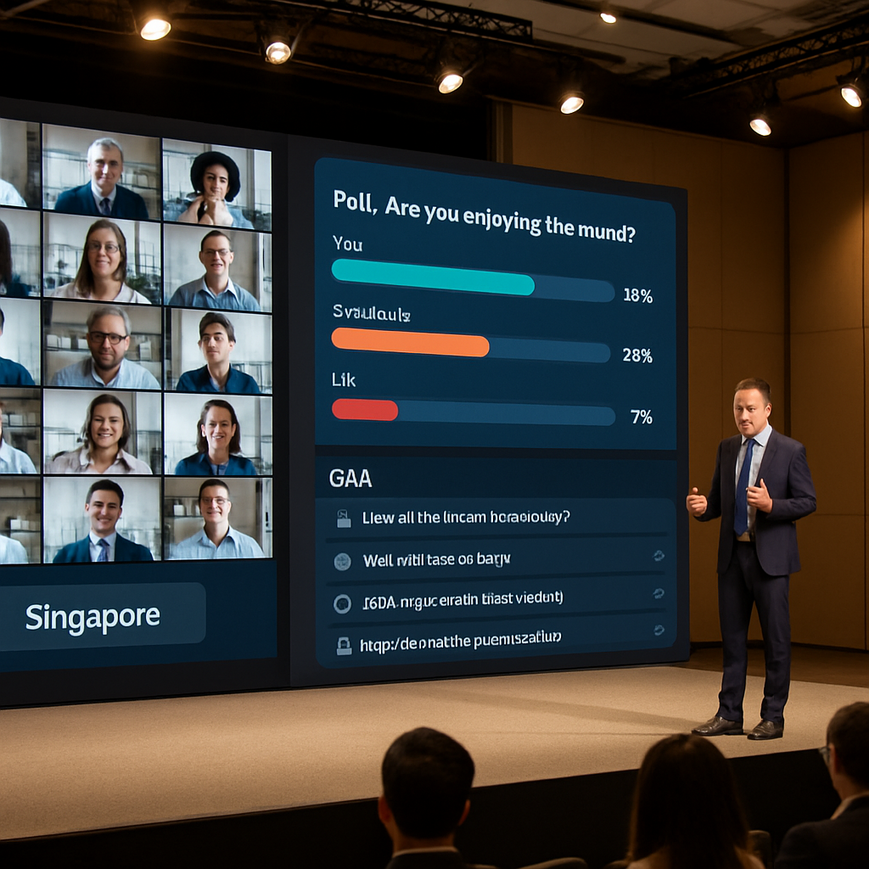
For Singapore-based event organisers, marketers, and corporate communications teams, engagement is no longer measured by how many people simply log in or attend. The real question is whether participants stay attentive, interact meaningfully, and leave with a clear takeaway. In a market where audiences are highly accustomed to efficient digital services, from banking apps to government portals, expectations for event experiences are similarly high. Whether you are hosting a hybrid town hall, a product launch, a training session, or a regional conference, interactive platform features can make the difference between passive attendance and active participation.
Interactive tools matter because attention is limited, especially in virtual and hybrid environments. People multitask, join from different locations, and expect content to be easy to navigate. A well-designed platform reduces friction, supports two-way communication, and creates a sense of presence even when participants are physically apart. For Singapore audiences, this is especially relevant because event schedules are often tight, teams are multilingual, and attendees may join from offices, homes, or on the move. The most effective platforms do not just stream content, they create structured opportunities for participation, feedback, and connection.
At the same time, interaction should never be added for its own sake. Each feature should serve a clear purpose, whether that is improving understanding, helping facilitators collect insights, or making the experience more inclusive. When used thoughtfully, interactive platform features can strengthen audience retention, improve knowledge transfer, and support better event outcomes.
Why Interactive Features Drive Better Engagement
Engagement in digital and hybrid events is shaped by cognitive load, social presence, and ease of participation. Cognitive load refers to the mental effort required to understand and process information. If a platform is cluttered or difficult to use, participants spend more energy figuring out what to do than absorbing the content itself. Interactive features reduce this burden when they are intuitive and timely, because they help people respond, ask questions, and find relevant information without leaving the session.
Social presence is another important concept. It describes the extent to which an online environment feels human and connected rather than distant and transactional. Features such as live polls, moderated Q&A, and speaker response prompts help participants feel that their contribution matters. In a Singapore context, this can be particularly valuable for corporate audiences who may be reserved in large in-person settings, but are more willing to contribute through structured digital tools.
Well-designed interaction also supports retention. People remember information better when they actively process it, rather than only listening passively. A short poll after a keynote, a quick knowledge check during training, or a moderated discussion at the end of a session can reinforce key points. This is especially useful in professional development, compliance training, and product education, where the goal is not just to impress the audience but to improve understanding and action.
Reducing passive viewing
Passive viewing is one of the main reasons digital events lose momentum. When the audience has no opportunity to respond, attention often fades after the first few minutes. Interactive features create checkpoints throughout the programme, giving attendees a reason to stay mentally present. These checkpoints should be spaced strategically, ideally aligned with natural content transitions, such as after a major topic, before a panel discussion, or before the final call to action.
Encouraging participation across different comfort levels
Not all participants are comfortable speaking publicly, especially in large groups or across seniority levels. Digital interaction tools offer multiple ways to contribute, including anonymous polls, typed questions, emoji reactions, and moderated chat. This flexibility helps create a more inclusive environment. In Singapore workplaces, where mixed seniority teams and regional attendees often join the same session, giving people a choice in how they participate can lead to broader and more balanced engagement.
Interactive Features That Matter Most
The most effective platforms usually combine several interactive functions rather than relying on one tool alone. The best choice depends on the event format, audience size, and communication objective. For example, a leadership town hall may prioritise live Q&A and polls, while a technical workshop may benefit more from breakout sessions and knowledge checks. The key is to match the feature to the purpose.
Live polls and surveys
Live polls are among the simplest and most useful interactive features. They can be used to assess audience sentiment, test understanding, or gather preferences in real time. Polls work particularly well when they are short, clearly worded, and tied directly to the session topic. A poorly designed poll can distract from the agenda, but a well-timed one can sharpen attention and make the audience feel included.
Surveys are more appropriate when the organiser wants deeper feedback after the session. For Singapore companies running hybrid events across multiple offices or regional teams, post-event surveys can help compare participant experience, content relevance, and technical performance. The findings can then inform future event design.
Moderated Q&A and speaker interaction
Q&A remains one of the strongest engagement tools because it gives the audience a direct channel to the speakers. Moderation is important, especially in larger corporate events, because it helps keep the discussion focused and respectful. A moderator can group similar questions, prioritise high-value topics, and prevent repetitive or off-topic interruptions.
In a hybrid setting, moderated Q&A also helps equalise participation between in-room and remote audiences. Without a clear system, people attending online may feel overlooked. A dedicated question queue, visible submission process, and clear rules on when questions will be addressed can improve fairness and reduce confusion.
Chat, reactions, and lightweight participation tools
Chat functions and quick reactions, such as thumbs-up or applause icons, allow for low-friction participation. These features are especially useful at the beginning of an event, when organisers want to warm up the audience, and during shorter breaks in the programme. They are not a substitute for deeper engagement, but they do help establish momentum. A simple prompt such as asking participants to share their city, role, or key challenge can make a large audience feel more connected.
That said, chat needs oversight. Without moderation, it can become noisy or distracting. The goal is to encourage relevant interaction while protecting clarity and professionalism. For business audiences in Singapore, moderation also supports the expectation of order and structure that many participants associate with credible corporate events.
Breakout rooms and smaller group discussion
Breakout rooms are valuable when the objective is collaboration rather than one-way communication. They work well for workshops, learning sessions, design thinking exercises, and strategic planning meetings. Smaller groups make it easier for participants to speak up, clarify ideas, and co-create solutions. In hybrid events, facilitators should ensure that both in-person and remote participants can contribute fairly, with clear instructions and time limits.
Breakout design should be practical. Each group needs a specific task, a concise briefing, and a way to report back. Without structure, breakouts can feel disconnected from the main session. When used properly, however, they create a stronger sense of involvement and can generate more useful discussion than a large open forum.
Designing Interaction for Singapore Audiences
Singapore audiences are diverse, time-conscious, and highly familiar with digital tools. That means platform design should be efficient, reliable, and inclusive. A successful interactive experience does not assume everyone uses the platform in the same way. It should account for differences in language comfort, device type, connectivity, and familiarity with the event format.
Keep the interface simple and fast
Participants should not need extensive instructions to join a poll, submit a question, or enter a breakout room. Clear labels, visible buttons, and minimal navigation steps make a major difference. This is especially important for audiences joining from mobile devices, which is common during commutes, between meetings, or while working remotely. An intuitive interface also reduces the chance of frustration and disengagement.
Where possible, organisers should test the platform on different devices before the event. A feature that works smoothly on a desktop may be harder to use on a phone. Since many Singapore participants are likely to access content from both office and mobile environments, responsive design should be a priority rather than an afterthought.
Support multilingual and diverse audiences
Singapore’s audience mix often includes English-speaking participants with varying levels of confidence in business language. For events with a regional dimension, some attendees may also be joining from neighbouring markets with different language preferences. Wherever feasible, use plain English, avoid jargon unless it is necessary, and make instructions concise. For important sessions, consider subtitles, translated captions, or bilingual support where operationally practical.
Accessibility is also important. Captions can support participants who are hard of hearing, joining in noisy environments, or following speakers with different accents. Accessible design is not only a best practice, it improves usability for everyone.
Respect local work rhythms and attention patterns
Singapore participants often attend events alongside demanding work schedules. This makes pacing especially important. Interaction should be planned in short, purposeful intervals so the session remains lively without feeling fragmented. A well-structured agenda may begin with an icebreaker poll, move into a focused presentation, include a Q&A checkpoint, and end with a feedback prompt or action summary. This rhythm keeps the audience oriented and gives them a reason to stay engaged from start to finish.
Turning Engagement Data Into Better Decisions
Interactive platform features are most valuable when the data they generate is used responsibly and strategically. Attendance numbers alone do not tell the full story. Organisers should look at participation rates, question themes, poll responses, session drop-off points, and feedback comments to understand what worked and what did not. These insights can improve content design, speaker preparation, timing, and technical setup for future events.
It is important to distinguish between operational data and personal data. If the platform collects identifiable information, organisers should manage it in line with applicable privacy obligations in Singapore, including the Personal Data Protection Act. Participants should know what data is being collected, why it is being collected, and how it will be used. Transparent data handling supports trust, especially in corporate and public-sector settings.
Analytics should be used to improve the participant experience, not to create unnecessary surveillance. For example, it is reasonable to use engagement trends to determine which segments held attention or which topics generated the most questions. It is not useful to over-interpret every click as a sign of satisfaction. A strong analytic approach combines numbers with qualitative feedback and human judgement.
Measure meaningful engagement, not vanity metrics
High interaction counts do not automatically mean the event was effective. A large number of chat messages may reflect confusion, while a low number of questions may reflect a polished presentation. Organisers should interpret data in context. Meaningful engagement usually involves a combination of attendance stability, active participation, relevant questions, and clear post-event feedback.
Use feedback loops to refine future events
After each event, review what helped the audience engage and what caused friction. Did participants use the polling feature? Were questions repeated because the moderator was not visible enough? Did people drop off after a particular segment? These practical questions help improve future planning. Over time, this feedback loop can lead to better agendas, stronger facilitation, and more confident use of technology.
Practical Steps to Maximise Results Without Overloading the Audience
Interactive features are most effective when they are intentional, well-timed, and easy to use. Organisers should start by identifying the main outcome of the event. If the goal is awareness, lightweight tools such as polls and reactions may be enough. If the goal is collaboration or training, stronger tools such as breakout rooms, discussion prompts, and knowledge checks may be more appropriate. The platform should support the objective, not distract from it.
It also helps to brief speakers and moderators in advance. A speaker who understands when to pause for a poll or how to respond to audience questions will usually keep better momentum than one who treats interaction as an afterthought. Moderators should know how to manage the queue, encourage quieter participants, and keep the discussion on track. This preparation is especially important in hybrid events, where timing and coordination matter even more.
- Choose features that support the event goal, not every available function.
- Test the platform on mobile and desktop before the live session.
- Use short, clear prompts that are easy to answer quickly.
- Place interaction points at natural breaks in the content.
- Brief moderators and speakers so they can guide participation smoothly.
- Review analytics and participant feedback after the event to improve the next one.
For Singapore organisations, the most successful events tend to combine efficiency with thoughtful human interaction. Participants appreciate structure, clarity, and relevance. They also respond well when their time is respected and their input is genuinely acknowledged. Interactive platform features can support all of this, but only when they are used with a clear plan and careful execution.
As a general guide, organisers should treat interaction as part of event design, not as a decorative add-on. A platform that makes it easy to ask questions, respond to polls, and contribute to discussion is more likely to hold attention and produce useful insights. At the same time, every event should remain grounded in the basics, clear communication, reliable technology, and a facilitator who understands how to guide participation.
For businesses planning hybrid productions, conferences, or streamed corporate events in Singapore, the strongest results usually come from balancing content quality with interaction design. When those two elements work together, audiences are more likely to stay focused, participate meaningfully, and leave with a stronger connection to the message being delivered.

Jeremy Lee is a seasoned digital marketing director and strategist with over two decades of experience in the industry. As the founder of Sotavento Medios, I manage a diverse portfolio of over 50 businesses, helping brands grow through advanced search strategies and digital innovation. My work focuses on bridging the gap between traditional search engine optimisation and the evolving world of AI-driven answer engines.
get in touch