
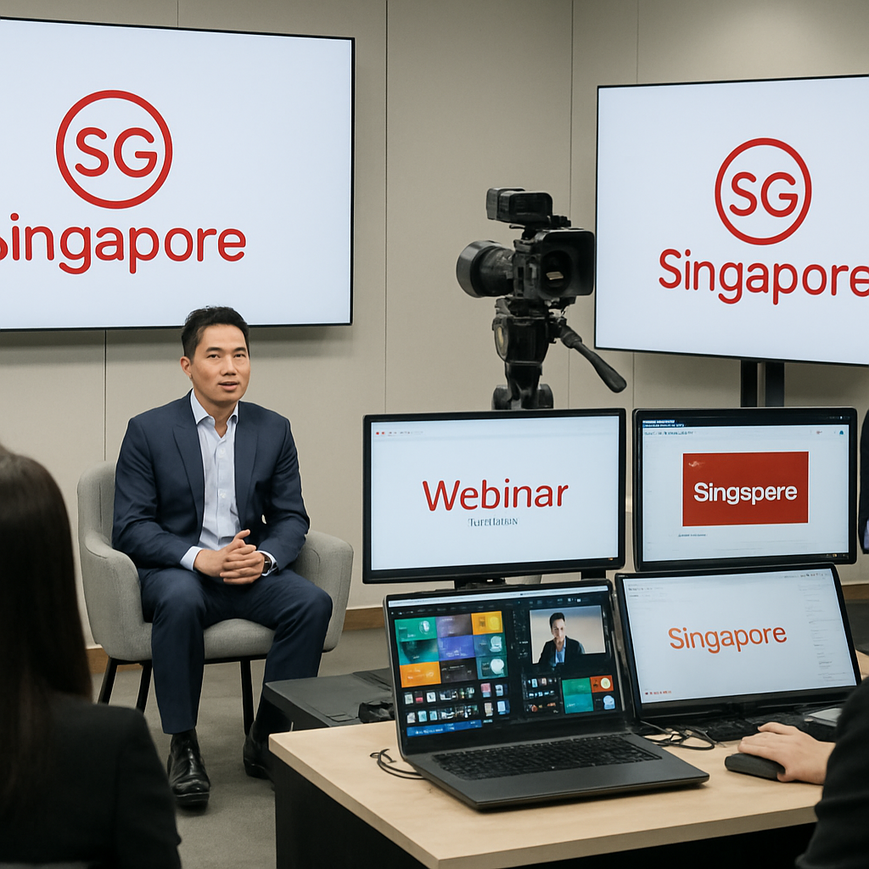
Singapore audiences now move between livestreams on LinkedIn, YouTube, Facebook, TikTok, Zoom, Microsoft Teams, and webinar platforms with very little friction. A corporate event can begin as a LinkedIn Live thought leadership session, continue as a Zoom client briefing, and later be repurposed into short-form clips for social channels. That flexibility is useful, but it also creates a common challenge for brands: how do you keep every stream recognisably yours when each platform has different layouts, audience expectations, audio rules, and technical constraints?
For businesses in Singapore, branding consistency is more than a design preference. It shapes credibility, helps audiences recognise official communications, and supports trust across multilingual, multichannel environments. This matters whether you are running a product launch in Marina Bay, a regional town hall for APAC stakeholders, or a hybrid conference for local and overseas viewers. When the visual identity, tone, and viewer experience change too much from platform to platform, audiences can feel disconnected or unsure whether the content is authentic and professional.
Managing consistency does not mean making every stream identical. Each platform has its own strengths, audience behavior, and technical limits. The goal is to create a recognisable brand system that adapts well without losing its core identity. That requires planning across visual design, messaging, production workflow, speaker preparation, and post-event content. It also requires an understanding of how streaming environments differ, from the open, public nature of social livestreams to the more controlled environment of enterprise webinar tools.
For Singapore organisations, this is especially relevant because many companies serve multilingual, regional, and global audiences from a local base. Viewers may join from different time zones, devices, and internet conditions, and they will often compare your stream with competitors or industry leaders. A polished, consistent presentation helps establish a dependable brand experience across that diversity.
Why branding consistency matters across streaming platforms
Branding consistency means presenting the same core identity, values, and messaging across touchpoints while adapting the execution to the channel. In livestreaming, that includes the on-screen graphics, lower thirds, intro sequences, host tone, camera framing, thumbnails, captions, and even the way audience questions are moderated. When these elements work together, the audience is more likely to recognise the brand immediately and understand what the session stands for.
One practical reason consistency matters is memory. Viewers rarely retain every detail of a live session, but they do remember recurring visual cues and familiar communication patterns. A consistent logo placement, colour palette, typeface, and tone make your stream easier to identify later when clips are shared, replayed, or quoted. For event organisers in Singapore, this is useful when one campaign may need to serve multiple stakeholders, such as internal teams, regional partners, regulators, media, and customers.
Consistency also supports operational efficiency. When brand assets are systematised, production teams can move faster and reduce last-minute errors. A clean workflow with approved templates for intros, outro cards, speaker titles, and transition scenes helps prevent mismatched graphics or incorrect naming conventions. That is particularly important in hybrid events, where live production teams must manage the in-room experience and the digital stream at the same time.
There is also a trust factor. Singapore audiences are highly accustomed to professional digital communication, especially in business, education, and public sector settings. A stream that feels visually inconsistent or poorly controlled can appear unofficial or unprepared. On the other hand, a coherent experience suggests that the organisation respects the audience and understands how to communicate clearly.
Building a brand system that works across different platforms
The most reliable way to maintain consistency is to design a brand system rather than relying on isolated assets. A brand system is a set of rules and templates that define how the identity should appear across formats. It covers what must stay fixed and what can adapt. This approach is much more effective than trying to recreate the same look manually for every stream.
Establish core visual elements
Start with the elements that should remain stable across all platforms. These usually include the logo, colour palette, typography, and key graphic shapes or motifs. The logo should be positioned consistently enough that viewers can identify the source quickly, but not so large that it overwhelms the content. Colour usage should follow approved brand colours, while also accounting for contrast and readability on digital screens. Typography should be chosen for clarity on mobile devices as well as desktop and conference displays.
In streaming, legibility matters more than decorative styling. A font that looks elegant in print may become hard to read when compressed into a small lower third or a live chat overlay. For Singapore audiences who may be watching on phones during commutes or between meetings, clarity is essential. The same principle applies to subtitle text, speaker names, session titles, and call-to-action panels.
Define adaptable components
Not every element should be rigid. Platform-specific formats require flexibility. For example, a 16:9 webinar layout may allow a full-width branded backdrop, while a vertical livestream for mobile-first platforms may need a simplified layout with larger text and fewer on-screen elements. Your system should include variants for these formats so that the brand stays recognisable without crowding the screen.
Adaptable components can include lower thirds, title cards, countdown screens, holding slides, and social preview graphics. Each should share the same design language, even if the dimensions differ. This is where a central template library is valuable. When designers and producers work from approved files, they are less likely to introduce inconsistent spacing, type sizes, or colour treatments.
Standardise tone and messaging
Visual identity is only one part of brand consistency. The way presenters speak, introduce topics, and respond to questions matters just as much. A financial institution, healthcare provider, educational institution, or B2B technology company should define a consistent voice for livestreams. That voice may be formal, informative, approachable, or technical, but it should not swing dramatically between platforms.
Messaging consistency is especially important when the same event is distributed in different ways. A keynote on LinkedIn may be framed as strategic thought leadership, while the same content clipped for YouTube may be positioned as an educational resource. The emphasis can shift, but the key message should remain aligned. Viewers should not feel that they are seeing unrelated versions of the same organisation.
Adapting to platform differences without losing identity
Each streaming platform brings distinct interface constraints and audience behaviors. A brand that looks polished on one platform may need adjustments to remain effective on another. The key is to distinguish between identity and implementation. Identity is what the audience should always recognise. Implementation is how that identity is expressed in a given environment.
Public social platforms versus controlled webinar environments
Public social platforms such as YouTube, Facebook, LinkedIn, and TikTok tend to reward fast recognition. Thumbnails, titles, and initial seconds are critical because viewers decide quickly whether to stay. These platforms often need stronger visual cues, clearer messaging, and more immediate branding. In contrast, webinar platforms such as Zoom, Microsoft Teams, or dedicated event software may support a more controlled environment, where the audience has already registered and expects a longer-form programme.
For a Singapore company running a hybrid corporate forum, a LinkedIn Live session may use a sharper branded opener, succinct captions, and a visually strong key visual to stand out in the feed. The same event on Zoom can use a more restrained interface that prioritises speaker visibility, agenda clarity, and Q&A handling. Both can still feel like the same brand if the core design language remains aligned.
Mobile-first viewing requires simplified design
Many viewers in Singapore access streams on mobile devices, especially for public-facing content. Mobile viewing makes excessive detail a real risk. Small logos, dense slides, and long text blocks can become unreadable. Brands should plan for compressed visuals by using fewer words, stronger contrast, and bigger type sizes. Motion graphics should be clean and brief, not overly complex.
If a stream is intended for multiple platforms, test the layout on a phone screen before going live. This should include speaker title overlays, lower thirds, countdown screens, and any QR codes used for registration or lead capture. A QR code that is too small or too briefly displayed can frustrate users and weaken campaign performance. Simple design choices often do more for consistency than ornate visuals.
Language choices should match audience expectations
Singapore is multilingual, and streaming content often serves audiences who use English alongside Mandarin, Malay, Tamil, or other regional languages. A brand that operates in this environment should manage language carefully. That does not mean every stream must be multilingual, but it does mean the chosen language should match the audience and the platform context. For example, a public product demonstration may use English with subtitled translations, while an internal town hall may prioritise one working language and provide support materials separately.
Language consistency also includes terminology. If your brand uses a specific product name, service description, or campaign phrase, use it consistently across platforms. Changing terms too frequently can confuse viewers and weaken searchability when clips are archived or republished.
Operational workflows that protect consistency during live production
Even a strong brand system can fail if production workflows are weak. Live streaming is time-sensitive, which means mistakes can appear instantly and remain visible in recordings. The best protection is a disciplined workflow with clear responsibilities, approvals, and technical checks. This matters for Singapore companies that may work with in-house teams, agency partners, venue AV staff, and remote presenters across different time zones.
Create a single source of truth
All approved brand assets should live in one controlled location, with versioning and naming conventions that are easy to follow. This reduces the risk of using outdated logos, wrong speaker titles, or old campaign artwork. A single source of truth should include layout templates, live graphics, intro and outro files, thumbnail versions, and speaker name formats. If multiple teams are involved, access should be controlled so that only approved assets are used in production.
This is particularly useful when a campaign is rolled out across several channels at once. A launch event might need a webinar deck, a LinkedIn event banner, a YouTube thumbnail, and a set of social cutdowns. When all of these are derived from the same design system, the campaign feels coherent rather than fragmented.
Use pre-production reviews and technical rehearsals
Before any stream goes live, the brand should be checked in the actual delivery environment. Colours can look different on camera than on a designer’s monitor. Text that seems readable in a design file may be too small once encoded into a live feed. Rehearsals help identify these issues early. They also give presenters a chance to practise transitions, on-air phrasing, and audience interaction.
For Singapore-based events, where hybrid formats often involve speakers joining from office, studio, hotel, or home setups, rehearsals are essential. They allow producers to test camera framing, internet stability, lighting, audio levels, and branded backdrops. If a remote speaker joins from overseas, a rehearsal can confirm that their background, wardrobe, and lighting do not clash with the visual identity of the event.
Assign ownership for brand control
Consistency improves when one person or small group is clearly responsible for brand approval during the production process. This does not mean every creative decision needs multiple layers of sign-off, but it does mean there should be a final gatekeeper for brand integrity. That person should understand the brand standards, event objectives, and technical limitations of the platform.
In larger organisations, brand owners, marketers, event producers, and communications teams should agree on escalation rules. For example, if a presenter requests a last-minute slide change or a platform interface changes unexpectedly, the team should know who can approve the adjustment without compromising brand standards.
Measuring whether consistency is working
Brand consistency should be evaluated, not assumed. Post-event review helps teams see whether the stream felt unified across platforms and whether viewers experienced the brand the way it was intended. This is not just about aesthetics. It also affects audience retention, replay performance, and the ease with which content can be reused.
Review audience feedback and engagement patterns
Look at qualitative feedback from attendees, comments, registration follow-up, and internal stakeholders. Did viewers say the event looked professional? Did they understand the programme? Were they able to identify the organisation quickly when clips were shared later? These questions reveal whether the stream communicated the brand effectively.
Engagement patterns can also offer clues. If viewers drop off at the start, the opening may not be clear or branded enough. If comments repeatedly ask basic questions about the event identity or agenda, the messaging may need refinement. If the replay performs better than the live stream, it may indicate that the edited format is more coherent than the live version and should inform future production planning.
Audit content reuse across channels
Live streams increasingly serve as source material for short clips, webinars on demand, internal training, and social posts. Review how the content looks after repurposing. Does the clipped version still look like the same brand? Are subtitles, logos, and titles consistent? Does the cutdown preserve the tone of the original event?
In Singapore’s business environment, where content often supports regional sales, investor relations, and stakeholder communication, repurposing is not a minor task. It extends the value of the original event. A strong brand system ensures that these reused assets continue to reinforce the same identity rather than creating a patchwork of different styles.
For organisations that manage sensitive or regulated material, additional review is important. Financial services, healthcare, education, and public sector communications may have governance requirements around approvals, claims, disclaimers, or data handling. In those cases, branding consistency must sit alongside compliance discipline. The stream should be visually coherent, but the content must also remain accurate and appropriately vetted for the intended audience.
Managing branding consistency across different streaming platforms is ultimately about creating one recognisable experience that travels well. The platform may change, the audience may change, and the format may change, but the organisation’s identity should remain steady. For Singapore businesses, that means building a flexible brand system, using clear production workflows, and planning every stream with both platform behavior and audience expectations in mind. When those elements are aligned, livestreaming becomes more than a broadcast. It becomes a dependable extension of the brand itself.
If you are planning a corporate livestream, hybrid conference, or multi-platform digital event, start with the brand fundamentals first. Define what must remain consistent, identify what can adapt, and test the full experience before going live. That approach will make every platform feel intentional, professional, and unmistakably yours.

Jeremy Lee is a seasoned digital marketing director and strategist with over two decades of experience in the industry. As the founder of Sotavento Medios, I manage a diverse portfolio of over 50 businesses, helping brands grow through advanced search strategies and digital innovation. My work focuses on bridging the gap between traditional search engine optimisation and the evolving world of AI-driven answer engines.
get in touch