
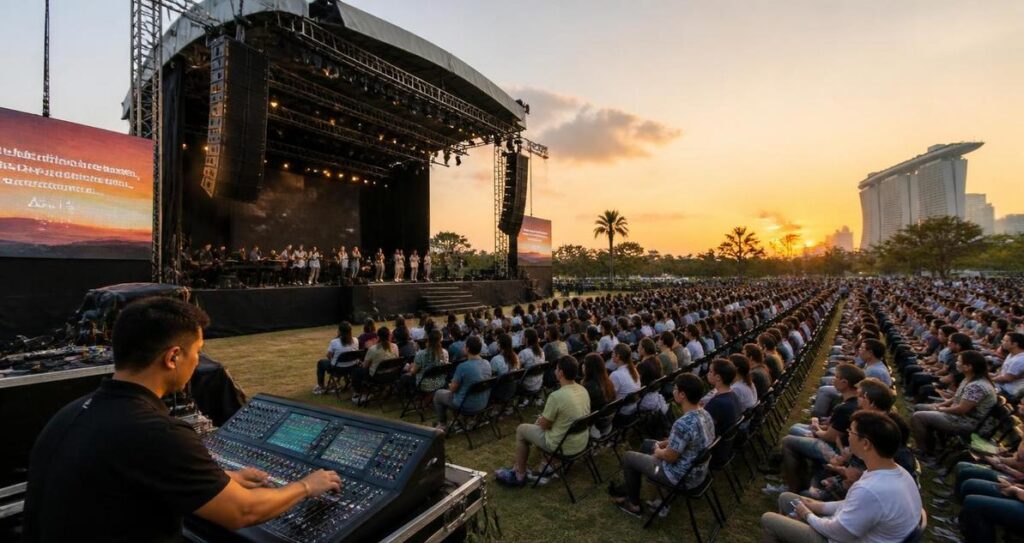
When a faith event moves outdoors, audio becomes more than a technical detail. It is the bridge between the speaker, the music team, and hundreds or even thousands of people gathered across open spaces, temporary seating, and live broadcast screens. In Singapore, where large-scale outdoor religious gatherings may take place in parks, open fields, precincts, school grounds, or temporary event venues, sound quality can be affected by humidity, heat, wind, passing traffic, building reflections, and crowd noise. If the audio is unclear, worshippers may miss key messages, singers may lose timing, and the entire experience can feel fragmented even when the programme itself is strong.
For organisers, the goal is not only volume. The real objective is speech intelligibility, musical balance, and consistent coverage across the entire audience area. That means choosing the right system, planning for the site, tuning for the environment, and managing the event in real time. These steps matter for faith-based events of all sizes, from sunrise prayer gatherings to major celebrations that bring together multiple choirs, speakers, and simultaneous language segments. The following guidance explains how to approach audio quality methodically, with practical considerations suited to Singapore’s climate, venue realities, and audience expectations.
Understanding the Acoustic Challenges of Outdoor Faith Events
Outdoor venues behave very differently from indoor sanctuaries. In enclosed spaces, walls and ceilings reflect sound, which can help reinforce speech and music, but can also create echoes and reverberation if not controlled. Outdoors, there are fewer reflective surfaces, so sound dissipates more quickly. This often means that speakers need careful placement and appropriate system design to prevent the front rows from being too loud while the back rows struggle to hear clearly.
In Singapore, environmental conditions add another layer of complexity. High humidity can affect equipment handling and storage, while sudden rain requires rapid protection of microphones, mixing consoles, loudspeakers, and power distribution. Wind can disrupt microphone pickup, especially for handheld or podium microphones. Nearby roads, construction, service vehicles, or public announcements may also compete with spoken content. Even the presence of large crowds can change the acoustic environment, because human bodies absorb sound differently from an empty test field.
Why speech intelligibility matters more than maximum volume
For faith events, the most important audio metric is speech intelligibility, which refers to how easily listeners can understand spoken words. A system that is simply loud is not necessarily clear. In fact, excessive volume can blur consonants and make announcements harder to follow. This is especially important when there are prayers, scripture readings, multilingual segments, or safety announcements that must be understood accurately.
Organisers should think in terms of even coverage rather than maximum output. The audience should hear the same message with similar clarity whether they are seated near the front, at the side, or farther back. This is achieved through correct loudspeaker placement, delay alignment for distant zones, and tuning that supports speech frequencies without making the system harsh.
Designing the Sound System for the Site
Successful outdoor audio begins long before event day. A proper site survey allows the technical team to understand audience layout, stage position, prevailing wind direction, power access, and possible noise sources. In Singapore, where many events take place in multi-use public spaces, the setup must also consider access restrictions, load-in timing, and any rules imposed by the venue operator or relevant authorities.
System design should match the event format. A single podium speaker requires a different setup from a programme that includes worship bands, choir microphones, guest speakers, and live translation. The more sources involved, the more important it is to manage routing, monitor mixes, and feedback control. A reliable design includes front-of-house speakers, fill speakers for wider areas, delay towers or delay lines for larger coverage zones, stage monitoring for performers, and redundant signal paths where possible.
Choosing loudspeakers and coverage patterns
Not all speakers project sound in the same way. Line array systems are commonly used for larger outdoor events because they can provide controlled vertical coverage and consistent throw across longer distances. Point-source loudspeakers may be suitable for smaller gatherings or fill areas. The key is not the brand name alone, but whether the chosen system matches the audience geometry and throws sound evenly without unnecessary spill into nearby residential or quiet zones.
Coverage pattern matters. If the sound beam is too narrow, people at the edges may hear poorly. If it is too wide, more sound energy is wasted, and spill into surrounding areas increases. Experienced engineers use prediction software, manufacturer data, and practical tuning to place cabinets at suitable heights and angles. For Singapore’s denser urban environment, controlling sound spill is often just as important as achieving good on-axis coverage.
Managing microphones and inputs
Microphone selection should match the source. Handheld dynamic microphones are often useful for speakers because they handle high sound pressure levels well and are less sensitive to ambient noise than many condenser microphones. Lavalier microphones can be useful when hands-free operation is necessary, but they may pick up more room noise, clothing rustle, and ambient sound. Headset microphones can provide strong speech clarity for presenters or performers who move around the stage, although their appearance may not suit every event format.
For musical segments, instrument microphones and direct inputs should be selected to preserve clarity while keeping stage noise under control. Each input should be gain-staged carefully so that the signal is strong but not distorted. Proper gain staging means setting the input level, preamp, and output levels so the audio remains clean throughout the chain. This reduces the chance of clipping, which occurs when the signal is too strong for the system and creates distortion.
Controlling Audio in Singapore’s Outdoor Conditions
Singapore’s weather and urban environment require proactive control measures. Outdoor events can encounter high humidity, intense sun, sudden rainfall, and variable wind. Electronics should be protected with weather-appropriate coverings, but these must not block ventilation or create overheating risks. Cabling should be secured to prevent trip hazards and minimise accidental disconnection. Connectors and junctions should be treated as vulnerable points that need extra protection from moisture.
Wind is often underestimated. It can create low-frequency rumble on microphones, reduce intelligibility, and make subtle speech sounds harder to understand. Using windshields or foam covers on microphones can help, especially for handheld and podium use. For more exposed settings, stronger wind protection may be needed. Microphone placement should also account for the direction of wind whenever possible, since positioning can significantly affect clarity.
Handling rain, heat, and humidity
Rain protection should be planned, not improvised. That means having a weather response plan, covered storage, waterproof cases, and clear decision points for pausing performance, relocating equipment, or stopping the programme if conditions become unsafe. Electrical safety remains a priority. Qualified technicians should manage power distribution, grounding, and load planning, especially when generators or temporary power systems are used.
Heat and humidity can affect both equipment reliability and operational comfort. Equipment racks, amplifiers, and mixers may need shade and airflow. Crew members should also work in conditions that allow concentration and safe handling of cables and equipment. For events that run for several hours, rest rotation for technical staff is sensible because fatigue can affect both decision-making and reaction time.
Reducing noise interference from the surroundings
Even in well-planned venues, outside noise can interfere with the programme. Nearby roads, construction activity, aircraft, public transport, and other events may contribute to background noise. The team should conduct a sound check at a time that reflects actual event conditions, not only at a quiet hour when the space sounds better than it will later. If possible, schedule the event flow so that more delicate spoken segments do not coincide with predictable noise peaks.
For faith events in busy areas of Singapore, the engineer may need to use high-pass filters to reduce low-frequency rumble, equalisation to improve clarity, and careful microphone technique to keep voices present in the mix. These techniques should be applied conservatively, because overprocessing can create a thin or unnatural sound.
Live Mixing, Monitoring, and Team Coordination
Good equipment alone does not guarantee good sound. The live mix, monitoring workflow, and communication between the production team and programme leads are equally important. During a large outdoor faith event, the audio engineer must balance spoken word, music, crowd response, and any playback material without making the mix fatiguing or inconsistent.
Clear communication before the event is essential. The technical team should know the run sheet, speaker order, prayer moments, music transitions, and any emergency announcements. If there are multiple languages or signalled transitions between speech and music, the audio team should understand these cues in advance. This helps the engineer make quick decisions without disrupting the flow of the programme.
Soundcheck should simulate real use
A soundcheck is most useful when it resembles the actual event. That means testing microphones with the people who will use them, at performance level, and in the same positions they will occupy during the programme. If the choir will sing from a riser, test them from the riser. If a speaker will move from podium to stage edge, test both positions. If there are delays for far seating areas, verify them during the soundcheck rather than assuming the settings will remain correct.
It is also wise to conduct a spoken-word intelligibility check from several audience positions. Ask a team member to listen from the front, middle, and back, then confirm that words are clear and not masked by music, wind, or environmental noise. This simple step can reveal problems that are not obvious from the mixing position alone.
Monitoring for performers and speakers
Stage monitoring helps speakers and performers hear themselves and stay in time. However, too much monitor volume can create feedback, which is the unwanted squealing sound caused when a microphone picks up amplified sound from a speaker and re-amplifies it in a loop. To reduce feedback, keep monitor levels practical, place microphones behind the speaker coverage where possible, and use directional microphones appropriately. In-ear monitoring may be useful for certain music teams, although it requires preparation and discipline.
Communication tools such as talkback microphones, intercoms, or clear briefing channels can also improve coordination between front-of-house, stage management, and camera or livestream teams. This matters for larger faith events where audio must serve both the live audience and the online audience at the same time.
Audio for Hybrid Faith Events and Livestream Integration
Many faith events in Singapore now include a hybrid component, with a live audience and an online audience watching from home. This creates additional audio requirements. The mix that sounds acceptable in the venue may not automatically translate well to a livestream. Online viewers usually hear the programme more directly, so issues such as excessive crowd noise, unbalanced music, or uneven speaker levels become more noticeable.
For hybrid events, it is helpful to create a separate broadcast mix. This mix can be adjusted independently from the house sound so that the stream remains clear and balanced. Speech should remain intelligible, music should not overwhelm dialogue, and audience response should be controlled enough to avoid distracting the online listener. The production team should also ensure that any microphones used for the livestream are correctly placed and not dependent solely on ambient pickup from the main PA system.
Coordinating with video and streaming teams
Audio, camera, and streaming workflows need to be planned together. If the speaker changes position, the camera framing and microphone pickup should remain aligned. If music cues are played from a device, that playback should feed both the house system and the stream in a controlled manner. Timing matters because a delay between what the audience sees and hears can create confusion, especially during call-and-response moments or prayer recitations.
For organisers working with professional event production teams, a shared cue sheet and communication protocol can prevent many common problems. This is particularly useful when the event includes multiple speakers, live music, translation, or pre-recorded segments.
Practical Checklist for Reliable Outdoor Audio
A structured checklist helps organisers reduce avoidable errors and keep the programme stable. The following points are especially useful for large-scale outdoor faith events in Singapore:
- Complete a site survey before confirming equipment needs.
- Match loudspeaker type and coverage to the audience layout.
- Use microphones suited to the source and environment.
- Protect gear from rain, humidity, and heat without blocking ventilation.
- Plan power distribution with qualified technicians and proper cable management.
- Test speech intelligibility from multiple audience positions.
- Prepare a weather response plan, including pause or relocation procedures.
- Coordinate audio cues with stage management, livestream, and translation teams.
- Keep backup microphones, cables, and critical playback options available.
- Brief speakers on microphone technique, especially for handheld and podium use.
These steps do not require unnecessary complexity, but they do require discipline. The strongest events are often the ones where the technical foundation is invisible because it has been carefully prepared in advance.
For event organisers, ministry teams, and venue planners, audio quality should be treated as part of the pastoral and communal experience, not as an afterthought. Clear sound supports understanding, participation, and inclusion, especially when people of different ages and hearing abilities are present. In Singapore, where weather, density, and venue constraints can all affect performance, the best results come from early planning, competent engineering, and realistic testing under conditions that reflect the actual event. If your outdoor faith programme depends on every word being heard and every song being carried with clarity, invest in a production approach that prioritises intelligibility, safety, and consistency from the first briefing to the final note.

Jeremy Lee is a seasoned digital marketing director and strategist with over two decades of experience in the industry. As the founder of Sotavento Medios, I manage a diverse portfolio of over 50 businesses, helping brands grow through advanced search strategies and digital innovation. My work focuses on bridging the gap between traditional search engine optimisation and the evolving world of AI-driven answer engines.
get in touch