
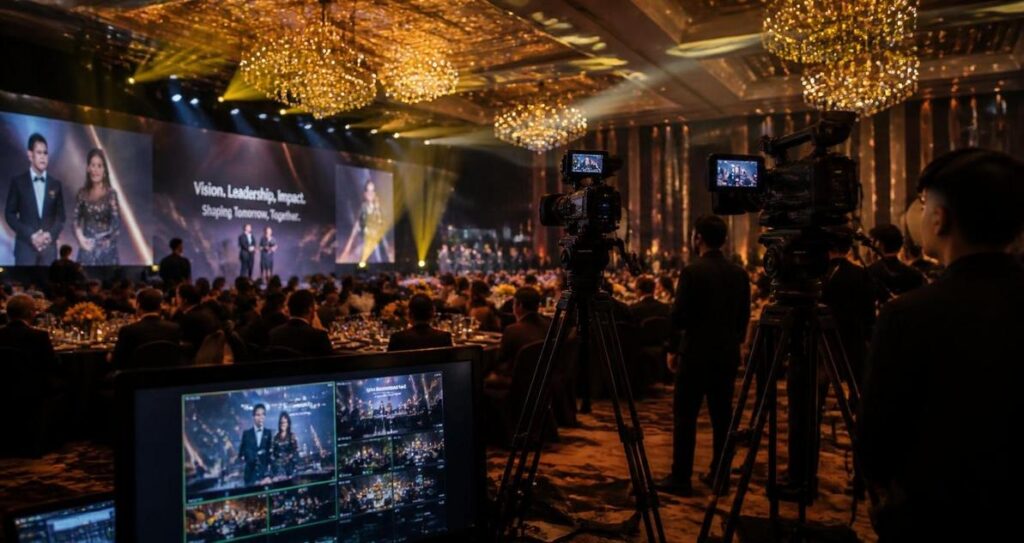
Luxury events in Singapore are judged quickly, often before a guest finishes the first conversation or the first glass of champagne. The lighting, the room design, the stage moments, and the way the event is presented on screen all shape how the brand is remembered. For high-end product launches, gala dinners, award ceremonies, private showcases, and corporate hospitality events, a single static camera rarely does justice to the scale and detail involved. A well-planned multi-camera setup gives the production team the ability to show the full atmosphere, capture important reactions, and produce polished live or recorded content that reflects the standard of the event itself.
For Singapore-based organisers, this matters even more because many luxury events here are designed for discerning local and regional audiences, including clients from finance, real estate, hospitality, technology, and premium consumer brands. These events often take place in venues such as hotel ballrooms, convention halls, rooftop spaces, and branded showrooms, each with its own technical constraints. A multi-camera workflow can help overcome these constraints by building a layered visual narrative, from wide establishing shots to close-ups of speakers, product details, and guest reactions. The result is not just coverage, but presentation with intent, which is exactly what premium events require.
Why multi-camera production is the standard for luxury event coverage
Luxury events rely on precision. Every cue, spotlight transition, presentation slide, and live performance is part of the audience experience, and camera coverage must support that experience without distracting from it. A multi-camera setup usually combines several camera positions to create visual variety and production flexibility. This approach is especially valuable when the event includes speeches, fashion presentations, product demonstrations, live entertainment, or moments that cannot be repeated.
Compared with a single-camera setup, multiple cameras allow the director to cut between angles in real time or in post-production. That means one camera can hold a wide shot of the venue while another focuses on the speaker, and a third captures audience reactions or detail shots. In luxury settings, those details matter. A close-up of a watch reveal, a couture fabric texture, a stage entrance, or a VIP handshake can add narrative weight and reinforce exclusivity. For brands, these images are often used after the event for social media, internal communication, recap videos, and media relations.
In Singapore, where event venues can vary from compact hotel spaces to large convention centres such as Suntec Singapore or Marina Bay Sands, multi-camera planning must account for sightlines, rigging restrictions, and venue rules. Professional production teams typically work with event organisers, AV partners, and venue technical teams to confirm camera positions, cable routing, power supply, and operator access. This planning stage is critical because a camera placed too late or too close to the audience can obstruct the guest experience or violate venue safety requirements.
What a luxury event camera plan needs to achieve
A strong camera plan does more than record the stage. It should create visual continuity, emphasise brand cues, and preserve the emotional atmosphere of the event. The production team usually maps the programme in advance, identifying the must-capture moments such as keynote entries, award presentations, live performances, product unveils, and VIP interactions. This helps determine how many cameras are needed and where each one should be placed.
For premium events, the typical goal is to balance three elements: coverage, discretion, and quality. Coverage ensures nothing important is missed. Discretion keeps the technology invisible enough that guests remain immersed. Quality means the footage must look refined, well-lit, and stable, even under difficult venue lighting conditions.
Planning the camera architecture for complex event spaces
Multi-camera production starts long before the first guest arrives. The camera architecture must reflect the event format, the venue layout, the audience size, and the final distribution requirements. Some events need a live cut for streaming to overseas stakeholders, while others need a polished aftermovie for brand marketing. Each outcome requires a different operating method, though both depend on careful pre-production.
In Singapore, venue access windows can be tight, especially in hotels and convention spaces with multiple events running in parallel. This makes early technical scoping essential. The production team needs to inspect ceiling heights, stage width, LED screen placement, house lighting positions, and possible camera blocking issues. For luxury events that include elaborate floral installations, staging, or runway elements, the camera positions must be coordinated with the scenic design so that equipment does not disrupt the visual composition.
Common camera roles in a premium setup
A multi-camera workflow usually assigns each camera a specific role. A wide master camera records the full stage and keeps the programme covered if a presenter moves unexpectedly or if the director needs a safe shot. A medium camera frames the speaker or performer more tightly, which is useful for speeches and formal announcements. A roaming or side camera can capture audience responses, guest arrivals, or candid details that add atmosphere. In larger productions, a close-up camera may be used for product features, award recipient reactions, or controlled beauty shots.
The most effective setups use lenses and framing choices that match the event’s tone. For example, a luxury jewellery launch may benefit from tighter shots and macro-style detail work, while a high-profile gala dinner may require elegant wide compositions that show the scale of the room without making the scene look crowded or cluttered. Camera movement should feel purposeful, not restless. Excessive panning or zooming can cheapen the visual impression, especially when the brand is positioning itself at a premium level.
Live switching and recorded coverage serve different goals
Not every luxury event needs a live-switched show, but when live delivery is required, the technical standard rises significantly. Live switching means a vision mixer or director selects camera angles in real time, often in sync with sound, graphics, and slides. This is common for conferences, awards, and hybrid events where remote participants need to see the programme clearly. For recorded coverage, the same footage may be edited later with more flexibility, allowing the team to refine pacing and highlight the best visuals.
For Singapore organisers working with regional audiences, hybrid event design has become a practical part of many premium productions. This does not change the need for elegance. It means the cameras must support both the in-room audience and the online viewer, without making the event feel like a broadcast studio. The best productions achieve this by using clean compositions, disciplined camera movement, and coordinated audio capture so that the final result feels intentional and polished.
Lighting, sound, and control systems that make luxury footage work
Camera quality alone does not create a premium image. Lighting and sound are equally important, because even the best camera cannot rescue a poorly lit or badly recorded event. Luxury venues often use atmospheric lighting, dimmed dining settings, or decorative effects that look beautiful in person but can be challenging for cameras. A production team must therefore plan for exposure, colour balance, and contrast well in advance.
In Singapore’s event environment, many luxury venues already have strong in-house AV infrastructure, but that does not mean the event is automatically camera-ready. House lighting may be designed for ambience rather than broadcast clarity. Reflections from glass, polished surfaces, mirrors, or metallic décor can also create visual complications. For this reason, production crews often bring supplemental lighting such as soft key lights, fill lights, or stage wash adjustments to improve facial visibility without flattening the atmosphere.
Why sound capture is inseparable from camera coverage
Video quality loses value quickly if the audio is unclear. At luxury events, sound usually includes speeches, live performances, ambient applause, and sometimes multilingual content. Proper audio capture may involve podium microphones, wireless handheld microphones, lavalier microphones, direct feeds from the audio console, and ambient room mics. A clean audio chain ensures that the recorded or streamed output matches the visual standard.
For Singapore events, where English is often mixed with Mandarin, Malay, Tamil, or other languages depending on the audience, sound clarity becomes even more important. If the event includes interpreters or translated segments, the camera team must coordinate with the audio team so that cuts, speaker changes, and subtitle workflows remain coherent. This is especially important for high-value corporate audiences, where professionalism is judged by both clarity and responsiveness.
Control room discipline keeps the production seamless
The control room, whether it is a dedicated production truck, a compact backstage system, or a temporary rack setup, is where the event comes together. Here the director, technical director, vision mixer, graphics operator, and audio engineer coordinate each cue. In luxury productions, the pace must be calm and exact. A missed cue or late cut can make even a beautifully designed event feel disorganised.
Good control room practice includes clear communication channels, rehearsed run sheets, and backup plans for signal loss or equipment failure. Camera tally lights, intercom systems, and synchronized timecode can improve coordination. When the event involves multiple speakers or live performances, the control team should also know which moments require full-screen graphics, which moments should stay on a wide shot, and where the edit points are for post-event deliverables.
How to adapt multi-camera production to Singapore venues and expectations
Singapore offers a highly developed events ecosystem, but it also comes with practical constraints that shape how luxury event production is executed. Venue booking schedules, noise restrictions, loading bay access, and public safety requirements all affect setup time. At certain venues, crew access may be tightly managed, and equipment movement must be coordinated with hotel operations or building management. A production plan that works in theory may fail if it does not account for these local realities.
For example, a ballroom event in Orchard or Marina Bay may require discreet rigging and a rapid build schedule because the space turns over quickly between functions. A luxury brand activation in a retail or showroom environment may have limited rigging points and require compact camera footprints. Outdoor events, including rooftop receptions or waterfront functions, may need additional attention to weather protection, reflections, wind noise, and power distribution.
Working within venue rules without compromising the visual result
Experienced production teams adapt the setup rather than forcing a generic solution onto the space. They may use smaller camera bodies on tripods or pedestals, remote heads for elevated angles, or wireless transmission where cabling is restricted. They may also coordinate with the venue to position equipment during load-in windows that minimise guest disruption. In some cases, a stealthy camera arrangement with long lenses is preferable to a large visible rig, particularly when the client wants the event to feel intimate and exclusive.
Singapore audiences generally expect polished execution, punctuality, and technical reliability. A luxury event should therefore look effortless to the guest, even though the behind-the-scenes coordination is highly structured. This is one reason experienced crews place so much emphasis on rehearsal, cue sheets, backup media, power redundancy, and pre-event testing.
Post-production is part of the camera strategy
The production plan should not end when the event ends. The way footage is shot directly affects editing efficiency and final quality. Consistent white balance, matching frame rates, proper exposure, and clean camera naming help the post-production team deliver quickly and accurately. For luxury brands, this matters because after-event content is often time-sensitive and must be used for press coverage, stakeholder communication, or campaign follow-up.
Post-production may include colour correction, audio cleanup, title graphics, lower thirds, highlight edits, and shorter social versions for digital platforms. If the live event is recorded with the edit in mind, the final content can feel more premium and more aligned with the brand identity. This is especially important in Singapore’s competitive corporate and lifestyle sectors, where premium presentation is expected, not optional.
What organisers should ask before choosing a multi-camera partner
Not every video vendor is equipped for luxury event production. Organisers should look for a team that understands both live event logistics and premium visual storytelling. The right partner should be able to explain the proposed camera plan, identify likely challenges, and show how the setup will support the event’s creative goals. They should also be comfortable working with venue managers, AV suppliers, and other vendors in a coordinated production environment.
Useful questions include whether the crew has experience with similar event formats, whether they can provide a technical site visit, how they manage backups for cameras and audio, and how they handle live switching versus post-event editing. It is also reasonable to ask how many crew members will be on site, how much rehearsal time is needed, and how the team protects the guest experience while maintaining clean sightlines.
- Ask for a clear camera plot and production workflow before confirming the booking.
- Check whether the team can work with your venue’s AV standards and safety procedures.
- Confirm audio capture methods, especially if the event includes speeches or performances.
- Review sample work from similar luxury or corporate events, not just generic promotional videos.
- Discuss deliverables early, including live stream output, highlight edits, and social media versions.
For Singapore organisers, choosing a vendor should be based on competence, reliability, and fit with the event brief, not simply on equipment lists. A strong team will ask the right questions and help shape the production plan around the event’s purpose, audience, and venue constraints.
When the goal is to communicate prestige, a multi-camera setup is not a technical luxury, it is a practical necessity. It gives the production team the flexibility to capture the atmosphere, the detail, and the emotional moments that define a luxury event. For Singapore brands and organisers, the best results come from early planning, venue-aware execution, and a team that treats each shot as part of the brand experience. If the event is meant to impress in the room and on screen, the camera strategy should be designed with the same level of care as the guest list, the lighting, and the stage design.
For general awareness only. Event production requirements vary by venue, programme, and technical scope, so organisers should review specific needs with a qualified event production professional before confirming any setup.
Jeremy Lee is a seasoned digital marketing director and strategist with over two decades of experience in the industry. As the founder of Sotavento Medios, I manage a diverse portfolio of over 50 businesses, helping brands grow through advanced search strategies and digital innovation. My work focuses on bridging the gap between traditional search engine optimisation and the evolving world of AI-driven answer engines.
get in touch