
The era of treating B2B event streaming as a simple extension of a physical event is over. For enterprise decision makers, production managers, and IT directors, the conversation has fundamentally shifted from merely avoiding buffering to architecting zero-failure production environments. The modern mandate for hybrid events is not just about delivering a stable video feed; it is about guaranteeing broadcast-grade resilience, ensuring signal integrity from acquisition to delivery, and creating data-rich ecosystems that provide tangible post-event value. This requires a deep, engineering-led approach to production infrastructure, one that moves beyond legacy protocols and embraces a new standard of technical excellence. In this analysis, we dissect the critical components of a zero-failure hybrid event production, focusing on the technical specifications and workflows that separate consumer-grade streaming from professional B2B broadcast solutions.
Architecting for Ingress: The Foundation of Signal Integrity
The reliability of any hybrid event broadcast is determined at its source. The initial capture and transport of audio and video signals, known as ingress or contribution, is the first and most critical link in the production chain. A failure here compromises everything that follows. Therefore, building a resilient ingress strategy requires a meticulous selection of protocols and physical infrastructure designed for professional broadcast environments, not simple web conferencing.
Beyond RTMP: Embracing SRT for Reliable Contribution
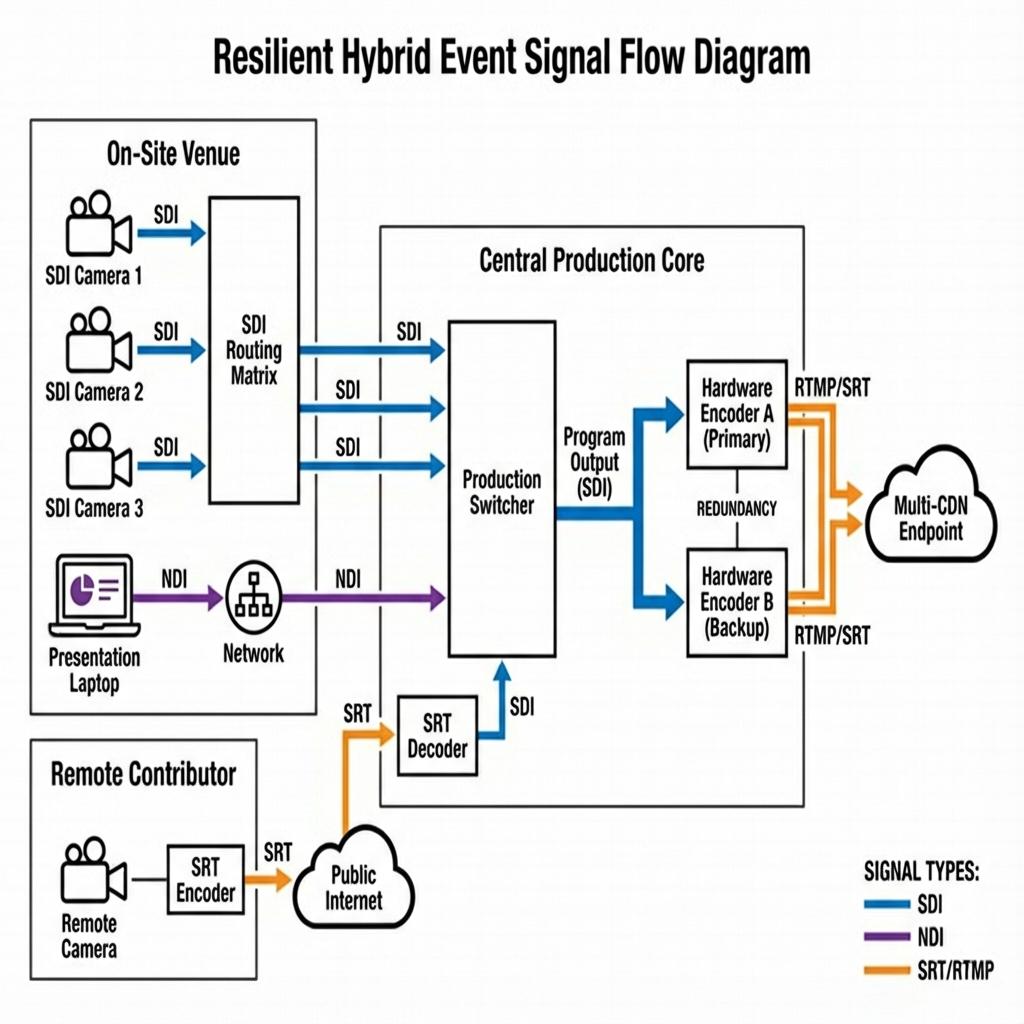
For years, the Real-Time Messaging Protocol (RTMP) was the de facto standard for streaming contribution. However, its reliance on TCP (Transmission Control Protocol) and its inability to gracefully handle network packet loss make it unsuitable for high-stakes B2B events traversing unpredictable networks. The modern standard for professional contribution is Secure Reliable Transport (SRT). Developed by Haivision, SRT is an open-source protocol that provides the low latency of UDP (User Datagram Protocol) with sophisticated error-correction mechanisms. It excels at maintaining signal integrity over volatile networks, including the public internet. Its ability to reconstruct lost packets, combined with AES-256 encryption, makes it the definitive choice for securely transporting high-bitrate feeds from remote presenters or off-site venues to a central production hub. A typical SRT workflow involves an encoder at the source (e.g., a remote speaker’s location) sending a stream to an SRT gateway or decoder at the master control facility, with latency settings configurable down to milliseconds to manage the buffer for packet recovery.
The NDI and SDI Symbiosis in Hybrid Environments
Within the physical event venue, signal transport is a choice between traditional baseband video and modern video-over-IP. Serial Digital Interface (SDI) remains the gold standard for on-premise, point-to-point reliability. A 12G-SDI connection, for instance, provides a dedicated, uncompressed 12 Gbps pipeline for a 4K UHD signal at 60 frames per second, ensuring zero-latency, artifact-free video from cameras to the production switcher. This is non-negotiable for primary program feeds within a controlled environment. Concurrently, Network Device Interface (NDI), a protocol developed by NewTek, offers unparalleled flexibility for secondary signals and monitoring. NDI allows high-quality, low-latency video to be transported over a standard Gigabit Ethernet network. This is ideal for routing presentation slides from a speaker’s laptop, sending confidence monitor feeds back to the stage, or integrating robotic PTZ cameras without dedicated SDI cabling. A robust hybrid architecture leverages both: SDI for mission-critical camera and program feeds, and a well-managed NDI network for ancillary sources, creating a powerful and flexible signal matrix.
The Redundant Core: Processing and Production Workflows
Once all source signals are successfully ingested, they enter the production core. This is where switching, encoding, recording, and routing occur. For a zero-failure mandate, every component and workflow within this core must be designed with redundancy and failover capabilities. A single point of failure is an unacceptable risk when the reputation of a multi-million dollar corporate event is on the line. This operational hub must function with the precision of a broadcast television master control room.
Fail-Safe Switching and Signal Routing
The production switcher is the heart of the live event. Enterprise-grade switchers (from brands like Ross, Grass Valley, or Blackmagic Design’s ATEM Constellation series) feature critical redundancies like dual power supplies and multiple control surface ports. The signal routing architecture feeding this switcher must be equally resilient. A primary routing matrix should manage all incoming SDI and NDI sources, with a completely parallel backup router ready for immediate switchover. We implement A/B signal paths for critical sources, meaning a primary camera might have two independent SDI runs to the routing core. This ensures that a cable failure or port malfunction does not result in a loss of signal. The program output from the switcher is then also routed through dual paths to the encoding and recording stages.
Encoding Strategy and ISO Recording for Data-Rich Assets
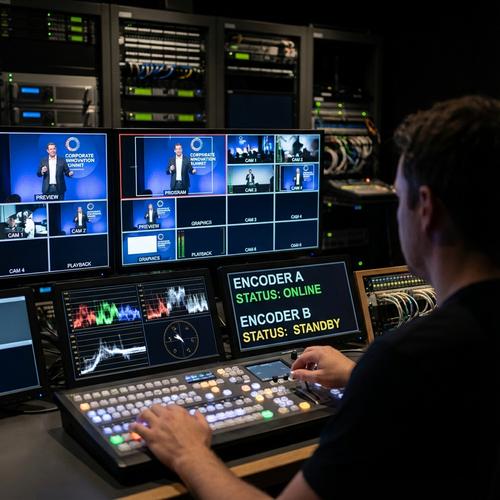
The encoding process converts the final program feed into a streamable format. A zero-failure strategy mandates, at minimum, two independent hardware encoders running in parallel. These encoders, often from manufacturers like AJA or Haivision, receive the same program feed and encode to multiple bitrates simultaneously, creating an adaptive bitrate ladder. Should the primary encoder fail, the stream from the secondary unit is activated seamlessly at the CDN level. Furthermore, the concept of a data-rich event extends to recording. Instead of just recording the final program mix, we capture Isolated Recordings (ISOs) of every individual camera feed and audio source. This is a fundamental practice in professional broadcasting. Capturing ISOs provides immense post-event value; it allows for a complete re-edit of the event, creation of breakout content, and detailed analysis of specific segments without being locked into the live-switched program. This raw data is an invaluable corporate asset.
On-Premise Appliances vs. Cloud Transcoding Architectures
The decision to encode on-premise versus in the cloud depends on the event’s specific requirements. On-premise hardware encoders provide maximum control and minimal latency, as the entire process is contained within the production facility. This is the preferred method for achieving the lowest possible glass-to-glass latency. For events requiring massive global scalability, a hybrid approach is often best. An on-premise encoder sends a high-bitrate contribution feed via SRT to a cloud-based media service like AWS Elemental MediaLive. The cloud service then transcodes this single feed into the various bitrates required for global distribution via a CDN. This architecture centralizes the heavy lifting of transcoding in a scalable cloud environment while maintaining tight control over the initial contribution feed from the venue.
Egress and Delivery: Reaching a Fragmented Enterprise Audience
The final stage of the production chain is egress: the delivery of the encoded video to the end-user. In a B2B context, the audience is often fragmented across corporate networks, home offices, and mobile devices, each with unique network constraints. A robust delivery strategy must account for this complexity, integrating with enterprise platforms and utilizing specialized delivery networks to ensure a flawless viewing experience for every participant, regardless of their location or device.
Enterprise CDN Strategy for Last-Mile Optimization
Standard Content Delivery Networks (CDNs) are optimized for public internet delivery but can struggle with the unique challenges of corporate networks. An Enterprise CDN (eCDN) is specifically designed to manage video traffic behind the corporate firewall. Solutions from providers like Kollective, Hive, or Ramp use peer-to-peer technology or caching nodes within the client’s network to minimize the strain on the corporate WAN. A single stream enters the network, and the eCDN distributes it internally, preventing thousands of individual employees from pulling the same high-bitrate stream from the public internet and saturating the company’s connection. Implementing an eCDN is a critical component for ensuring high-quality playback for the in-office segment of a hybrid audience.
Seamless Integration with UC and Enterprise Platforms
Hybrid events are not just one-way broadcasts; they are interactive experiences. This requires seamless integration with Unified Communications (UC) platforms like Microsoft Teams, Zoom, and Webex. The technical challenge is to inject a high-quality, multi-camera switched program feed into these platforms, replacing the standard webcam input. This is commonly achieved using NDI tools that create a virtual camera output from the production switcher’s program feed. This allows remote participants on Teams or Zoom to see the full, professionally produced event, not just a single low-resolution camera. It is also critical to manage the audio signal flow, ensuring that remote presenters brought in via these platforms can be heard by the in-person audience and vice versa, using mix-minus audio setups to prevent feedback loops.
The Role of a Unified Control Plane and Monitoring
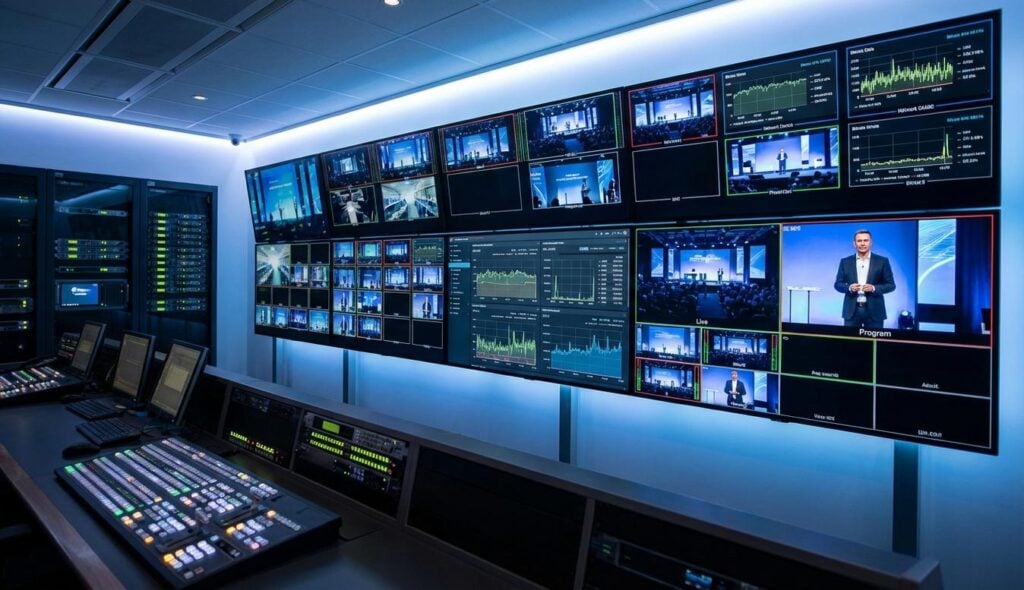
Managing this complex ecosystem of ingress, processing, and egress requires a unified control plane and comprehensive monitoring. A technical director should be able to view the status of all sources, switcher outputs, encoder health, and stream performance from a central dashboard. Multiview monitors are essential, displaying all camera feeds, program and preview outputs, and downstream keyer graphics. Waveform monitors and vectorscopes are used to ensure color accuracy and video signal levels adhere to broadcast standards like SMPTE. Real-time monitoring of SRT statistics, CDN performance, and eCDN analytics provides the necessary data to preemptively identify and resolve issues before they impact the audience. This data-driven approach to production is the final pillar of a zero-failure methodology. By shifting from a reactive to a proactive model, we ensure the technical execution of the event is as flawless as the content being presented.

Jeremy Lee is a seasoned digital marketing director and strategist with over two decades of experience in the industry. As the founder of Sotavento Medios, I manage a diverse portfolio of over 50 businesses, helping brands grow through advanced search strategies and digital innovation. My work focuses on bridging the gap between traditional search engine optimisation and the evolving world of AI-driven answer engines.
get in touch