
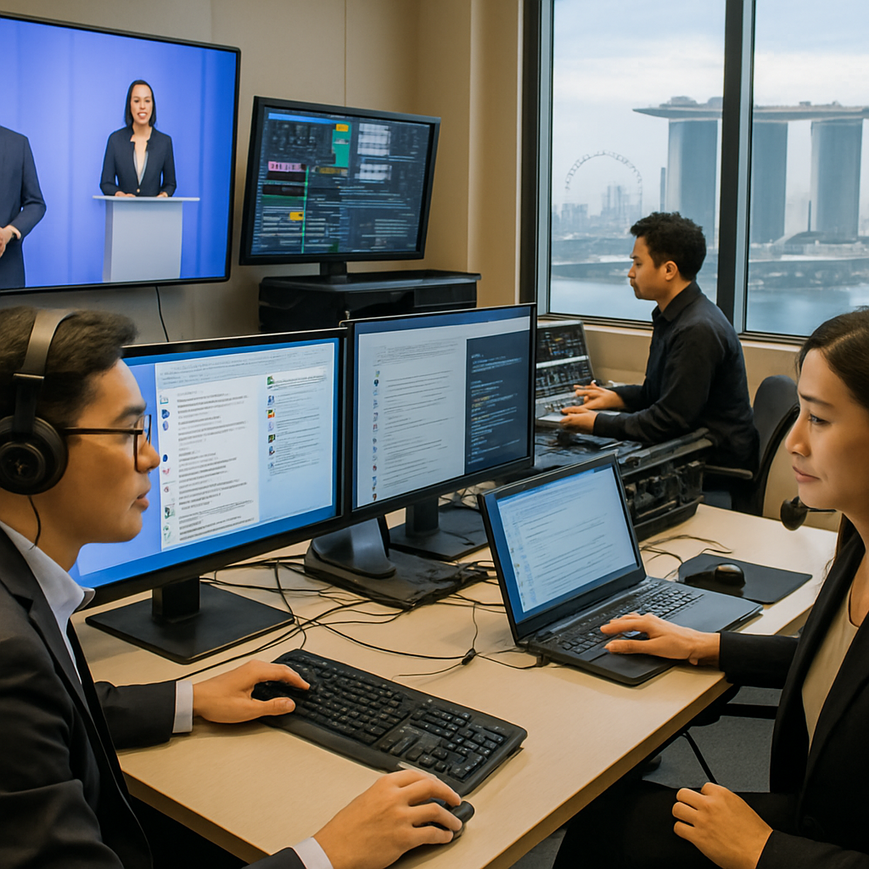
When a corporate livestream reaches a large audience, the chat window can become just as important as the video feed. For Singapore-based organisations, especially those running town halls, product launches, investor updates, training sessions, or hybrid conferences, chat moderation is not a cosmetic extra. It is part of audience management, reputation protection, and event operations. A single stream can attract employees, clients, partners, vendors, and members of the public at the same time, which means the chat may contain useful questions, off-topic remarks, spam, duplicate comments, and occasionally inappropriate content that needs prompt handling.
Good chat moderation helps the audience feel heard while keeping the session orderly and professional. It also supports the speaker by reducing distractions and making it easier to surface the right questions at the right time. In a Singapore context, where many corporate events are bilingual or multilingual, and where businesses often serve diverse regional stakeholders, moderation must account for language variety, time-zone coordination, and clear escalation processes. The goal is not to silence audience participation, but to design a system that allows engagement without letting the chat overwhelm the event.
For companies that host high-attendance streams, the moderation plan should be treated with the same care as the run sheet, technical rehearsal, and speaker briefing. This is especially important when the stream covers sensitive topics such as financial performance, workplace policy, product safety, or public announcements. A strong moderation workflow protects the integrity of the event, supports compliance expectations, and improves the overall attendee experience.
Why chat moderation matters in large corporate streams
In a small webinar, one host can often read and respond to most comments. At scale, that approach quickly fails. Large corporate streams can generate more messages than any single moderator can assess in real time, and the chat may move faster than the presenter can keep up with. If unmanaged, the conversation can become repetitive, confusing, or distracting, making it hard for attendees to find important information.
Moderation has a direct effect on perceived professionalism. If a stream is supposed to represent a company’s brand, the chat environment should reflect the same standard as the stage set and presentation slides. A well-run moderation system also helps protect speakers from being drawn into unprepared exchanges. Instead of reacting to every comment, moderators can filter, group, and route questions so the speaker addresses the most relevant ones.
There is also a practical trust element. Audiences are more likely to participate when they believe the space is being monitored fairly and consistently. That matters for Singapore organisations that communicate to employees across offices, or to external stakeholders who may expect clarity, responsiveness, and a polished digital experience. Moderation is therefore not only about deleting problematic posts, it is about shaping a predictable, respectful, and usable communication channel.
Common risks in high-volume chat environments
Large chat feeds often attract a few recurring issues. Spam messages can repeat the same link or promotional text. Comment storms may appear when one topic triggers many similar reactions in a short period. Duplicate questions can bury useful queries and slow down the session. Off-topic discussion can distract the audience from the main presentation. In more sensitive events, inappropriate language, personal attacks, or misleading claims may also appear and require swift intervention.
For corporate streams, there is a further risk of information leakage. Employees or external participants may post confidential details, unapproved opinions, or speculative statements. Moderators need to understand what content should be removed, what should be escalated, and what can remain visible. A clear policy helps avoid inconsistent decisions during the pressure of a live event.
Building a moderation framework before the stream starts
Effective chat moderation begins long before the live session. The most reliable systems are designed in pre-production, tested during technical rehearsal, and refined after each event. In practice, this means assigning roles, defining rules, selecting the right platform settings, and preparing response scripts in advance. For Singapore organisations working across internal teams, regional offices, and external audiences, this preparation reduces confusion and makes moderation easier to execute under time pressure.
A moderation framework should identify what the chat is for. Is it a question channel, a networking space, a customer feedback channel, or a mix of all three? The answer affects how comments are handled. For example, an investor briefing may require a tighter question format and more stringent filtering than an internal company celebration. A training webcast may allow more audience interaction but still need strict control over off-topic chatter.
Set clear rules for participation
Publish simple chat guidelines before the event and, where appropriate, pin them at the start of the stream. These rules should explain acceptable behaviour, prohibited content, and the preferred format for questions. Keep the language practical and easy to understand. Participants should know whether they may post during the presentation, whether questions should be typed in a specific format, and whether moderators will select questions for the speaker.
Rules should cover basic conduct such as no harassment, no offensive language, no spam, no misleading claims, and no sharing of confidential information. If the event is public-facing, mention that comments may be hidden or removed if they breach the rules. If the event is internal, include reminders about professionalism and workplace respect. Clear expectations reduce friction and help participants self-regulate.
Match the moderation model to the event size
A single moderator may be adequate for a modest webcast, but large-scale corporate streams often need a layered approach. One person can watch for urgent issues, another can cluster questions by theme, and a third can communicate selected items to the host or producer. For very large events, moderation can be divided by function, with one team handling chat review, another handling audience questions, and another managing escalation to legal, HR, communications, or technical support when needed.
The moderation model should also reflect the platform’s capabilities. Some platforms allow keyword filters, slow mode, comment approval, or restricted chat access. Others provide private back-end moderation controls. The team should understand these features well before the event so they can use them confidently if the chat becomes active very quickly.
Prepare responses and escalation paths
Moderators do not need to improvise every reply. Prepare standard responses for common situations such as “We have noted your question and will group similar queries,” or “Please refer to the event guidelines for acceptable chat conduct.” Pre-written responses save time and keep the tone consistent. They also reduce the chance of emotional or reactive wording during a fast-moving stream.
Equally important is the escalation path. The team should know who handles legal concerns, data privacy issues, sensitive employee relations matters, security threats, and technical failures. In Singapore, where corporate communications can intersect with regulatory expectations, fast internal escalation is a safeguard. Moderators should not be left guessing whether a comment warrants removal, further review, or a private handover.
Practical moderation techniques during the live event
When the stream goes live, moderators must work with speed, judgement, and consistency. The main task is to maintain the flow of the conversation without creating unnecessary disruption. That means distinguishing between content that is simply repetitive and content that is inappropriate or risky. Not every message needs a visible action, but every message should be observed against the event’s rules.
Large-scale moderation works best when the team uses a triage mindset. Some comments are safe to leave alone. Some should be answered later. Some should be hidden or removed immediately. Some should be escalated. This approach keeps attention on the most important issues instead of treating every post as equally urgent.
Use tiered review, not one-size-fits-all reaction
A tiered review process helps moderators prioritise. Low-risk comments, such as expressions of support or simple acknowledgements, may stay visible. Medium-priority items, such as repeated questions or off-topic remarks, can be grouped or redirected. High-priority items, such as abusive language, threats, privacy breaches, or misinformation, should be acted on promptly according to the moderation policy.
This tiered structure is especially useful when a stream includes multiple stakeholder groups. For example, a product launch may attract customers asking about features, employees commenting internally, and industry observers discussing the market. Not every comment requires the same level of attention. Tiering prevents the team from overreacting to harmless discussion while still allowing fast intervention when the risk is real.
Keep the audience informed about how questions are handled
People are less likely to repeat the same question if they know how the process works. Periodic messages such as “We are collecting questions and will respond to grouped themes shortly” can reduce duplication and help participants remain patient. If the session is especially busy, moderators can encourage attendees to upvote or rephrase questions in a concise form, depending on the platform.
For Singapore audiences, clarity matters. Many viewers participate in English, while others may use Mandarin, Malay, Tamil, or a mix of languages. The moderation team should anticipate variation in phrasing and avoid making assumptions about intent based only on language style. A respectful, multilingual-aware approach helps maintain inclusion and professionalism.
Protect the speaker’s attention and pacing
One of the moderator’s main responsibilities is to shield the presenter from chat overload. The speaker should not be expected to read live comments while also delivering a polished talk. Instead, moderators can curate a short list of representative questions, group similar issues together, and pass them to the host in batches. This keeps the pacing controlled and reduces the risk of derailing the agenda.
If the event has a Q and A segment, the moderator should coordinate closely with the producer so the transition is smooth. A rushed handover can make the session feel disorganised. A well-timed handover, on the other hand, makes the audience feel that their questions are being taken seriously and handled in an orderly way.
Technology, compliance, and operational alignment
Technology is an important part of chat moderation, but it is not a substitute for human judgement. Automated filters can help block profanity, spam, or repeated text, yet they can also miss context or incorrectly flag legitimate comments. The best outcome usually comes from combining platform tools with trained human moderators who understand the event’s purpose and risk profile.
For Singapore companies, the moderation plan should also align with data handling and internal governance expectations. If the event records chat logs, those logs may contain personal data, opinions, or work-related information. The team should know who can access the logs, how long they will be kept, and whether they will be used for follow-up, reporting, or compliance review. Organisations should coordinate with their internal policies and relevant legal or privacy guidance where applicable.
Use platform tools thoughtfully
Most professional streaming platforms offer some combination of keyword blocking, slow mode, comment approval, user muting, or message pinning. These tools can make moderation easier, but they work best when configured before the live event. During rehearsal, the team should test whether approved questions appear quickly, whether hidden comments can be reviewed easily, and whether moderators can communicate with one another without cluttering the public chat.
Keyword filters should be reviewed carefully. Overly broad filters can suppress legitimate questions and frustrate the audience. Narrow filters are usually safer, especially for events with industry-specific terminology or multilingual participation. The objective is to reduce noise without blocking normal conversation.
Document decisions for consistency and auditability
For corporate events, moderation should be consistent enough that similar comments receive similar handling. Keeping a simple log of actions, such as removed comments, escalated issues, and repeated questions, can help teams review decisions later. This record is useful for post-event analysis, internal reporting, and continuous improvement. It also helps organisers explain why certain actions were taken if questions arise after the stream.
This documentation does not need to be complex. A shared incident sheet or moderator note system may be sufficient, provided it is secure and accessible to the right people. The important point is that moderation should not be invisible in a way that makes learning impossible. Good event teams improve by reviewing what happened, not by relying on memory alone.
Training the moderation team for Singapore corporate events
Moderators need more than technical familiarity. They need judgement, composure, and a shared understanding of the event’s tone. Training should include the event objectives, audience profile, escalation contacts, and examples of content that must be removed or escalated. The team should also rehearse likely scenarios, such as repeated questions, negative feedback, disruptive participants, and platform issues.
In Singapore, where many corporate streams serve a broad mix of local and regional viewers, moderators should be able to recognise when a comment is simply culturally different, versus when it is genuinely inappropriate. This is where experience matters. A good moderator keeps the atmosphere respectful without being unnecessarily heavy-handed. The aim is to preserve useful participation while protecting the event’s credibility.
Run a live rehearsal with chat scenarios
A rehearsal is the best time to pressure-test the moderation plan. Simulate common and difficult chat patterns, then see how quickly the team can respond. Can they identify which comments to hide? Can they group questions by topic? Can they alert the producer without interrupting the speaker? These drills expose weak points before the real audience arrives.
Rehearsal also helps with role clarity. When everyone knows who is responsible for monitoring, who is escalating, and who is communicating with the host, the live event becomes easier to manage. That shared clarity is especially valuable when multiple vendors or internal departments are involved.
Build a calm tone under pressure
Chat moderation is not only a technical task, it is a communication skill. Moderators should write in a calm, concise, and neutral way. Even when a user is being disruptive, the response should remain professional. This prevents the moderation team from escalating the situation unintentionally.
For example, a simple message such as “We are removing comments that do not follow the event guidelines” is usually better than a confrontational reply. The tone of the moderation response sets the tone for the rest of the chat. In a large stream, that tone can influence whether the audience behaves constructively or becomes more reactive.
Managing chat moderation for large-scale corporate streams is ultimately about control, clarity, and credibility. The most effective teams do not rely on a single person watching a crowded chat feed. They plan in advance, define rules, assign roles, use platform tools intelligently, and review each event afterward. For Singapore organisations, this approach is particularly important because corporate audiences are diverse, expectations are high, and events often carry reputational or operational weight.
The practical takeaway is straightforward. Treat chat moderation as a core part of event production, not a last-minute add-on. Build a policy that fits the audience, train the team that will enforce it, and make sure the speaker, producer, and moderators work from the same playbook. If the stream involves sensitive information, internal matters, or public-facing announcements, involve the relevant internal stakeholders early so moderation decisions are consistent with organisational requirements. When chat moderation is designed well, the audience can participate meaningfully, the speaker can stay focused, and the event can proceed with the professionalism that Singapore business audiences expect.
Note: This article is for general information only and is not a substitute for legal, regulatory, or organisational policy advice. Companies should align moderation practices with their internal governance standards and seek appropriate professional guidance for sensitive events.

Jeremy Lee is a seasoned digital marketing director and strategist with over two decades of experience in the industry. As the founder of Sotavento Medios, I manage a diverse portfolio of over 50 businesses, helping brands grow through advanced search strategies and digital innovation. My work focuses on bridging the gap between traditional search engine optimisation and the evolving world of AI-driven answer engines.
get in touch